• HOME
  • NEWS
  • EXPLORE
    • CAREER
      • Companies
      • Jobs
    • EVENTS
    • iGEM
      • News
      • Team
    • PHOTOS
    • VIDEO
    • WIKI
  • BLOG
  • COMMUNITY
    • FACEBOOK
    • INSTAGRAM
    • TWITTER
Thursday, June 18, 2026
BIOENGINEER.ORG
No Result
View All Result
  • Login
  • HOME
  • NEWS
  • EXPLORE
    • CAREER
      • Companies
      • Jobs
        • Lecturer
        • PhD Studentship
        • Postdoc
        • Research Assistant
    • EVENTS
    • iGEM
      • News
      • Team
    • PHOTOS
    • VIDEO
    • WIKI
  • BLOG
  • COMMUNITY
    • FACEBOOK
    • INSTAGRAM
    • TWITTER
  • HOME
  • NEWS
  • EXPLORE
    • CAREER
      • Companies
      • Jobs
        • Lecturer
        • PhD Studentship
        • Postdoc
        • Research Assistant
    • EVENTS
    • iGEM
      • News
      • Team
    • PHOTOS
    • VIDEO
    • WIKI
  • BLOG
  • COMMUNITY
    • FACEBOOK
    • INSTAGRAM
    • TWITTER
No Result
View All Result
Bioengineer.org
No Result
View All Result
Home NEWS Science News

Scientists discover new ‘boat’ form of promising semiconductor GeSe

Bioengineer by Bioengineer
March 21, 2017
in Science News
Reading Time: 2 mins read
0
Share on FacebookShare on TwitterShare on LinkedinShare on RedditShare on Telegram
IMAGE

Credit: Cava lab

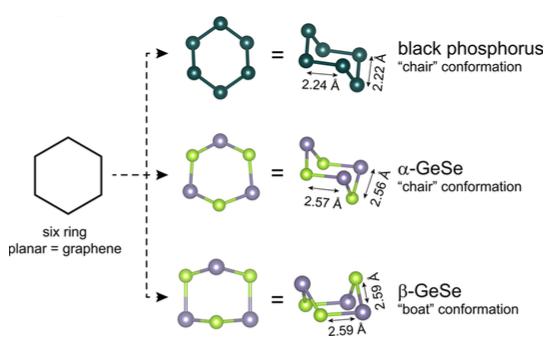
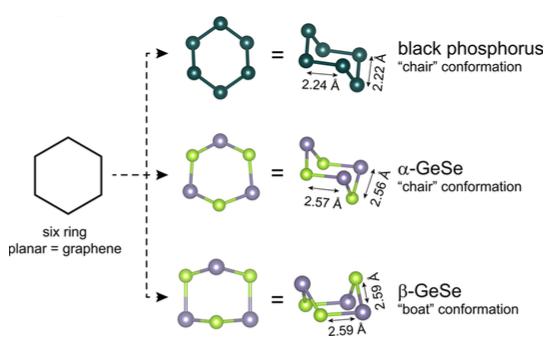
Princeton researchers have discovered a new form of the simple compound GeSe that has surprisingly escaped detection until now. This so-called beta-GeSe compound has a ring type structure like graphene and its monolayer form could have similarly valuable properties for electronic applications, according to the study published in the Journal of the American Chemical Society.

Graphene has been hailed as a two-dimensional wonder material for electronics but its lack of a band gap has hindered its development for devices. As such, a closely related material, black phosphorus, has been receiving intense research attention because it has a small band gap and a high charge carrier mobility, and can easily be reduced to nanometer thicknesses. The researchers calculated that GeSe is highly analogous to black phosphorus and can be considered a pseudo-group-V element.

Under extreme pressure, black phosphorus is transformed into a simple cubic form, so the team wondered if the same could be done to GeSe and heated the abundant alpha-GeSe form of the compound to 1200 °C under 6 GPa of pressure or 60,000 times atmospheric pressure.

"What we found was not only a new kind of GeSe–which is already unconventional by itself in that you rarely find new binary compounds anymore–but that it has this uncommon 'boat' conformation that we were amazed by," said first author of the study Fabian von Rohr, a postdoctoral researcher in the laboratory of Robert Cava, the Russell Wellman Moore Professor of Chemistry.

beta-GeSe's rare "boat" form is likely stabilized by the slightly smaller distance between its layers, while black phosphorus and alpha-GeSe exist in standard "chair" conformations. The difference in structures gives rise to the compounds' different electronic properties. The researchers found that beta-GeSe possesses a band gap size in between that of black phosphorus and alpha-GeSe, which could prove promising for future applications. GeSe is also an attractive material for electronics because it's robust under ambient conditions while black phosphorus is reactive to both air and water.

###

Read the full article here:

von Rohr, F. O.; Ji, H.; Cevallos, F. A.; Gao, T.; Ong, N. P.; Cava, R. J. "High-Pressure Synthesis and Characterization of beta-GeSe–A Six-Membered-Ring Semiconductor in an Uncommon Boat Conformation." Journal of the American Chemical Society 2017 139, 2771. This work was supported by the Gordon and Betty Moore Foundation, EPiQS initiative, Grants GBMP-4412 and GBMF-4539.

Media Contact

Tien Nguyen
[email protected]
609-258-6523
@Princeton

http://www.princeton.edu

############

Story Source: Materials provided by Scienmag

Share12Tweet8Share2ShareShareShare2

Related Posts

Confined Migration Causes DNA Damage in Neurons

June 18, 2026

Multimodal Multitask AI Transforms Lung Cancer Grading

June 18, 2026

New Study Seeks to Prolong Immune System Longevity

June 18, 2026

KAIST Creates Next-Generation Self-Powered Wearable Sensor withstanding 668% Stretch

June 18, 2026
Please login to join discussion

POPULAR NEWS

  • ESMO 2025: mRNA COVID Vaccines Enhance Efficacy of Cancer Immunotherapy

    326 shares
    Share 130 Tweet 82
  • Saying Goodbye to PGY-6: Pediatric Fellowship Realities

    102 shares
    Share 41 Tweet 26
  • Multi-Hospital Study Reveals Long Covid Burden Is Twice as High as Current Estimates

    92 shares
    Share 36 Tweet 23
  • Detection of EDCs in Breast Milk and Infant Urine Up to Six Months Highlights Early Exposure Risks

    76 shares
    Share 30 Tweet 19

About

We bring you the latest biotechnology news from best research centers and universities around the world. Check our website.

Follow us

Recent News

Confined Migration Causes DNA Damage in Neurons

Multimodal Multitask AI Transforms Lung Cancer Grading

New Study Seeks to Prolong Immune System Longevity

Subscribe to Blog via Email

Success! An email was just sent to confirm your subscription. Please find the email now and click 'Confirm' to start subscribing.

Join 82 other subscribers
  • Contact Us

Bioengineer.org © Copyright 2023 All Rights Reserved.

Welcome Back!

Login to your account below

Forgotten Password?

Retrieve your password

Please enter your username or email address to reset your password.

Log In
No Result
View All Result
  • Homepages
    • Home Page 1
    • Home Page 2
  • News
  • National
  • Business
  • Health
  • Lifestyle
  • Science

Bioengineer.org © Copyright 2023 All Rights Reserved.