

• HOME
  • NEWS
  • EXPLORE
    • CAREER
      • Companies
      • Jobs
    • EVENTS
    • iGEM
      • News
      • Team
    • PHOTOS
    • VIDEO
    • WIKI
  • BLOG
  • COMMUNITY
    • FACEBOOK
    • INSTAGRAM
    • TWITTER
Sunday, April 19, 2026
BIOENGINEER.ORG
No Result
View All Result
  • Login
  • HOME
  • NEWS
  • EXPLORE
    • CAREER
      • Companies
      • Jobs
        • Lecturer
        • PhD Studentship
        • Postdoc
        • Research Assistant
    • EVENTS
    • iGEM
      • News
      • Team
    • PHOTOS
    • VIDEO
    • WIKI
  • BLOG
  • COMMUNITY
    • FACEBOOK
    • INSTAGRAM
    • TWITTER
  • HOME
  • NEWS
  • EXPLORE
    • CAREER
      • Companies
      • Jobs
        • Lecturer
        • PhD Studentship
        • Postdoc
        • Research Assistant
    • EVENTS
    • iGEM
      • News
      • Team
    • PHOTOS
    • VIDEO
    • WIKI
  • BLOG
  • COMMUNITY
    • FACEBOOK
    • INSTAGRAM
    • TWITTER
No Result
View All Result
Bioengineer.org
No Result
View All Result
Home NEWS Science News Biology

Scientists developed enzymes with remote control

Bioengineer by Bioengineer
November 21, 2018
in Biology
Reading Time: 2 mins read
0
Share on FacebookShare on TwitterShare on LinkedinShare on RedditShare on Telegram
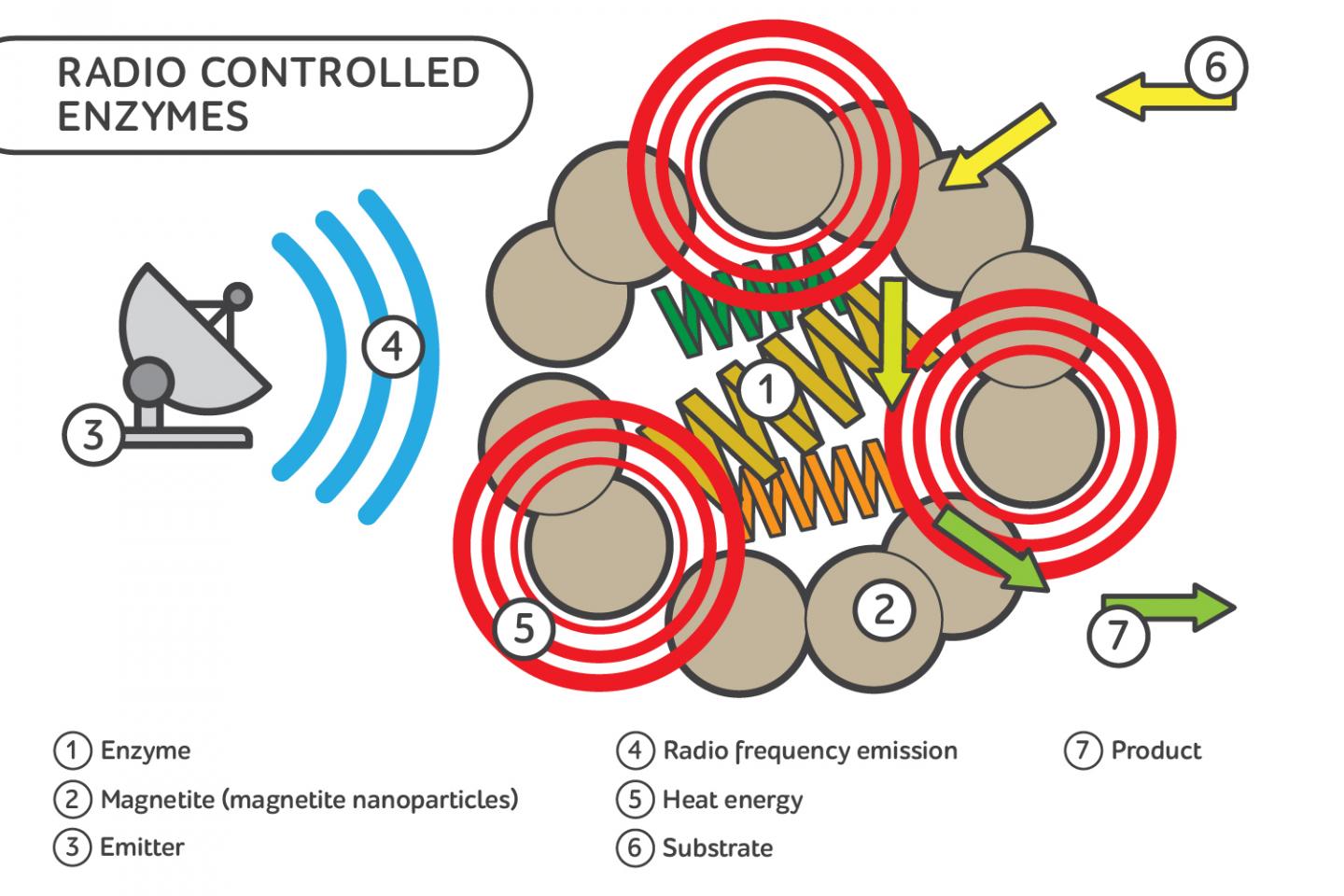
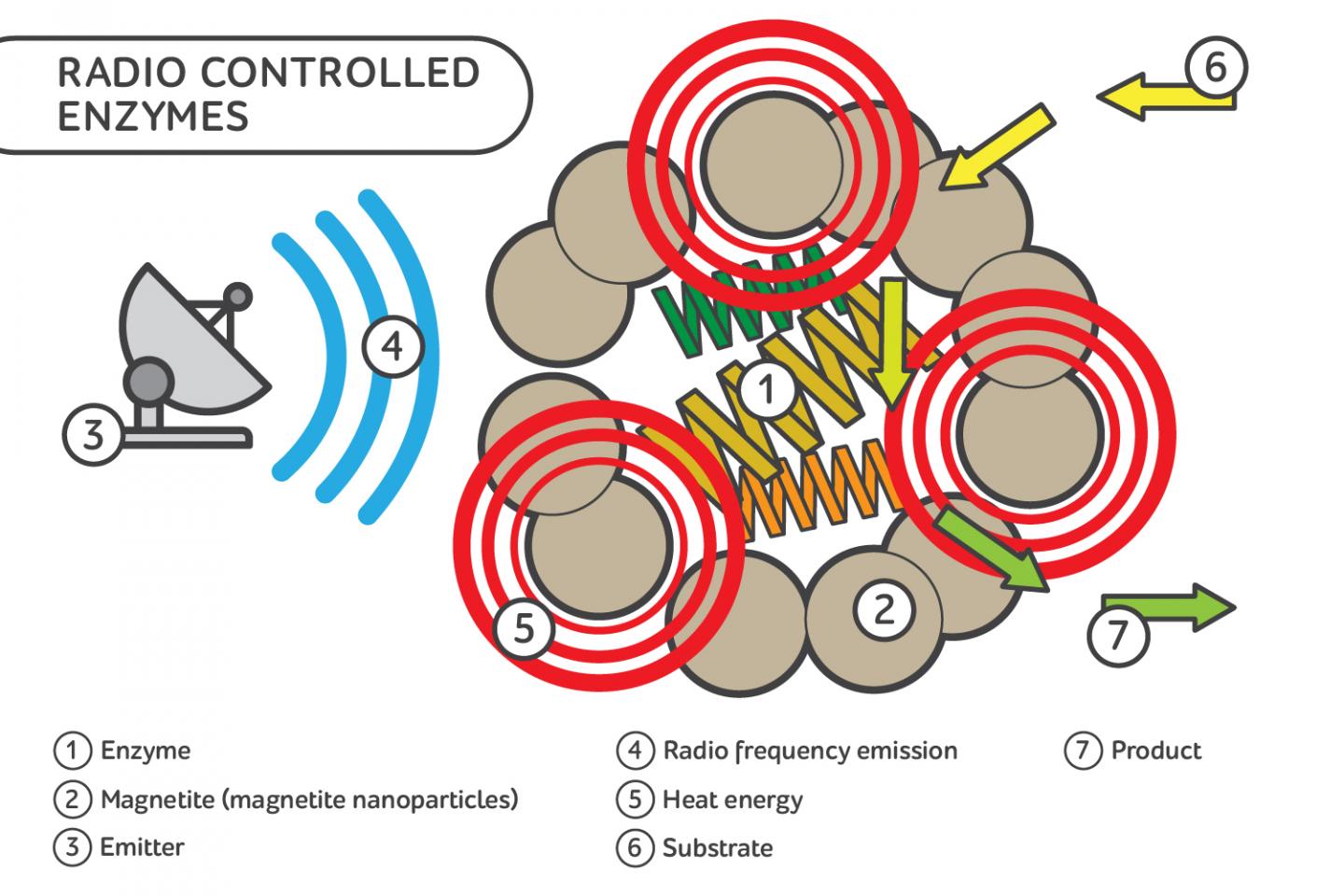
IMAGE

Credit: ITMO University

Scientists developed a method to enhance the activity of enzymes by using radio frequency radiation. The method requires making a special complex consisting of enzymes and magnetic nanoparticles. The particles can adsorb radio emission and convert it to heat, resulting in enzymatic processes acceleration by more than four times. Such method can be used to create radio-controlled biochemical systems and adjust metabolism in living organisms. The results are published in ACS Biomaterials Science & Engineering.

Enzymes are involved in a variety of reactions in living organisms, and their effectiveness depends on a variety of conditions. Although usually the enzyme activity is controlled chemically, researchers from ITMO University showed that this can be done remotely using physical methods such as radio frequency field.

To make radio-controlled enzymes, the scientists synthesized a special complex in which an enzyme is enclosed in a rigid porous framework of magnetite nanoparticles. Whenever the radio field is applied, the nanoparticles adsorb radio emission and heat up, passing additional energy to the enzyme and resulting in the enzymatic reaction rate acceleration. An experiment conducted on a model enzyme, carbonic anhydrase, demonstrated that the reaction rate can be increased by more than four times.

"There are very few studies out there that explore enzyme manipulation through the radio waves. We were the first who managed to increase the activity of a non-thermostable enzyme. Typically, these enzymes change the conformation at high temperatures and then stop working. But placed within the rigid framework of nanoparticles, the enzyme is stabilized from structure rearrangements as the nanoparticles mechanically restrict the enzyme mobility," comments Andrey Drozdov, member of ITMO University's SCAMT Laboratory.

There are two key parameters among the advantages of the radio emission used in the work. On the one hand, such radio waves can easily go through the tissues, and on the other, they are absolutely harmless to the body. Thus, by using the radiofrequency field, you can control the activity of enzymes in the body and adjust cell metabolism. In the near future, scientists plan to try out this method on other enzymes in an attempt to influence the vital activity of bacteria or cells.

Since this topic has a lot of potentials, further work will focus on using the technique with other enzymes, as well as in living cells. For example, it is still unclear whether it is possible with this method to make bacteria or cells divide more often or, on the contrary, to stop their division," notes Yulia Andreeva, the first author of the study.

###

Reference: Enzymatic Nanocomposites with Radio Frequency Field-Modulated Activity. Yulia I. Andreeva et al. ACS Biomaterials Science & Engineering. 30 October, 2018

https://pubs.acs.org/doi/10.1021/acsbiomaterials.8b00838

Media Contact

Dmitry Malkov
[email protected]
7-953-377-5508
@spbifmo_en

http://en.ifmo.ru/

Related Journal Article

http://dx.doi.org/10.1021/acsbiomaterials.8b00838

Share12Tweet8Share2ShareShareShare2

Related Posts

On-Demand Growth of Liver Tissue Directly Within the Body

On-Demand Growth of Liver Tissue Directly Within the Body

April 17, 2026
Conserved DNA Architect Links Chloroplasts to Cell Cycle

Conserved DNA Architect Links Chloroplasts to Cell Cycle

April 17, 2026

UTS Study Reveals Toxic Metal Exposure from E-Cigarette Devices

April 17, 2026

Can Exercise Help You Beat Stress Hormones? New Insights from a Clinical Trial

April 17, 2026
Please login to join discussion

POPULAR NEWS

  • Scientists Investigate Possible Connection Between COVID-19 and Increased Lung Cancer Risk

    62 shares
    Share 25 Tweet 16
  • NSF funds machine-learning research at UNO and UNL to study energy requirements of walking in older adults

    101 shares
    Share 40 Tweet 25
  • Boosting Breast Cancer Risk Prediction with Genetics

    47 shares
    Share 19 Tweet 12
  • Self-Oscillating Electroactive Nanocomposites Boost Heat Pumps

    41 shares
    Share 16 Tweet 10

About

BIOENGINEER.ORG

We bring you the latest biotechnology news from best research centers and universities around the world. Check our website.

Follow us

Recent News

Financial Strain of Non-Communicable Diseases in Indian Elderly

Elevated Fetal Catecholamine Metabolites Signal Growth Restriction

Comorbidities Shape Hip Fracture Surgery Outcomes

Subscribe to Blog via Email

Enter your email address to subscribe to this blog and receive notifications of new posts by email.

Join 79 other subscribers
  • Contact Us

Bioengineer.org © Copyright 2023 All Rights Reserved.

Welcome Back!

Login to your account below

Forgotten Password?

Retrieve your password

Please enter your username or email address to reset your password.

Log In
No Result
View All Result
  • Homepages
    • Home Page 1
    • Home Page 2
  • News
  • National
  • Business
  • Health
  • Lifestyle
  • Science

Bioengineer.org © Copyright 2023 All Rights Reserved.