Universal technology is cost-effective, allows to purify industrial wastewater, desalinate water, and dispose of waste
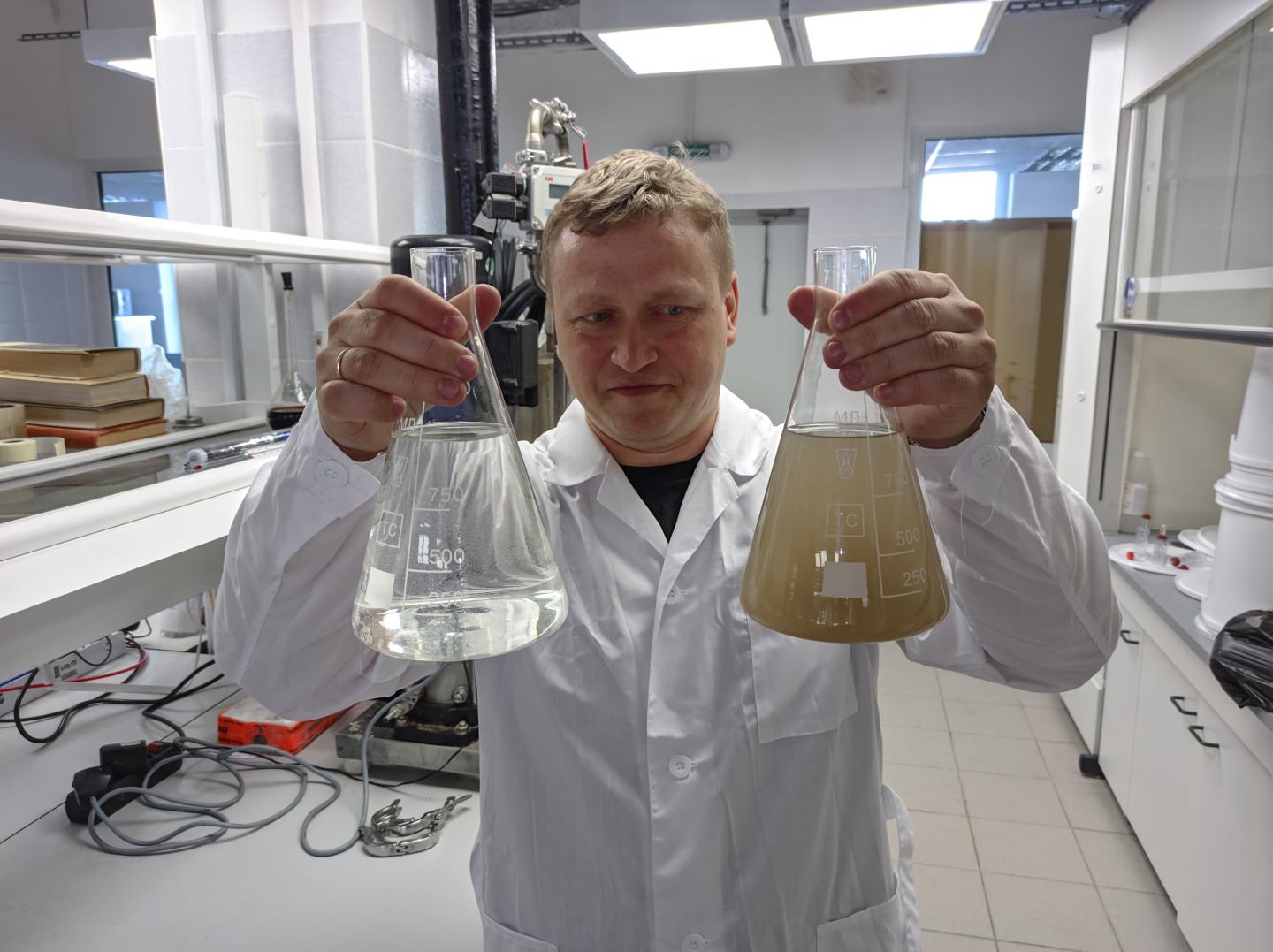
Credit: UrFU / Eduard Nikulnikov
Russian group of scientists led by an associate professor at the Ural Federal University (UrFU) has developed a technology for processing liquid industrial waste. The technology has no analogs in the world. It is universal, suitable for almost any industrial enterprise. It allows cleaning industrial wastewater – remove insoluble components from the solution and desalinate the water.
Wastewater treatment by this technology takes place in two stages. The first one is the preliminary cleaning of solutions from suspended rock particles. This stage has been worked out in the oil-producing sector and assumes the use of ceramic membranes. Then comes electrodialysis. With the help of anionic and cationic membranes, scientists separate all salt components into two zones. As a result, scientists get a very salty solution (10 times saltier than seawater) and purified water.
“We went further and used an additional type of membrane – bipolar,” said Alexander Cherepanov, professor at UrFU. “This is a construction of the first two types of membranes. It decomposes the water in the sludge into hydrogen and hydroxyl groups, which bind to the separated salt components. Due to this, we get hydrochloric acid and alkali. Thus, from the initial solution, we get two – acidic and alkaline.”
Acidic and alkaline solutions are chemical reagents used in industry.
“That is, we do not just dispose of potash production waste, but we process it into a marketable product, using zero-cost raw materials,” said Alexander Cherepanov. “This means that the potash industry does not need to purchase chemical reagents. They will take them from the post-production waste.”
Received products will be in demand as a basis for household chemicals production, materials for glass manufacture, detergent for cleaning equipment, food, and oil industries. Also, acidic and alkaline solutions with residual salt content are ideal for: removing contaminants inside oil wells and increasing the recovery of oil-bearing reservoirs.
“Since the costs of waste processing are minimal, the sale of the received products can be no less profitable than the production of potash fertilizers,” said Alexander Cherepanov. “Our technology and apparatus are also good for seawater desalting. The process is nothing more than an aqueous sodium chloride solution and some other compounds and elements, including potassium. For example, it can help solve the problem of lack of drinking water.”
Researchers already have two patents on this technology. Now they are preparing to apply for a third one. Besides, they are working on an industrial modular installation. The expected service life is at least ten years.
“It is enough to dock the corresponding number of modules to increase the installation productivity,” said Alexander Cherepanov. “We calculate the equipment dimensions to fit a standard 20 lb. shipping container, protecting it from external influences and convenient for transportation.”
###
Reference
Liquid waste (sludge) from potash production is a highly concentrated sodium chloride solution with a residual content of unrecovered potassium salts. They contain insoluble rock components (sand, clay, etc.). Such waste is very salty, highly mineralized, and very hazardous to the environment if leaked. Today, the largest potash deposits exist in Russia, Canada, Germany, Belarus. In Russia, companies contain such waste in sludge storages – huge open tanks, the size of football fields. The total mass of accumulated waste amounts to several hundred million tons.
Researchers already have two patents on this technology. Patent 1 (https:/
Media Contact
Anna Marinovich
[email protected]