• HOME
  • NEWS
  • EXPLORE
    • CAREER
      • Companies
      • Jobs
    • EVENTS
    • iGEM
      • News
      • Team
    • PHOTOS
    • VIDEO
    • WIKI
  • BLOG
  • COMMUNITY
    • FACEBOOK
    • INSTAGRAM
    • TWITTER
Sunday, August 23, 2026
BIOENGINEER.ORG
No Result
View All Result
  • Login
  • HOME
  • NEWS
  • EXPLORE
    • CAREER
      • Companies
      • Jobs
        • Lecturer
        • PhD Studentship
        • Postdoc
        • Research Assistant
    • EVENTS
    • iGEM
      • News
      • Team
    • PHOTOS
    • VIDEO
    • WIKI
  • BLOG
  • COMMUNITY
    • FACEBOOK
    • INSTAGRAM
    • TWITTER
  • HOME
  • NEWS
  • EXPLORE
    • CAREER
      • Companies
      • Jobs
        • Lecturer
        • PhD Studentship
        • Postdoc
        • Research Assistant
    • EVENTS
    • iGEM
      • News
      • Team
    • PHOTOS
    • VIDEO
    • WIKI
  • BLOG
  • COMMUNITY
    • FACEBOOK
    • INSTAGRAM
    • TWITTER
No Result
View All Result
Bioengineer.org
No Result
View All Result
Home NEWS Science News Chemistry

Scientists develop surface acidity — and selectivity-tunable manganese oxide catalyst

Bioengineer by Bioengineer
May 28, 2019
in Chemistry
Reading Time: 2 mins read
0
IMAGE
Share on FacebookShare on TwitterShare on LinkedinShare on RedditShare on Telegram

IMAGE

Credit: JIA Xiuquan

A research group led by Prof. XU Jie from the Dalian Institute of Chemical Physics (DICP) of the Chinese Academy of Sciences has developed a surface acidity- and selectivity-tunable manganese oxide catalyst using a surface modification technique. Their findings were published in Nature Communications.

Surface properties of transition metal oxides play a pivotal role in their catalytic applications. Despite numerous reports investigating the surface chemisorption of organic molecules on metal oxides, it is not clear how adsorption of organic modifiers can be exploited to optimize the catalytic properties of metal oxides.

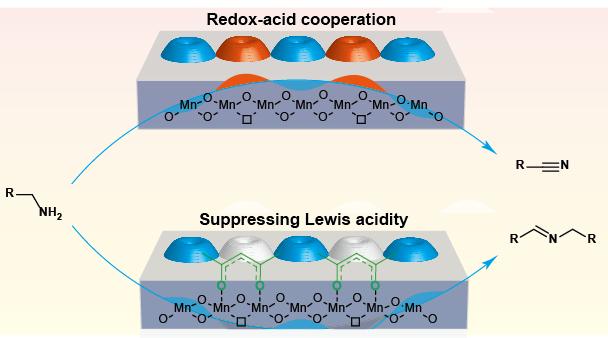
The researchers used enolic acetylacetones to modify the surface Lewis acid properties of manganese oxide catalysts. This enabled rational control of the oxidation selectivities of structurally diverse arylmethyl amines so they could switch from nitriles to imines.

The stable modification of acetylacetones strongly influenced the redox-acid cooperative catalysis of MnOx by suppressing the surface Lewis acidity of the catalysts. In the aerobic oxidation reaction of benzylamine, using unmodified MnOx as catalyst, nitrile was obtained with a yield of 86.5%. In contrast, the MnOx modified by acetylacetones produced imine with a yield of 90.6% under identical conditions.

The current study demonstrates an example of a selectivity-switchable metal oxide catalyst with an organic switch to tune its surface properties. This may contribute to future insights into the surface structure-activity relationships of metal oxide catalysts.

###

Media Contact
Wang Yongji
[email protected]

Original Source

http://english.cas.cn/

Related Journal Article

http://dx.doi.org/10.1038/s41467-019-10315-9

Tags: Chemistry/Physics/Materials SciencesMaterials
Share13Tweet8Share2ShareShareShare2

Related Posts

Scientists uncover design rules for high-performance thermoelectric materials

Scientists uncover design rules for high-performance thermoelectric materials

August 22, 2026
Bringing Optical Fibre Materials to Photonic Chips

Bringing Optical Fibre Materials to Photonic Chips

August 22, 2026

Nanoscience and Liquid Crystals Unite in Functional Hybrids With Transformative Applications

August 22, 2026

Designing Better Biomedical Hydrogels Through Molecular Building Blocks and Hierarchical Structures

August 22, 2026
Please login to join discussion

POPULAR NEWS

  • Dual-oxygen pancreatic cancer organoids mirror basal-classical diversity, spatial transcriptomics confirms

    29 shares
    Share 12 Tweet 7
  • Tirzepatide Versus GLP-1 Agonists for Stroke Risk in Atrial Fibrillation and Diabetes

    29 shares
    Share 12 Tweet 7
  • Real-world study examines psychotic complications of subcutaneous foslevodopa/foscarbidopa infusions in 198 patients

    29 shares
    Share 12 Tweet 7
  • Blood-flow signals from liver vessels direct region-specific liver function through Wnt pathways

    29 shares
    Share 12 Tweet 7

About

We bring you the latest biotechnology news from best research centers and universities around the world. Check our website.

Follow us

Recent News

Dual-oxygen pancreatic cancer organoids mirror basal-classical diversity, spatial transcriptomics confirms

Tirzepatide Versus GLP-1 Agonists for Stroke Risk in Atrial Fibrillation and Diabetes

Real-world study examines psychotic complications of subcutaneous foslevodopa/foscarbidopa infusions in 198 patients

Subscribe to Blog via Email

Enter your email address to subscribe to this blog and receive notifications of new posts by email.

Join 85 other subscribers
  • Contact Us

Bioengineer.org © Copyright 2023 All Rights Reserved.

Welcome Back!

Login to your account below

Forgotten Password?

Retrieve your password

Please enter your username or email address to reset your password.

Log In
No Result
View All Result
  • Homepages
    • Home Page 1
    • Home Page 2
  • News
  • National
  • Business
  • Health
  • Lifestyle
  • Science

Bioengineer.org © Copyright 2023 All Rights Reserved.