• HOME
  • NEWS
  • EXPLORE
    • CAREER
      • Companies
      • Jobs
    • EVENTS
    • iGEM
      • News
      • Team
    • PHOTOS
    • VIDEO
    • WIKI
  • BLOG
  • COMMUNITY
    • FACEBOOK
    • INSTAGRAM
    • TWITTER
Tuesday, July 7, 2026
BIOENGINEER.ORG
No Result
View All Result
  • Login
  • HOME
  • NEWS
  • EXPLORE
    • CAREER
      • Companies
      • Jobs
        • Lecturer
        • PhD Studentship
        • Postdoc
        • Research Assistant
    • EVENTS
    • iGEM
      • News
      • Team
    • PHOTOS
    • VIDEO
    • WIKI
  • BLOG
  • COMMUNITY
    • FACEBOOK
    • INSTAGRAM
    • TWITTER
  • HOME
  • NEWS
  • EXPLORE
    • CAREER
      • Companies
      • Jobs
        • Lecturer
        • PhD Studentship
        • Postdoc
        • Research Assistant
    • EVENTS
    • iGEM
      • News
      • Team
    • PHOTOS
    • VIDEO
    • WIKI
  • BLOG
  • COMMUNITY
    • FACEBOOK
    • INSTAGRAM
    • TWITTER
No Result
View All Result
Bioengineer.org
No Result
View All Result
Home NEWS Science News Biology

Scientists develop novel predictable multi-nucleotide deletion systems in plants

Bioengineer by Bioengineer
June 30, 2020
in Biology
Reading Time: 2 mins read
0
IMAGE
Share on FacebookShare on TwitterShare on LinkedinShare on RedditShare on Telegram

IMAGE

Credit: IGDB

Many small regulatory elements, including miRNAs, miRNA binding sites, and cis-acting elements, comprise only 5~24 nucleotides and play important roles in regulating gene expression, transcription and translation, and protein structure, and thus are promising targets for gene function studies and crop improvement.

The CRISPR-Cas9 system has been widely applied in genome engineering. In this system, a sgRNA-guided Cas9 nuclease generates chromosomal double-strand breaks (DSBs), which are mainly repaired by nonhomologous end joining (NHEJ), resulting in frequent short insertions and deletions (indels) of 1~3 bp. However, the heterogeneity of these small indels makes it technically challenging to disrupt these regulatory DNAs. Thus, the development of a precise, predictable multi-nucleotide deletion system is of great significance to gene function analysis and application of these regulatory DNAs.

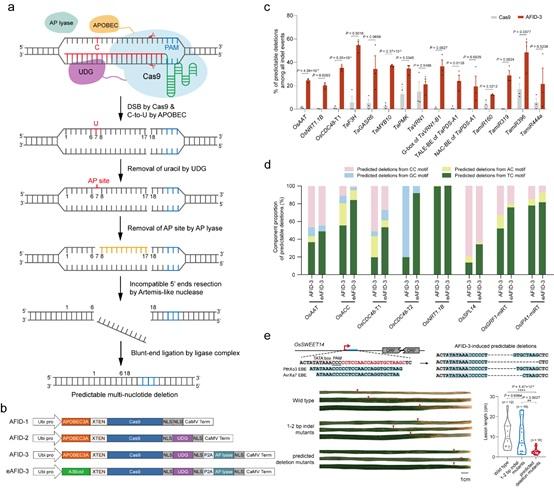
A research team led by Prof. GAO Caixia from the Institute of Genetics and Developmental Biology of the Chinese Academy of Sciences (CAS) has been focusing on developing novel technologies to achieve efficient and specific genome engineering. Based on the cytidine deamination and base excision repair (BER) mechanism, the researchers developed a series of APOBEC-Cas9 fusion-induced deletion systems (AFIDs) that combine Cas9 with human APOBEC3A (A3A), uracil DNA-glucosidase (UDG) and AP lyase, and successfully induced novel precise, predictable multi-nucleotide deletions in rice and wheat genomes.

“AFID-3 produced a variety of predictable deletions extending from the 5?-deaminated Cs to the Cas9 cleavage sites, with the average predicted proportions over 30%,” said Prof. GAO.

The researchers further screened the deamination activity of different cytosine deaminases in rice protoplasts, and found that the truncated APOBEC3B (A3Bctd) displayed not only a higher base-editing efficiency but also a narrower window than other deaminases.

They therefore replaced A3A in AFID-3 with A3Bctd, generating eAFID-3. The latter produces more uniform deletions from the preferred TC motifs to double-strand breaks, 1.52-fold higher than AFID-3.

Moreover, the researchers used the AFID system to target the effector-binding element of OsSWEET14 in rice, and found that the predictable deletion mutants conferred enhanced resistance to rice bacterial blight.

AFID systems are superior to other current tools for generating predictable multi-nucleotide targeted deletions within the protospacer, and thus promise to provide robust deletion tools for basic research and genetic improvement.

The team’s scientific paper, entitled “Precise, predictable multi-nucleotide deletions in rice and wheat using APOBEC-Cas9,” was published in Nature Biotechnology.

###

This research was supported by grants from the Strategic Priority Research Program of CAS, the National Transgenic Science and Technology Program and the National Natural Science Foundation of China.

Media Contact
QI Lei
[email protected]

Original Source

http://english.cas.cn/newsroom/research_news/life/202006/t20200630_239366.shtml

Related Journal Article

http://dx.doi.org/10.1038/s41587-020-0566-4

Tags: BiologyGeneticsPlant Sciences
Share12Tweet8Share2ShareShareShare2

Related Posts

Here are a few rewritten headlines for a science magazine post, each with a slightly different tone: Intriguing & poetic: How do organs sculpt themselves? Sea stars hold the secret Direct & research-focused: Sea stars reveal the hidden rules of organ formation Metaphorical & inviting: Tiny architects beneath the waves: What sea stars teach us about building organs Short & punchy: Star-shaped clues to how our organs take shape Question-led: Could a sea star show us how organs form? Elegant & feature-style: The body’s blueprint, glimpsed in a sea star’s arm

July 6, 2026
Bacteria evolve faster with unconventional gene copies — Biology

Bacteria evolve faster with unconventional gene copies

July 6, 2026

Neighbours rewire soil feedback via root microbiome shifts

July 6, 2026

Evolution-Inspired Biosensors Revolutionize Lipid Tracking in Real Time

July 2, 2026
Please login to join discussion

POPULAR NEWS

  • Detection of EDCs in Breast Milk and Infant Urine Up to Six Months Highlights Early Exposure Risks

    77 shares
    Share 31 Tweet 19
  • New Drug Candidate Developed at McMaster Shows Potential for Treating Brain Cancer

    58 shares
    Share 23 Tweet 15
  • Saying Goodbye to PGY-6: Pediatric Fellowship Realities

    103 shares
    Share 41 Tweet 26
  • KTU Researchers Explore Ultrasound’s Role in Enhancing Blood Flow Beyond Diagnostics

    53 shares
    Share 21 Tweet 13

About

We bring you the latest biotechnology news from best research centers and universities around the world. Check our website.

Follow us

Recent News

Flame retardant BDE-209 targets molecularly linked to ulcerative colitis

Ultra-high frequency particle impacts mimic rockbursts to shatter hard rock

Kidney transplant outcomes in older adults studied by German researchers

Subscribe to Blog via Email

Enter your email address to subscribe to this blog and receive notifications of new posts by email.

Join 83 other subscribers
  • Contact Us

Bioengineer.org © Copyright 2023 All Rights Reserved.

Welcome Back!

Login to your account below

Forgotten Password?

Retrieve your password

Please enter your username or email address to reset your password.

Log In
No Result
View All Result
  • Homepages
    • Home Page 1
    • Home Page 2
  • News
  • National
  • Business
  • Health
  • Lifestyle
  • Science

Bioengineer.org © Copyright 2023 All Rights Reserved.