• HOME
  • NEWS
  • EXPLORE
    • CAREER
      • Companies
      • Jobs
    • EVENTS
    • iGEM
      • News
      • Team
    • PHOTOS
    • VIDEO
    • WIKI
  • BLOG
  • COMMUNITY
    • FACEBOOK
    • INSTAGRAM
    • TWITTER
Sunday, June 28, 2026
BIOENGINEER.ORG
No Result
View All Result
  • Login
  • HOME
  • NEWS
  • EXPLORE
    • CAREER
      • Companies
      • Jobs
        • Lecturer
        • PhD Studentship
        • Postdoc
        • Research Assistant
    • EVENTS
    • iGEM
      • News
      • Team
    • PHOTOS
    • VIDEO
    • WIKI
  • BLOG
  • COMMUNITY
    • FACEBOOK
    • INSTAGRAM
    • TWITTER
  • HOME
  • NEWS
  • EXPLORE
    • CAREER
      • Companies
      • Jobs
        • Lecturer
        • PhD Studentship
        • Postdoc
        • Research Assistant
    • EVENTS
    • iGEM
      • News
      • Team
    • PHOTOS
    • VIDEO
    • WIKI
  • BLOG
  • COMMUNITY
    • FACEBOOK
    • INSTAGRAM
    • TWITTER
No Result
View All Result
Bioengineer.org
No Result
View All Result
Home NEWS Science News Chemistry

Scientists develop a composite membrane for long-life zinc-based flow batteries

Bioengineer by Bioengineer
February 24, 2020
in Chemistry
Reading Time: 2 mins read
0
IMAGE
Share on FacebookShare on TwitterShare on LinkedinShare on RedditShare on Telegram

IMAGE

Credit: HU Jing

Researchers led by Profs. LI Xianfeng from the Dalian Institute of Chemical Physics (DICP) of the Chinese Academy of Sciences recently developed a composite membrane for long-life zinc-based flow batteries. Their study was published in Angewandte Chemie International Edition.

The zinc-based flow battery (ZFB) has captured much attention as a stationary energy storage application due to its low cost, intrinsic high safety and environmental friendliness. However, its development is limited by poor cycle life and poor charge-discharge performance, mainly due to zinc dendrite/accumulation issues.

Ion-conducting membranes play an important role in regulating the morphology of zinc deposition and inhibiting the growth of dendrites, thereby improving the cycling stability of the battery.

In the early stage of their research, LI’s group adjusted the direction and morphology of zinc deposition by modulating the negative charge properties of the porous ion-conducting membrane, thus improving the area capacity and cycling stability of zinc-based flow batteries (Nat. Commun., 2018). 

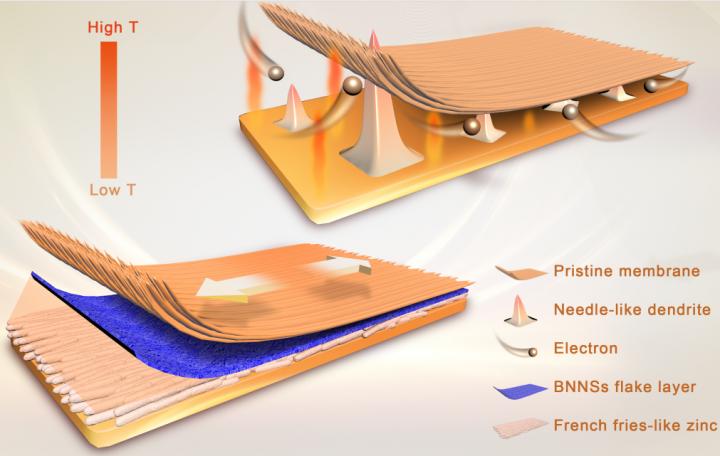
Based on their previous work, the researchers then developed a composite membrane by coating boron nitride nanosheets (BNNSs) exhibiting high thermal conductivity and mechanical strength onto a porous membrane substrate.

The BNNSs flake layer facing the negative electrode serves as the heat-porter, thus improving the surface temperature distribution of the electrode and further adjusting the zinc morphology. Moreover, its high level of mechanical strength prevents the metallic zinc from damaging the membrane.

The synergistic effect of these two factors can improve the cycle life of ZFBs. Alkaline zinc-iron flow batteries assembled with this membrane can stably run for 500 charge-discharge cycles (~800 h) at a current density of 80 mA cm-2 without significant attenuation.

Most importantly, energy efficiency above 80% can be obtained even at 200 mA cm-2. These results may serve as a reference for the regulation of zinc anodes in zinc-based batteries.

###

The study was supported by the National Natural Science Foundation of China, the Key Projects Program of the Natural Science Foundation of Liaoning Province, the Major Scientific and Technological Innovation Project of Shandong Province and DICP funding.

Media Contact
CHEN Si
[email protected]

Original Source

http://english.cas.cn/

Related Journal Article

http://dx.doi.org/10.1002/anie.201914819

Tags: Chemistry/Physics/Materials SciencesEnergy/Fuel (non-petroleum)
Share12Tweet8Share2ShareShareShare2

Related Posts

AI and Physics Collaborate to Design Advanced Hydrogen Storage Materials

June 25, 2026

International Team Including Dresden Scientists Develops Novel Designer Proteins for Advanced Study of Living Tissue

June 25, 2026

New Study Uncovers Key Factors Driving Water Chemistry in Nanoscale Environments

June 25, 2026

Plasma Technology Extends Catalyst Lifespan in Hydrogen Production

June 24, 2026
Please login to join discussion

POPULAR NEWS

  • Saying Goodbye to PGY-6: Pediatric Fellowship Realities

    103 shares
    Share 41 Tweet 26
  • Multi-Hospital Study Reveals Long Covid Burden Is Twice as High as Current Estimates

    92 shares
    Share 36 Tweet 23
  • Detection of EDCs in Breast Milk and Infant Urine Up to Six Months Highlights Early Exposure Risks

    77 shares
    Share 31 Tweet 19
  • New Drug Candidate Developed at McMaster Shows Potential for Treating Brain Cancer

    58 shares
    Share 23 Tweet 15

About

We bring you the latest biotechnology news from best research centers and universities around the world. Check our website.

Follow us

Recent News

Tracking Lanthanide-Labeled Microplastics in Plants

POSTECH Researchers Slash Cost of Reconstituted Cell-Free Systems by 95%

AI and Physics Collaborate to Design Advanced Hydrogen Storage Materials

Subscribe to Blog via Email

Success! An email was just sent to confirm your subscription. Please find the email now and click 'Confirm' to start subscribing.

Join 82 other subscribers
  • Contact Us

Bioengineer.org © Copyright 2023 All Rights Reserved.

Welcome Back!

Login to your account below

Forgotten Password?

Retrieve your password

Please enter your username or email address to reset your password.

Log In
No Result
View All Result
  • Homepages
    • Home Page 1
    • Home Page 2
  • News
  • National
  • Business
  • Health
  • Lifestyle
  • Science

Bioengineer.org © Copyright 2023 All Rights Reserved.