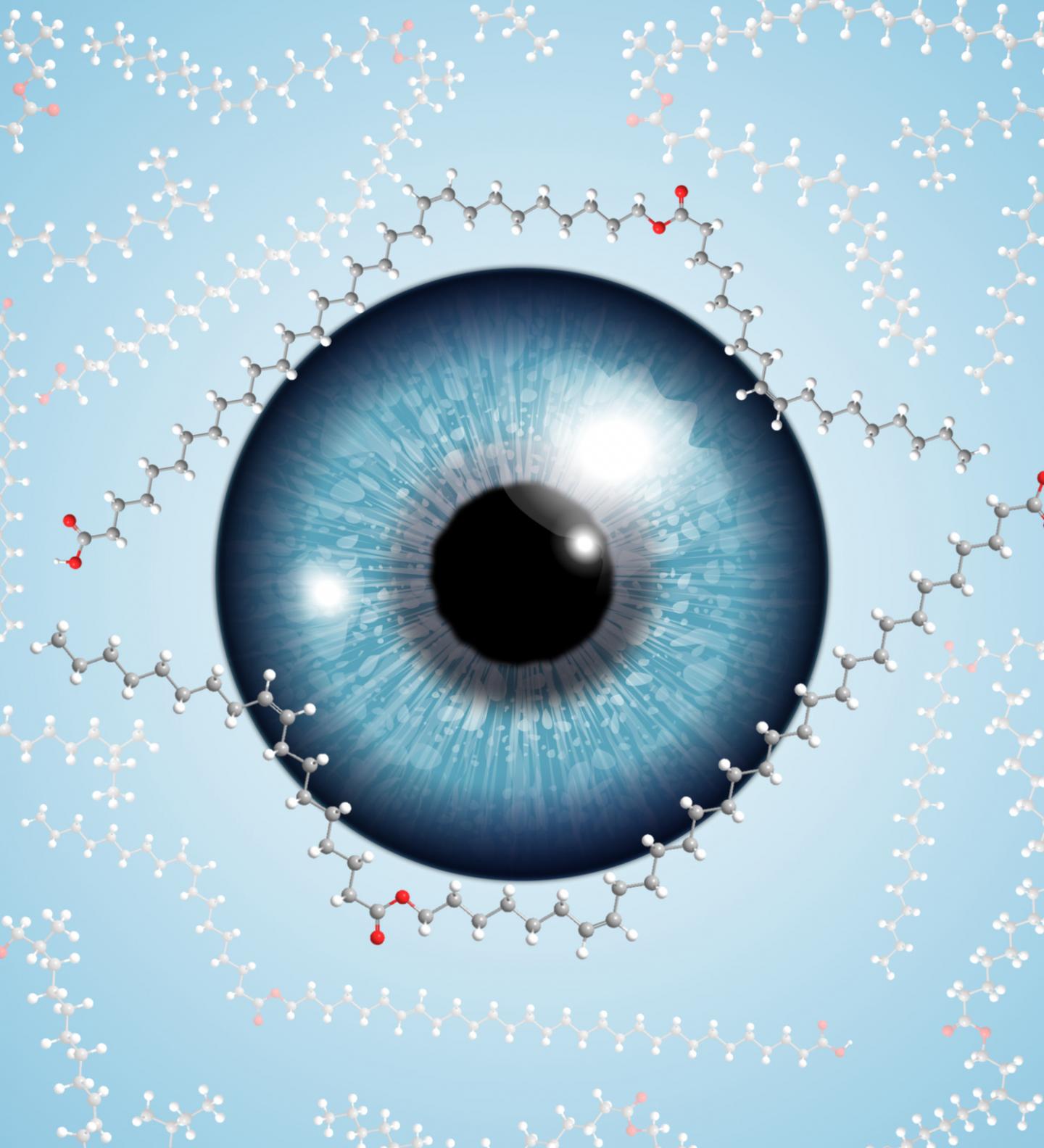
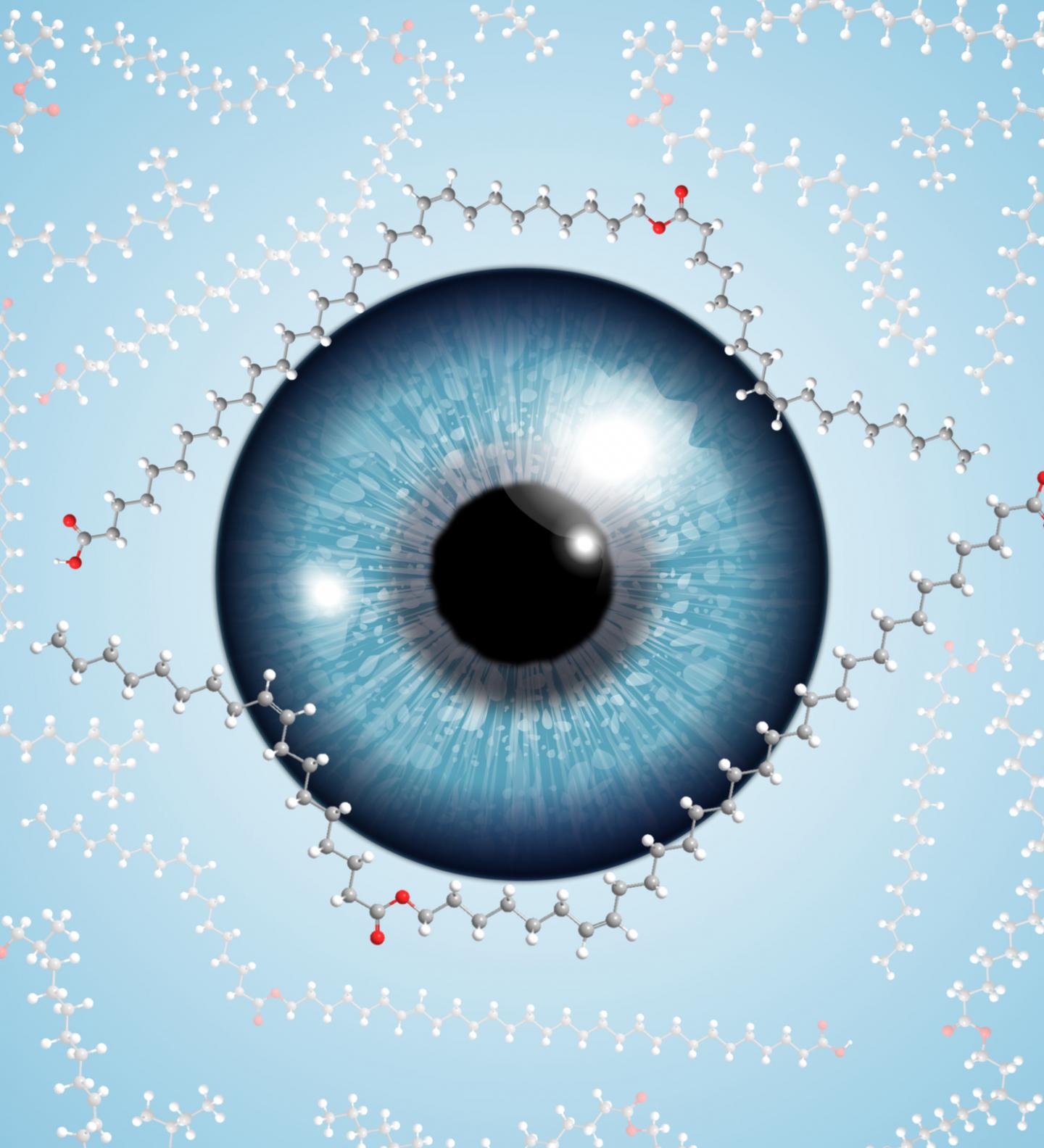
Credit: Sarah Hancock/JLR
As anyone who has experienced an annoying alternation between dry and watery eyes can confirm, tears alone aren't enough to keep the eye from drying out. A microscopically thin film of oils known as the tear film lipid layer is key to preventing the tear film from evaporating. In this month's issue of the Journal of Lipid Research, a group of Australian researchers report the structure of a key long-chain lipid in the tear film lipid layer. Their finding may be used to improve treatments for dry eye.
Although the long-chain lipids in question make up just 5% of the tear film lipid layer, they play an important role in vision. Without them, earlier studies showed, the lipid layer would resemble an oil slick atop a puddle. "This clearly wouldn't be satisfactory for you to look through," said Stephen Blanksby, a professor at the Queensland University of Technology who led the research team in this study. He saw the Langmuir trough research, carried out by others, as a prompt to determine the precise structure of the ultra-long-chain lipids of the eye.
The tear film lipid layer comes from meibum, secreted from the lower eyelid. Scientists can collect meibum samples from brave volunteers by running a small spatula gently over their lower lids, but it is difficult to obtain enough for conventional assays like NMR.
Complicating matters, the team needed to differentiate between isomers. They knew long lipid was made of two fatty acids, but not whether they were joined end-to-end or branched, a question conventional mass spectrometry couldn't answer.
Fortunately, Blanksby and colleague Todd Mitchell of the University of Wollongong have spent the last decade fine-tuning mass spectrometric techniques to characterize lipids. "We were able to bring a unique toolbox to bear," said Blanksby. "Some of these techniques may not exist outside Todd's and my laboratory."
By incorporating established approaches, such as ozonolysis, into a mass spectrometry workflow, the team determined that the most abundant of the ultra-long lipids is joined end-to-end, and pinpointed each of its double bonds. The mass spectrometers handed off the structure to chemist colleagues led by Michael Kelso, who developed a method to synthesize it.
The team is now working with industry partner Allergan, which co-funded the research with the Australian Research Council, on incorporating the new synthetic long-chain lipid as a component of drops for dry eye. While our knowledge of the lipid layer has expanded, according to Blanksby many eye drops still use mineral oil. "This type of work provides a framework to produce a product that mimics, and is based on, the actual components that are present in human tears," he said. He hopes that by creating a better match to the real tear film, blurriness and other side effects of using eye drops can be alleviated.
###
About the Journal of Lipid Research:
The Journal of Lipid Research (JLR) is the most-cited journal devoted to lipids in the world. For over 50 years, it has focused on the science of lipids in health and disease. The JLR aims to be on the forefront of the emerging areas of genomics, proteomics, and lipidomics as they relate to lipid metabolism and function. For more information about JLR, visit http://www.jlr.org.
Media Contact
Laurel Oldach
[email protected]
240-283-6648
@asbmb
http://www.asbmb.org
Related Journal Article
http://dx.doi.org/10.1194/jlr.M086702