• HOME
  • NEWS
  • EXPLORE
    • CAREER
      • Companies
      • Jobs
    • EVENTS
    • iGEM
      • News
      • Team
    • PHOTOS
    • VIDEO
    • WIKI
  • BLOG
  • COMMUNITY
    • FACEBOOK
    • INSTAGRAM
    • TWITTER
Thursday, October 8, 2026
BIOENGINEER.ORG
No Result
View All Result
  • Login
  • HOME
  • NEWS
  • EXPLORE
    • CAREER
      • Companies
      • Jobs
        • Lecturer
        • PhD Studentship
        • Postdoc
        • Research Assistant
    • EVENTS
    • iGEM
      • News
      • Team
    • PHOTOS
    • VIDEO
    • WIKI
  • BLOG
  • COMMUNITY
    • FACEBOOK
    • INSTAGRAM
    • TWITTER
  • HOME
  • NEWS
  • EXPLORE
    • CAREER
      • Companies
      • Jobs
        • Lecturer
        • PhD Studentship
        • Postdoc
        • Research Assistant
    • EVENTS
    • iGEM
      • News
      • Team
    • PHOTOS
    • VIDEO
    • WIKI
  • BLOG
  • COMMUNITY
    • FACEBOOK
    • INSTAGRAM
    • TWITTER
No Result
View All Result
Bioengineer.org
No Result
View All Result
Home NEWS Science News Biology

Scientists clarify light harvesting in green algae

Bioengineer by Bioengineer
November 26, 2019
in Biology
Reading Time: 3 mins read
0
IMAGE
Share on FacebookShare on TwitterShare on LinkedinShare on RedditShare on Telegram

IMAGE

Credit: Dr. LIU Zhenfeng’s group


Algae are indispensable because they generate about 50% of primary organic matter and account for about 50% of all oxygen on Earth. They produce oxygen through oxygenic photosynthesis -a biological process that “harvests” light and turns it into chemical energy.

A new study by Chinese and Japanese researchers has now characterized the light-harvesting system of Chlamydomonas reinhardtii, a common unicellular green alga. This research enhances understanding of the molecular basis for efficient light harvesting as well as photoprotection in green algae under variable light conditions.

The study was conducted by Dr. LIU Zhenfeng’s group from the Institute of Biophysics (IBP) of the Chinese Academy of Sciences and Dr. Jun Minagawa from Japan’s National Institute for Basic Biology. Results were published online in Nature Plants on Nov. 25, 2019 in an article entitled “Structural insights into light harvesting for photosystem II in green algae.”

Oxygenic photosynthesis in algae and plants relies on photosystem II (PSII) molecules and light-harvesting complex II (LHCII) molecules, and their associated supercomplexes, to convert light energy into chemical energy. For example, PSII catalyzes the splitting of water molecules into oxygen and protons. PSII also assembles with LHCII at the peripheral region to absorb photon energy efficiently.

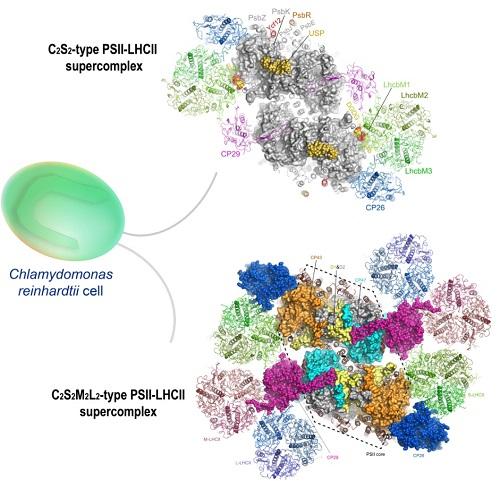
C. reinhardtii has been an important model for photosynthesis research over the past few decades as well as a platform for the production of high-value products such as biofuel and pharmaceutical compounds. Its LHCII molecules join with PSII molecules to form the C2S2M2L2 supercomplex – the largest known algae or plant PSII-LHCII supercomplex, in addition to the smaller C2S2-type supercomplex.

The researchers solved the structures of both C2S2M2L2 and C2S2 by using cryo-electron microscopy (cryo-EM). They also deciphered in great detail the assembly mechanisms and energy transfer pathways of the two supercomplexes.

Their research shows that the LHCII trimer strongly associated with the PSII core (C) contains three distinct subunits, namely, LhcbM1, LhcbM2 and LhcbM3. Two special lipid molecules mediate the interactions between LhcbM1 and the PSII core antenna CP43.

Furthermore, they discovered that one pair of moderately associated LHCII trimers (M-LHCII) and an additional pair of loosely associated LHCII trimers (L-LHCII) attach at the peripheral region of the C2S2 supercomplex, leading to the formation of the C2S2M2L2 > supercomplex.

By analyzing the structure of C2S2M2L2 supercomplex, the scientists found that the minor antenna complexes CP29 and CP26 contain several green algae-specific regions that are absent in homologs from land plants. They discovered that these special regions on CP29 play a crucial role in linking L-LHCII and M-LHCII and stabilizing the resulting assembly, whereas those of CP26 strengthen its own interactions with S-LHCII (LHCII strongly-associated with PSII).

In addition, using quantitative analysis of chlorophyll-chlorophyll relationships, the team unraveled multiple energy transfer routes from L-LHCII, M-LHCII and S-LHCII to PSII, thus explaining the fundamental steps of the light-harvesting process in green algae.

###

The project was funded by the National Key R&D Program of China, the National Natural Science Foundation of China, the Strategic Priority Research Program and the Key Research Program of Frontier Sciences of CAS, among others.

Media Contact
LIU Zhenfeng
[email protected]

Original Source

http://english.cas.cn/newsroom/research_news/life/201911/t20191125_226221.shtml

Related Journal Article

http://dx.doi.org/10.1038/s41477-019-0543-4

Tags: BiodiversityBiologyBiomechanics/BiophysicsMicrobiologyMolecular Biology
Share12Tweet8Share2ShareShareShare2

Related Posts

ResolVI cleans up noisy spatial transcriptomics data after segmentation goes wrong

ResolVI cleans up noisy spatial transcriptomics data after segmentation goes wrong

October 8, 2026
Platinum Chemotherapy, Not PARP Inhibitors, Emerges as the Main Driver of Blood Clone Expansion

Platinum Chemotherapy, Not PARP Inhibitors, Emerges as the Main Driver of Blood Clone Expansion

October 8, 2026

Kefir Fails to Rescue Growth of Hand-Reared Pigeon Chicks, Study Finds

October 8, 2026

Human Meninges Cell Atlas Upends Century-Old View of Meningioma Origins

October 8, 2026
Please login to join discussion

POPULAR NEWS

  • Alloys That Shrink Their Own Grains: New PIX Mechanism Refines Metals With Heat Alone

    Alloys That Shrink Their Own Grains: New PIX Mechanism Refines Metals With Heat Alone

    29 shares
    Share 12 Tweet 7
  • Endurance Exercise Reshapes the Liver in Males and Females Through Distinct Molecular Routes

    29 shares
    Share 12 Tweet 7
  • Single Transcription Factor PU.1 Rapidly Converts Fibroblasts into Macrophage-Lineage Cells

    29 shares
    Share 12 Tweet 7
  • New Scale Measures How Ready Nurse Educators Really Are for the AI Era

    29 shares
    Share 12 Tweet 7

About

We bring you the latest biotechnology news from best research centers and universities around the world. Check our website.

Follow us

Recent News

Alloys That Shrink Their Own Grains: New PIX Mechanism Refines Metals With Heat Alone

Endurance Exercise Reshapes the Liver in Males and Females Through Distinct Molecular Routes

Single Transcription Factor PU.1 Rapidly Converts Fibroblasts into Macrophage-Lineage Cells

Subscribe to Blog via Email

Success! An email was just sent to confirm your subscription. Please find the email now and click 'Confirm' to start subscribing.

Join 85 other subscribers
  • Contact Us

Bioengineer.org © Copyright 2023 All Rights Reserved.

Welcome Back!

Login to your account below

Forgotten Password?

Retrieve your password

Please enter your username or email address to reset your password.

Log In
No Result
View All Result
  • Homepages
    • Home Page 1
    • Home Page 2
  • News
  • National
  • Business
  • Health
  • Lifestyle
  • Science

Bioengineer.org © Copyright 2023 All Rights Reserved.