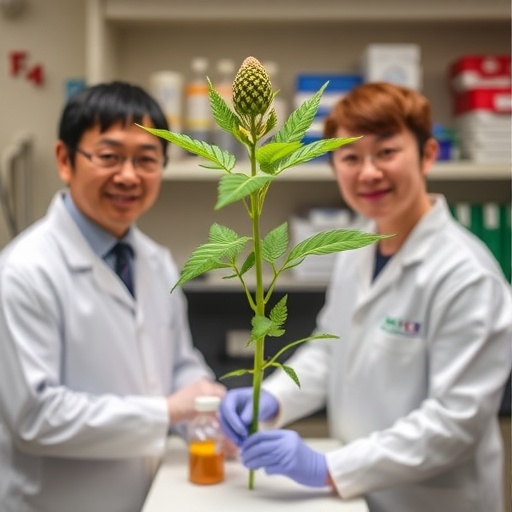
In the relentless pursuit of novel therapeutic agents, nature continues to be an irreplaceable reservoir of complex bioactive molecules. Among the myriad natural compounds, monoterpenoid indole alkaloids (MIAs) stand out due to their intricate architectures and remarkable biological activities. These alkaloids, characterized by their multiple interconnected rings and precisely oriented stereocenters, often exhibit potent pharmacological properties that could revolutionize treatments for various diseases. A prime example is bisleuconothine A, an oligomeric MIA isolated from the bark of a tropical plant in 2010, noted for its impressive anticancer efficacy against formidable breast and lung cancer cells.
Despite the promising therapeutic potential of such molecules, their structural complexity has posed formidable challenges to synthetic chemists. Traditional methods struggled to recreate the delicate three-dimensional arrangements essential for the activity of MIAs, drastically limiting access to these compounds for extensive biological and pharmaceutical evaluation. The synthesis of bisleuconothine A and related alkaloids requires constructing a labyrinth of chiral centers and fused rings, demanding innovative strategies that transcend classical synthetic frameworks.
Addressing this challenge, a research team under the aegis of Professor Hayato Ishikawa at Chiba University, Japan, embarked on an ambitious project to devise an efficient and enantioselective total synthesis of bisleuconothine A and its structurally related counterpart, bousigonine B. Their groundbreaking findings, recently published in Angewandte Chemie International Edition, describe an elegant synthetic approach that cleverly mimics the biosynthetic pathways favored by nature, bringing these complex alkaloids within reach of synthetic laboratories for the first time.
Central to their strategy is the development of an innovative organocatalytic reaction that diverges from the traditional reliance on metal catalysts. Organocatalysis, employing small chiral organic molecules to steer chemical transformations, offers advantages in terms of selectivity, environmental compatibility, and operational simplicity. The Ishikawa team exploited this approach to construct a pivotal 3-ethylpiperidine scaffold, a structural motif pervasive in many indole alkaloids and vital to their bioactivity. Their method harnessed a cascade or domino reaction, wherein multiple sequential bond-forming events transpire in a single synthetic operation, dramatically enhancing efficiency and yield.
Through meticulous optimization, the researchers fine-tuned the organocatalyst and reaction conditions to produce a highly pure, enantiomerically enriched intermediate. This versatile intermediate acts as a synthetic linchpin, enabling divergent elaboration into multiple alkaloid frameworks. The power of this strategy lies in its modularity and scalability, providing a practical platform to access diverse oligomeric MIAs beyond bisleuconothine A and bousigonine B.
Subsequent to the generation of the common intermediate, the team orchestrated two bioinspired coupling reactions that recreate the natural synthetic logic plants employ to assemble such complex molecules. These coupling steps effectively joined separately constructed alkaloid fragments into the intricate polycyclic architectures characteristic of the target molecules. The entire total synthesis of bisleuconothine A unfolded over 20 meticulously choreographed steps, culminating in the landmark achievements of synthesizing bousigonine B with an additional final step, marking its first successful laboratory synthesis.
This synthesis not only validates the efficacy of organocatalytic cascade reactions in crafting complex natural products but also underscores the strategic importance of bioinspired methods in modern synthetic chemistry. By emulating the natural assembly pathways, chemists can navigate the synthetic complexity with greater precision and fewer detours, thereby accelerating the discovery pipeline for novel bioactive compounds.
The implications of this work are far-reaching. Given bisleuconothine A’s potent anticancer properties, the ability to synthesize it and analogs reliably opens avenues for systematic biological studies and potential drug development. Professor Ishikawa emphasizes that this synthetic breakthrough is more than a chemical triumph; it could serve as a catalyst for innovation in medicinal chemistry, potentially leading to new treatments for cancer and other diseases that remain elusive to conventional therapeutics.
Moreover, the methodology’s adaptability suggests a broader utility in synthesizing other complex alkaloid families sharing the same foundational piperidine scaffold. Such a generalizable approach to accessing diverse MIAs and related natural products could transform how pharmaceutical researchers approach these compounds, shifting from scarce natural isolates to abundant synthetic sources.
The research team is currently extending this synthetic platform to a range of additional MIAs, intending not only to expand the chemical repertoire but also to facilitate comprehensive biological evaluations. By bridging synthetic organic chemistry with pharmacological research, they aim to accelerate the translation of natural product-inspired molecules into tangible therapeutic candidates.
This pioneering work exemplifies the convergence of innovative catalysis, strategic reaction design, and biomimetic principles, illuminating pathways through the formidable challenge posed by complex natural product synthesis. It embodies the potential of modern synthetic chemistry to unlock nature’s molecular treasures for humanity’s benefit.
For further details on this research and its ongoing developments, readers are encouraged to consult the original publication in Angewandte Chemie International Edition and follow updates from Chiba University’s pharmaceutical sciences department.
Subject of Research: Not applicable
Article Title: Enantioselective Total Syntheses of Bisleuconothine A and Bousigonine B
News Publication Date: 23-May-2026
Web References: http://dx.doi.org/10.1002/anie.6698305
References: Authors: Satoshi Matsumiya, Yukine Mizukami, Akihiro Morita, Kazuma Hirata, Shinya Shiomi, Shota Tominaga, Noriyuki Kogure, Hiromitsu Takayama, Mariko Kitajima, and Hayato Ishikawa; Graduate School of Pharmaceutical Sciences, Chiba University, Japan.
Image Credits: Professor Hayato Ishikawa, Chiba University, Japan
Keywords
Physical sciences, Chemistry, Organic chemistry, Organic compounds, Alkaloids, Organic catalysts, Organic synthesis, Organic reactions, Total synthesis, Stereochemistry
Tags: bioactive plant-derived alkaloidsbisleuconothine A anticancer propertieschiral center construction in alkaloidscomplex molecule synthesis in medicinal chemistryenantioselective synthesis methodsfused ring systems in natural productsinnovative synthetic strategies in organic chemistrymonoterpenoid indole alkaloids synthesisnatural product drug discoverypharmaceutical applications of MIAssynthetic challenges in bioactive moleculestotal synthesis of complex alkaloids