• HOME
  • NEWS
  • EXPLORE
    • CAREER
      • Companies
      • Jobs
    • EVENTS
    • iGEM
      • News
      • Team
    • PHOTOS
    • VIDEO
    • WIKI
  • BLOG
  • COMMUNITY
    • FACEBOOK
    • INSTAGRAM
    • TWITTER
Wednesday, June 24, 2026
BIOENGINEER.ORG
No Result
View All Result
  • Login
  • HOME
  • NEWS
  • EXPLORE
    • CAREER
      • Companies
      • Jobs
        • Lecturer
        • PhD Studentship
        • Postdoc
        • Research Assistant
    • EVENTS
    • iGEM
      • News
      • Team
    • PHOTOS
    • VIDEO
    • WIKI
  • BLOG
  • COMMUNITY
    • FACEBOOK
    • INSTAGRAM
    • TWITTER
  • HOME
  • NEWS
  • EXPLORE
    • CAREER
      • Companies
      • Jobs
        • Lecturer
        • PhD Studentship
        • Postdoc
        • Research Assistant
    • EVENTS
    • iGEM
      • News
      • Team
    • PHOTOS
    • VIDEO
    • WIKI
  • BLOG
  • COMMUNITY
    • FACEBOOK
    • INSTAGRAM
    • TWITTER
No Result
View All Result
Bioengineer.org
No Result
View All Result
Home NEWS Science News Biology

Science-based guidelines for building a bee-friendly landscape

Bioengineer by Bioengineer
April 5, 2019
in Biology
Reading Time: 2 mins read
0
IMAGE
Share on FacebookShare on TwitterShare on LinkedinShare on RedditShare on Telegram

IMAGE

Credit: Bernadette M. Mach & Daniel A. Potter, University of Kentucky

St. Paul, MN (April, 2019)–Bees are critical members of the ecosystem: 75% of leading food crops have some level of dependency on pollinators. However, native bee populations are struggling because of loss of habitat and food, often caused by urban and suburban development. The good news is that a single tree or shrub can produce thousands of flowers with high-quality pollen and nectar, providing bees with the protein and carbohydrates they need to thrive.

Many resources encourage homeowners and land care managers to create bee-friendly environments, but most of them include lists of recommended plants rarely backed by science. To rectify this, Dr. Daniel Potter surveyed 72 native and non-native woody plant species in 5 sample sites throughout the Ohio Valley region to document which species attract which bees. His findings, which he summarizes in the webcast “Woody Plants for Urban Bee Conservation,” include the following:

  • Both native and non-native plants attract diverse communities of bees, and non-native plants can extend the flowering season.
  • Flower form matters. Plants that are horticulturally modified for aesthetic reasons, such as flowers with double petals, don’t attract bees.
  • Many of the best bee-magnet plants are pest free, which is attractive to homeowners.

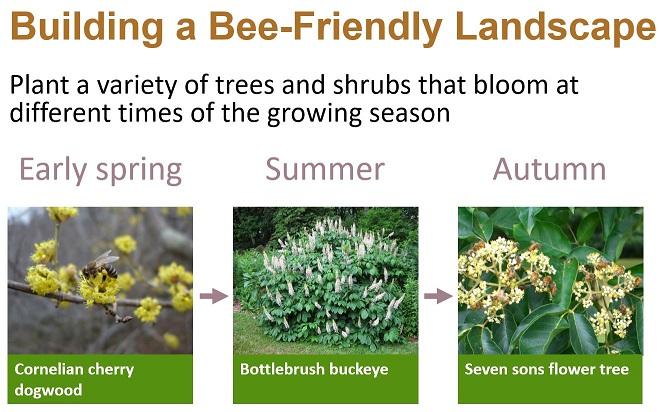
Potter ends his presentation with a list of the best woody plants and recommendations for building a bee-friendly landscape. He suggests planting a variety of trees and shrubs that bloom at different times of the growing season–such as a cornelian cherry dogwood that blooms in the early spring, a bottlebrush buckeye for the summer season, and a seven sons flower tree for the autumn–to provide crucial floral resources through the winter. Other recommendations can be found in the webcast.

This 19-minute webcast is part of a module in the new Pollinators Hub on the Plant Management Network (PMN). The module includes a webcast, summary webcast, podcast, slide set, and study guide. PMN is a cooperative, not-for-profit resource for the applied agricultural and horticultural sciences. Together with more than 80 partners, which include land-grant universities, scientific societies, and agribusinesses, PMN publishes quality, applied, and science-based information for practitioners.

###

Media Contact
Ashley Bergman Carlin
[email protected]
Tags: Agricultural Production/EconomicsClimate ChangeEarth ScienceEcology/EnvironmentFood/Food ScienceNonprofessionalPlant SciencesPopulation Biology
Share12Tweet8Share2ShareShareShare2

Related Posts

Decoding the Secret Code of a Crucial Immune Sensor

June 24, 2026

Decades of Data Reveal Which Orcas Call Puget Sound Home

June 24, 2026

Copal Tree Genetics Reveal Tropical Forest Connectivity

June 24, 2026

How Intestinal Mucus Influences Klebsiella pneumoniae Colonization and Antibiotic Effectiveness

June 24, 2026
Please login to join discussion

POPULAR NEWS

  • Saying Goodbye to PGY-6: Pediatric Fellowship Realities

    103 shares
    Share 41 Tweet 26
  • Multi-Hospital Study Reveals Long Covid Burden Is Twice as High as Current Estimates

    92 shares
    Share 36 Tweet 23
  • Detection of EDCs in Breast Milk and Infant Urine Up to Six Months Highlights Early Exposure Risks

    77 shares
    Share 31 Tweet 19
  • New Drug Candidate Developed at McMaster Shows Potential for Treating Brain Cancer

    58 shares
    Share 23 Tweet 15

About

BIOENGINEER.ORG

We bring you the latest biotechnology news from best research centers and universities around the world. Check our website.

Follow us

Recent News

BALatrine Reduces Helminth Infections: Central Java Trial

Decoding the Secret Code of a Crucial Immune Sensor

Late Neanderthal Genetic Diversity in Northwest Europe

Subscribe to Blog via Email

Enter your email address to subscribe to this blog and receive notifications of new posts by email.

Join 82 other subscribers
  • Contact Us

Bioengineer.org © Copyright 2023 All Rights Reserved.

Welcome Back!

Login to your account below

Forgotten Password?

Retrieve your password

Please enter your username or email address to reset your password.

Log In
No Result
View All Result
  • Homepages
    • Home Page 1
    • Home Page 2
  • News
  • National
  • Business
  • Health
  • Lifestyle
  • Science

Bioengineer.org © Copyright 2023 All Rights Reserved.