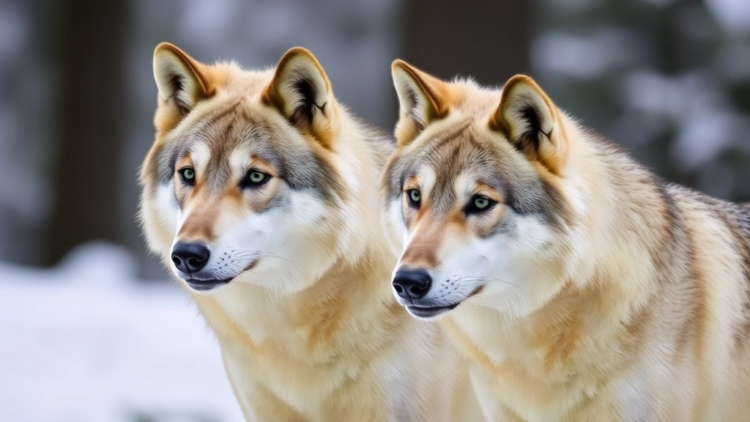
One of Europe’s most closely monitored large carnivore populations may be sliding toward a genetic point of no return, according to a new study published in the journal Heredity. Researchers Joachim Mergeay of the Research Institute for Nature and Forest and KU Leuven, Øystein Flagstad of the Norwegian Institute for Nature Research, and Robin S. Waples of the University of Washington have calculated, year by year, the effective population size of the Scandinavian wolf population since its founding in the 1980s. Their conclusion is stark: the effective size of the population is unsustainably low for both the short term and the long term, and the simulation studies that Norwegian and Swedish authorities have relied upon to justify their management targets substantially overestimate the population’s genetic health.
The timing of the study could hardly be more consequential. Managing authorities in Norway and Sweden have decided to reduce the Scandinavian wolf population to approximately 170 individuals, a census size they consider sustainable. That decision rests in part on recent population viability analyses commissioned by the same authorities, which concluded that a population of this magnitude could maintain its genetic viability. The new pedigree-based analysis directly challenges those conclusions, questioning whether the scientific foundation for the cull quotas is sound.
At the heart of the study is a concept that conservation biologists regard as perhaps the single most important number in population genetics: the effective population size, abbreviated Ne. Unlike the census count of animals, the effective size captures how many individuals would be needed in an idealized population to produce the same rate of genetic drift, inbreeding, and loss of diversity as the real population actually experiences. In practice, Ne is almost always far smaller than the raw headcount, because not every animal breeds, sex ratios are rarely balanced, and reproductive success is unevenly distributed. The effective size determines the pace at which genetic diversity erodes and inbreeding accumulates, and it therefore governs both short-term extinction risk through inbreeding depression and long-term viability through the loss of adaptive potential.
What makes the new analysis unusually powerful is the quality of the underlying data. Since the Scandinavian wolf population was re-established by a handful of founders, researchers have meticulously reconstructed its complete pedigree, drawing on decades of field monitoring, DNA sampling, and individual identification. Raw source data drawn from the pedigree compilation published by Åkesson and colleagues in 2023 allowed the team to calculate Ne precisely for every year since the population’s founding, using four-year cohorts along a one-year moving window. Rather than inferring genetic health from statistical snapshots of DNA samples, the researchers could trace the actual reproductive paths of every known animal, an approach that removes much of the uncertainty that plagues conventional genetic estimates.
The results reveal a population whose effective size has remained persistently and critically low throughout its history. The Scandinavian population was founded by only a few individuals and, despite growing to several hundred animals in census terms, has never achieved an effective size compatible with widely accepted conservation genetic benchmarks. The population’s history includes a well-documented severe inbreeding depression episode in the late 1990s and early 2000s, when pups from closely related pairs suffered dramatically reduced survival, and a partial genetic rescue delivered by a single immigrant male from the Finnish-Russian population. Subsequent work has documented the genomic consequences of this intensive inbreeding, including elevated levels of harmful homozygosity across the genome.
The study also scrutinizes the assumptions of the recent simulation studies that inform current management, including minimum viable population analyses prepared for the Swedish Environmental Protection Agency. According to Mergeay and colleagues, those simulations greatly overestimate the effective size of the Scandinavian wolf population, likely because they fail to adequately account for the population’s peculiar and well-documented reproductive structure. Wolves live in territorial packs in which typically only the dominant pair breeds, a social system that dramatically inflates the gap between census numbers and effective size. When this mating structure is properly represented, the same census count translates into a far smaller effective population than the commissioned analyses assumed, and the projected timelines for inbreeding and diversity loss become correspondingly more alarming.
The implications reach beyond Scandinavia. Conservation genetics has long relied on rules of thumb, notably the 50/500 rule, which suggests that an effective size of at least 50 is needed to avoid short-term inbreeding depression and 500 to retain long-term evolutionary potential, with revised recommendations pushing the long-term figure considerably higher. A population managed at a census size of roughly 170 animals, with a pack structure that suppresses Ne far below the census count, falls short of these benchmarks by a wide margin. The findings echo warnings issued in 2022 in the journal Science, when prominent conservation geneticists argued that planned culls would endanger the Swedish wolf population, and they align with a growing body of evidence from other inbred wolf populations, including the famously inbred wolves of Isle Royale, where genetic erosion contributed to a population crash.
The study arrives amid a charged political and legal debate over wolf management in Europe. Wolf culling policies in both Norway and Sweden have drawn formal complaints under the Bern Convention on the conservation of European wildlife and natural habitats, and the European Court of Justice has recently clarified the legal yardstick of favourable conservation status in a wave of wolf-related cases. Under the EU Habitats Directive, member states must maintain populations at a status where they can thrive long term without being dependent on continued conservation measures, a standard that inherently involves genetic considerations. If the effective size of the Scandinavian population is genuinely too small for long-term persistence, the legal and scientific case for reducing it further becomes considerably harder to defend.
The authors emphasize that their findings do not merely refine an academic parameter; they strike at the usefulness of the very models being used to set quotas. If simulation studies overestimate Ne, they will systematically underestimate the rate of inbreeding and the speed of diversity loss, producing optimistic projections of viability that the real population cannot match. The researchers suggest that management informed by these flawed models risks steering the population into an extinction vortex, in which shrinking numbers accelerate inbreeding, inbreeding depresses survival and reproduction, and the resulting decline further shrinks the population. Recent theoretical work suggests such vortices can be driven as much by a shortage of beneficial mutations as by the accumulation of harmful ones, underscoring how difficult a genetically impoverished population is to rescue once diversity is gone.
For the Scandinavian wolf, the path forward suggested by the genetics is clear even if politically difficult: either the population must be allowed to grow substantially, or gene flow from the larger Finnish-Russian wolf population must be facilitated at a rate sufficient to counteract drift and inbreeding. The one-migrant-per-generation rule, long a staple of conservation genetics, may need to be exceeded in this case given the population’s extreme isolation and skewed reproductive structure. What the new study makes unmistakable is that the current management trajectory, a population capped at 170 animals justified by models that overestimate its genetic buffer, is incompatible with the population’s own pedigree. As the authorities finalize their reduction plans, they will have to reckon with a complete, individual-level record of every wolf that has lived in Scandinavia, and that record tells a story of a population living dangerously close to its genetic limits.
Subject of Research: Effective population size and genetic viability of the Scandinavian wolf population
Article Title: The effective size of the Scandinavian wolf population is too small for both short- and long-term conservation
Article References: Mergeay, J., Flagstad, Ø., & Waples, R. S. (2026). The effective size of the Scandinavian wolf population is too small for both short- and long-term conservation. Heredity. https://doi.org/10.1038/s41437-026-00877-y
Image Credits: AI Generated
DOI: 10.1038/s41437-026-00877-y
Keywords: Scandinavian wolf population, effective population size, inbreeding, conservation genetics, population viability analysis, genetic drift, wolf culling, pedigree analysis, Heredity, large carnivore management, genetic rescue, extinction risk
Cite Scienmag News
APA MLA Chicago
Juliet Wilcox. (September 22, 2026). Scandinavian Wolves Are Too Inbred to Survive, Landmark Genetic Study Warns. Scienmag. https://scienmag.com/scandinavian-wolves-are-too-inbred-to-survive-landmark-genetic-study-warns/
Juliet Wilcox. “Scandinavian Wolves Are Too Inbred to Survive, Landmark Genetic Study Warns.” Scienmag, 22 September 2026, https://scienmag.com/scandinavian-wolves-are-too-inbred-to-survive-landmark-genetic-study-warns/. Accessed 22 September 2026.
Juliet Wilcox. “Scandinavian Wolves Are Too Inbred to Survive, Landmark Genetic Study Warns.” Scienmag. September 22, 2026. https://scienmag.com/scandinavian-wolves-are-too-inbred-to-survive-landmark-genetic-study-warns/
Copy citation Download RIS
Tags: challenges of small population managementconservation geneticseffective population sizeeffects of low effective population sizeEuropean large carnivore conservationextinction riskgenetic driftgenetic health assessment of Scandinavian wolvesgenetic rescueHeredityimpact of inbreeding on carnivore survivalimplications for wolf population recoveryinbreedinginbreeding and genetic diversitylarge carnivore managementlong-term sustainability of European wolvespedigree analysispedigree-based genetic studiespopulation viability analysispopulation viability analysis accuracyScandinavian wolf populationScandinavian wolf population geneticswildlife conservation management decisionswolf culling