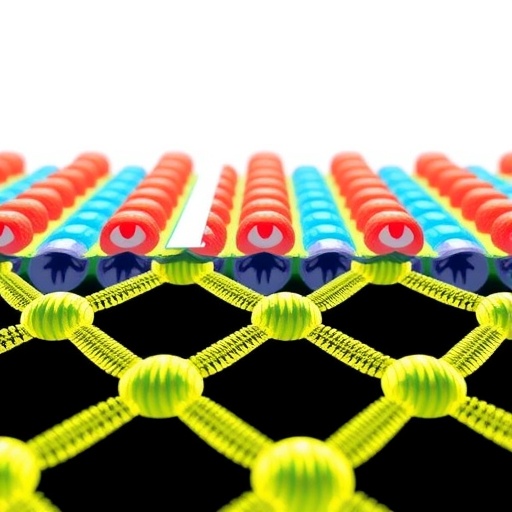
Metal–organic framework (MOF) membranes have long promised energy savings for gas separations, yet turning laboratory breakthroughs into scalable devices has remained difficult. The central challenge is that crystalline MOFs, when processed into macroscopic membranes, often lose performance or become impractically hard to manufacture. In a new study, researchers introduce a membrane architecture designed to close the gap between intrinsic MOF selectivity and industrially compatible fabrication.
The team reports “quasi-pure” MOF membranes—materials composed of more than 90 vol% MOF—fabricated using solution-processing routes familiar to industry. The approach hinges on a merged-phase strategy that fuses MOFs and polymers into a single pseudo-continuous phase, rather than treating them as separate components. This fusion helps the resulting material behave mechanically and processably like a polymer film while retaining MOF-driven transport.
A second key innovation is tailoring MOF surface character to mimic polymer-like interfaces. With these modified surfaces, MOFs can form rheologically controlled flocculated networks even at extreme solid loadings. The result is a concentrated, crack-resistant membrane structure that can be deposited, dried, and handled without sacrificing the pore-network environment responsible for selective diffusion and adsorption.
To benchmark the concept, the researchers fabricated quasi-pure membranes from representative MOFs, including ZIF-67, CALF-20, and CuBDC. They then tested essential separations spanning hydrocarbon mixtures and carbon capture, as well as hydrogen purification. Across these targets, the membranes delivered performance approaching that of their “associated” pure MOF counterparts, indicating that the merged-phase processing does not substantially degrade the functional pore chemistry.
One headline demonstration targets propylene/propane separation, a notoriously energy-intensive industrial duty. The quasi-pure (110)-oriented ZIF-67 membranes achieve a propylene permeability of about 160 barrer and a mixed-gas selectivity near 100. The authors argue these metrics are sufficient to reach polymer-grade propylene.
Techno-economic considerations further strengthen the case: the study estimates an 80% reduction in purification cost compared with distillation, attributable to lower energy requirements when separations shift from thermal to membrane-based processes. This cost advantage, if scalable, could materially affect how propylene is produced and purified.
Crucially, the work emphasizes manufacturing relevance. The researchers report continuous roll-to-roll fabrication of the quasi-pure membranes at an industrial plant, suggesting the method can be integrated into production lines rather than confined to specialized lab settings. In doing so, they address the long-standing mismatch between crystalline membrane performance and real-world manufacturability.
By combining merged-phase chemistry, polymer-like MOF interfaces, and extreme-concentration network control, the study proposes a practical pathway for crystalline MOF membranes at scale. The quasi-pure architecture may become a template for future membrane materials that require both high selectivity and industrial throughput.
Subject of Research: Scalable quasi-pure MOF membranes for energy-efficient gas separations
Article Title: Scalable quasi-pure MOF membranes for energy-efficient gas separations
Article References: Song, S., Fan, D., Jia, X. et al. Scalable quasi-pure MOF membranes for energy-efficient gas separations. Nature (2026). https://doi.org/10.1038/s41586-026-10655-9
DOI: https://doi.org/10.1038/s41586-026-10655-9
Image Credits: AI Generated
Keywords: Metal–organic frameworks, MOF membranes, gas separation, propylene/propane, roll-to-roll fabrication, roll-to-roll manufacturing, carbon capture, hydrogen purification
Tags: crack-resistant MOF membrane structuresenergy savings in gas separationsenergy-efficient gas separation membranesfused-phase MOF-polymer compositeshigh-performance gas separation materialsindustrial application of MOF membranespolymer-like MOF surface modificationquasi-pure metal–organic framework membranesrobust MOF membrane fabrication techniquesscalable MOF membrane fabricationselective gas diffusion in MOFssolution-processing MOF membranes