Preventing endangered carnivores from eating valuable livestock may require going back to Ecology 101
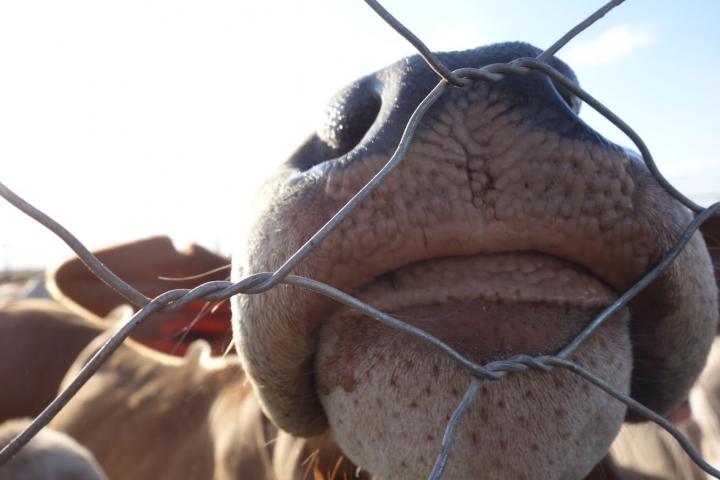
Credit: Photo by Christine Wilkinson, funded by the National Geographic Society
Berkeley — For predators like wolves, cougars and snow leopards, a cow or sheep out to pasture may make for an easy and tasty meal. But when wild animals eat livestock, farmers face the traumatic loss of food or income, frequently sparking lethal conflicts between humans and their carnivorous neighbors.
Humans have struggled to reduce the loss of livestock to carnivores for thousands of years, and yet, solutions remain elusive. According to a new study led by researchers at the University of California, Berkeley, solving this ancient puzzle requires going back to Ecology 101.
Effectively reducing encounters between domestic prey and wild predators, the researchers argue, requires knowing the principles governing the ecological interactions among these players and their surrounding landscape. Simply put, getting in the mind of predators — considering the ecology of how they hunt, how their prey behaves and how they interact with the landscape around them — will help farmers and wildlife managers target interventions to discourage wild carnivores from preying on valuable livestock.
“There is no ‘one-size-fits-all’ solution for livestock predation, because the variables at play change, depending on the stakeholders, the landscape and the carnivores and livestock involved — as well the scale and cost of management tools,” said Christine Wilkinson, a graduate student in environmental science, policy and management at UC Berkeley and lead author on the study, which appeared this week in the journal Conservation Biology. “But at the core of the problem is an ecological act: predation.”
In addition to lethal means of warding off potential predators, like poisoning or hunting, a variety of nonlethal deterrents are available. Guardian dogs, lights, electric fencing or bright-colored flags can all keep carnivores at bay while preserving the local ecology. Other strategies, like regularly moving livestock to different pastures or keeping them inside an enclosure at night, can make it harder for carnivores to locate and hunt them.
But the same techniques that prevent wolves from eating sheep in the rocky valleys of Idaho may not be as effective at preventing snow leopards from killing livestock in the high elevations of the Himalayas. Instead of focusing on the overall effectiveness of any one technique, the authors urge wildlife managers to approach the problem by considering a framework that includes the carnivore ecology, the livestock ecology and how the two species interact with the landscape around them.
“By knowing the full ecological story, we can tinker with the tools in our management toolkit to keep both predators and livestock safe,” said Defenders of Wildlife senior scientist and co-author Jennie Miller.
For instance, wolves are known to be afraid of strings of red flags called fladry, and using fladry around a pasture might be a cost-effective method for keeping the predators away from sheep. But considering other aspects of the ecology, such as where the pastures are located, or where the sheep are kept at night, could yield even better results, depending on context.
These strategic combinations of deterrents have successfully kept predators at bay in a variety of settings, the paper points out. The authors highlight three case studies from around the world, demonstrating the success that can occur when ecology is the foundation of targeted interventions, and the failure that can occur when it is ignored.
The study’s framework provides guidance for livestock managers to consider their management techniques as a component of livestock ecology. “Livestock have, in some sense, been bred to be an easy target for carnivores,” Wilkinson said. “Humans have to recreate the defenses that we bred away.”
The next step for
###
the researchers is applying this framework to provide livestock managers with concrete tools to mitigate conflict as part of a larger, collaborative research and outreach effort based in the Brashares Group at UC Berkeley.
The interdisciplinary team of co-authors on the paper also included Alex McInturff, Veronica Yovovich, Kaitlyn Gaynor, Kendall Calhoun, Harshad Karandikar, Jeff Vance Martin, Phoebe Parker-Shames, Avery Shawler, Amy Van Scoyoc and, senior author, Justin Brashares of UC Berkeley.
This research was supported by a National Science Foundation Graduate Research Fellowship and National Geographic Society grant 466 WW-100C-17.
Media Contact
Kara Manke
[email protected]
Original Source
https:/
Related Journal Article
http://dx.