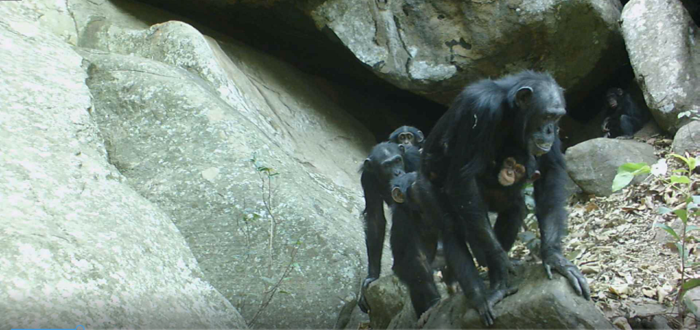
To prosper, most great apes need lush forests in Africa (bonobos, chimpanzees, and gorillas) or Southeast Asia (orangutans), except for some groups of chimpanzees that live in savannahs, habitats characterised by high temperatures and very low seasonal rainfall.
Credit: Jane Goodall Institute Spain and Senegal
To prosper, most great apes need lush forests in Africa (bonobos, chimpanzees, and gorillas) or Southeast Asia (orangutans), except for some groups of chimpanzees that live in savannahs, habitats characterised by high temperatures and very low seasonal rainfall.
Adriana Hernández, Serra Hunter professor at the Faculty of Psychology of the University of Barcelona, co-led the study conducted by an international team of primatologists who reviewed the existing research on the behaviour and ecology of savannah chimpanzees to understand how these apes adapt to extreme conditions.
According to the researchers, the environmental conditions of these places would lead to a specific type of behaviours and physiological responses in these chimpanzees –such as resting in caves or digging in order to get water– which are not observed in their counterparts that live in more forested areas, where they do not deal with these extreme environmental conditions.
“The study on savannah chimpanzees and what we call the landscape savannah effect have important implications for reconstructing the behaviour of the first hominis who lived in similar habitats and therefore, it helps us to better understand our own evolution”, notes Adriana Hernández, who co-led the study, published in the journal Evolutionary Anthropology, together with Stacy Lindshield, from the University of Purdue (United States).
The genetically closest-to-humans evolutionary living relative
Chimpanzees (Pan troglodytes) are our closest living relatives, since they share 98.7% of their DNA with humans and have a common ancestor that lived between 4.5 and 6 million years ago. Despite this proximity, they lack some of the biological and cultural traits that humans possess to adapt to extreme heat, such as numerous eccrine sweat glands, relative lack of hair, or the ability to create artefacts such as water containers and sun hats to mitigate dehydration and sunstroke.
The chimpanzees that live in the savannah are taxonomically indistinguishable from other chimpanzees. For this reason, comparisons of behaviour, morphology and ecology with chimpanzees that live in more forested landscapes provide key information for hypothesising how early humans may have adapted millions of years ago while African forests were receding and gave place to savannahs.
“We know that early hominins adapted to savannah environments similar to those occupied by chimpanzees today, and researchers think that savannah conditions caused adaptations in our ancestors, such as brain expansion or tolerance to high temperatures”, says Adriana Hernández, who is also the co-director of research at the Jane Goodall Institute Spain. “Therefore –she continues–, understanding how our genetically closest living relatives adapt to a dry, hot, seasonal and open environment, very similar to those where early hominins lived, helps us to model how our ancestors might have adapted and how the features that define us as humans might have emerged”.
Strategies to adapt to high temperatures
Among the different characteristics of savannah chimpanzees described in the study, their strategies to deal with high temperatures stand out. “Understanding how they deal with heat can help us better understand what strategies human ancestors may have used to cope with high temperatures. Some strategies are probably the same for chimpanzees and hominins, such as the use of caves or going into water pools to cool down”, notes the researcher. Another example the researcher highlights is the ways in which these chimpanzees try to hydrate themselves during the advanced dry season, such as digging for water when this resource is reduced to just a few spots in the landscape. “Early hominins also had to deal with low water availability during part of the year”, Hernández adds.
Groups distributed over larger areas
The study also confirmed that chimpanzee social groups in the savannah are distributed over unusually large areas of around 100 km², while chimpanzees living in more forested areas have ranges between 3 and 30 km², approximately. “However, although group sizes are similar in different habitats, chimpanzees in the savannah have a much lower population density, which could be explained by the low availability of food in this habitat”.
Despite the fact that we know much more about savannah chimpanzees now than ever before, their exact numbers are unknown, although according to the researchers “there are fewer than those living in the forest areas, as the total area they occupy is much smaller”. In addition, because they have a lower population density, there are far fewer individuals in areas of the same size than in the forest. “It should be noted that there are far fewer sites where savannah chimpanzees have been studied, as there are only two study sites where savannah chimpanzees are habituated to humans and their behaviour can be observed directly. In contrast, there are many study sites where chimpanzees are fully habituated to researchers in the forest, a habitat where these primates have been studied for decades”, explains Adriana Hernández.
Keys to understanding adaptation to climate change
Another important contribution of this study is that it helps to understand the potential effects of climate change on the species. “The adaptation of savannah chimpanzees to extreme climates can help us model how chimpanzees that currently inhabit forests might adapt to changes that climate studies project will make their environments drier and warmer. This is important, since the species is categorized as Endangered and the West African subspecies (Pan troglodytes verus) is Critically Endangered”, says the expert.
In this regard, the researchers call for “more research into the biological and cultural aspects underlying the effect of the savannah environment”, given that climate projections point to “an increase in hotter and drier areas in the future”, they conclude.
DOI
10.1002/evan.21924
Method of Research
Observational study
Subject of Research
Animals
Article Title
Chimpanzees (Pan troglodytes) in savanna landscapes
Article Publication Date
20-Sep-2021