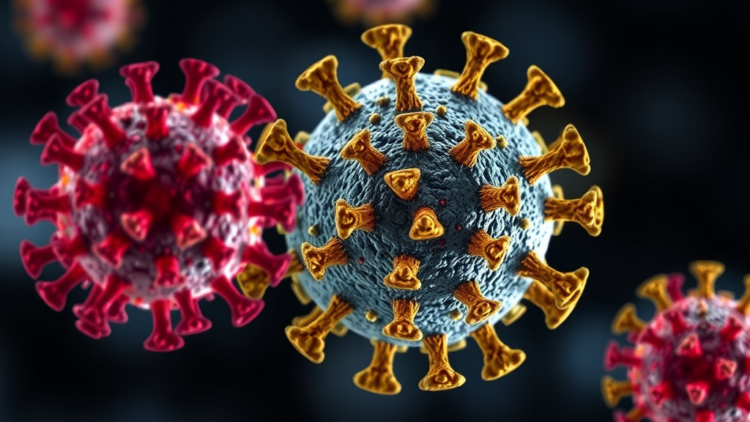
When a virus slips into a human cell, the first hours of infection decide much of what follows. The cell’s pattern recognition receptors scan the cytoplasm for molecular signatures that betray an invader, chief among them double-stranded RNA, and one of the most important sentinels in this surveillance system is the retinoic acid-inducible gene I, known widely as RIG-I. Once RIG-I binds viral RNA, it initiates a signaling cascade that culminates in the production of type I and type III interferons, the cytokines that place neighboring cells on heightened alert and coordinate the antiviral response. SARS-CoV-2, the agent responsible for COVID-19, has proven remarkably adept at delaying or blunting this alarm, and a study published in Virology Journal now adds a detailed mechanism to the growing catalog of its evasion strategies. The work, led by researchers at Guizhou Medical University, focuses on nonstructural protein 14, or NSP14, and reveals how this multifunctional viral enzyme quietly severs a critical partnership that amplifies interferon signaling.
NSP14 is one of sixteen nonstructural proteins encoded by the SARS-CoV-2 genome, and it wears two enzymatic hats that are both essential for viral replication. Its N-terminal domain functions as an exoribonuclease, proofreading freshly synthesized viral RNA and excising mismatched nucleotides, while its C-terminal domain acts as an N7-methyltransferase, adding a methyl group to the 5′ cap of viral messenger RNA so that the RNA masquerades as a cellular transcript. This cap modification allows viral RNA to evade detection by innate immune receptors and to be translated efficiently by the host machinery. Previous research had implicated NSP14 in antagonizing interferon responses, but the precise route it takes through the signaling network remained incompletely mapped, particularly with respect to the RIG-I pathway that dominates the sensing of RNA viruses.
To dissect this question, the research team employed overexpression systems and reporter assays to test what happens to interferon production when NSP14 is present. The results were unambiguous. Elevated levels of NSP14 significantly suppressed both type I and type III interferon responses, along with the expression of downstream interferon-stimulated genes, the effector proteins that execute much of the antiviral program. The suppression extended to key signaling intermediates: activation of TBK1, the kinase that phosphorylates downstream transcription factors, and activation of IRF3, the transcription factor that drives interferon-beta transcription, were both dampened. In effect, NSP14 was acting upstream of the phosphorylation events that normally convert RNA sensing into gene expression, placing its point of interference early in the RIG-I signaling axis.
A central question in such experiments is which part of a viral protein carries out a given function, and the team addressed this by testing whether NSP14’s immunosuppressive effect depended on its catalytic activities or on its interactions with other viral components. NSP14 is known to form a complex with NSP10, a cofactor that stimulates its exoribonuclease activity, and the researchers examined whether this partnership was required. It was not. The inhibitory effect on RIG-I-mediated antiviral signaling persisted independently of complex formation with NSP10. What did matter was the C-terminal N7-methyltransferase activity. When that function was disabled, the ability of NSP14 to suppress interferon production was lost, indicating that the methyltransferase domain is the business end of the immune evasion strategy, even though the mechanism does not appear to operate through cap modification of viral RNA itself.
With the functional requirement mapped to the methyltransferase domain, the investigators turned to the question of which host protein NSP14 might be targeting. Using immunoprecipitation followed by mass spectrometry, they searched for cellular interaction partners of NSP14 and identified DHX15, a DEAH-box helicase that had previously been characterized as a co-receptor of RIG-I. DHX15 belongs to the large family of DExD/C-box helicases, enzymes that remodel RNA structures and, in several cases, contribute to innate immune signaling. The finding that a viral enzyme with methyltransferase activity physically contacts DHX15 suggested a plausible bridge between the protein’s known biochemistry and its observed immunological effect.
The significance of DHX15 as a target becomes clear when its normal role is considered. Earlier studies had established that DHX15 cooperates with RIG-I to enhance signaling triggered by RNA viruses, functioning as a co-receptor that strengthens the antiviral response. In other words, DHX15 is not merely an accessory protein; it is part of the amplification system that allows the RIG-I pathway to generate a robust interferon signal. A virus that could disrupt the DHX15-RIG-I partnership would effectively turn down the volume of the alarm before it ever reaches the nucleus. The research team set out to test whether NSP14 does exactly that, and their experiments confirmed the hypothesis.
Using co-immunoprecipitation assays, the researchers demonstrated that NSP14 dampens the interaction between DHX15 and RIG-I. By binding to DHX15, the viral protein occupies a partner that would otherwise assist RIG-I in propagating the activation signal downstream to MAVS, the mitochondrial antiviral-signaling protein that serves as the platform assembling TBK1 and other signaling components. The consequences of this interference follow a coherent logic: with fewer productive DHX15-RIG-I complexes, reduced activation of TBK1 and IRF3 follows, and the transcription of interferon genes falters. The pathway from viral methyltransferase to blunted cytokine output is thus traced step by step, from protein-protein contact at the level of the sensors to diminished phosphorylation at the level of the kinases to reduced gene expression at the level of the interferon loci.
These findings carry several implications for how scientists understand the immune battlefield inside SARS-CoV-2-infected cells. First, they illustrate the economy of viral genomes, in which a single protein performs multiple jobs: the same NSP14 molecule that proofreads and caps the viral RNA also moonlights as an immune antagonist, using its methyltransferase domain for a second, noncanonical purpose. Second, they highlight DHX15 as a newly appreciated node of viral attack, expanding the list of host factors that coronaviruses manipulate and suggesting that the partnership between helicase co-receptors and RIG-I-like receptors is a vulnerability that pathogens have evolved to exploit. Third, they reinforce the picture of SARS-CoV-2 as a virus with a formidable arsenal of evasion strategies, in which early innate immune suppression buys time for viral replication before adaptive immunity can mount an effective response.
The study also opens avenues for therapeutic thinking. If NSP14’s N7-methyltransferase activity is required for suppressing interferon production, then inhibitors of that enzymatic function might do double duty, impairing viral RNA capping while simultaneously relieving the brake on innate immunity. Small molecules targeting the methyltransferase domain are already of interest in antiviral drug development, and this work adds an immunological rationale to the enzymatic one. Similarly, approaches that stabilize or mimic the DHX15-RIG-I interaction could, in principle, restore signaling amplitude in infected tissues, although such strategies remain far from clinical application. As with all mechanistic cell culture studies, important caveats apply: the experiments relied on overexpression systems, and confirming that the same interference operates during authentic SARS-CoV-2 infection at physiological protein levels will be an important next step.
What the research ultimately delivers is a clearer molecular narrative of how SARS-CoV-2 mutes the body’s first response to infection. The virus does not merely hide its RNA; it actively dismantles the cooperative architecture of the sensing machinery, using NSP14 to pry apart DHX15 and RIG-I and thereby weakening the signal before it can cascade into interferon production. Every element of that cascade, from the helicase partnership at the membrane-associated sensor level to the phosphorylation of TBK1 and IRF3 to the expression of interferon-stimulated genes, is diminished as a result. In mapping this route with biochemical precision, the team at Guizhou Medical University has not only illuminated a specific evasion tactic of a globally significant pathogen but has also underscored a broader lesson of the COVID-19 era: the proteins viruses bring with them are often multitaskers, and understanding their secondary functions may reveal the most consequential battlegrounds of all.
Subject of Research: SARS-CoV-2 NSP14-mediated evasion of RIG-I-mediated innate antiviral immunity through disruption of the DHX15-RIG-I interaction
Article Title: SARS-CoV-2 NSP14 suppresses RIG-I-mediated interferon production by dampening the interaction between DHX15 and RIG-I
Article References: Liu, H., Hu, R., Lei, X., Han, Y., & Nie, Y. (2026). SARS-CoV-2 NSP14 suppresses RIG-I-mediated interferon production by dampening the interaction between DHX15 and RIG-I. Virology Journal. https://doi.org/10.1186/s12985-026-03314-y
Image Credits: AI Generated
DOI: 10.1186/s12985-026-03314-y
Keywords: SARS-CoV-2, NSP14, RIG-I, DHX15, innate immunity, interferon, immune evasion, N7-methyltransferase, TBK1, IRF3, virology, pattern recognition receptors
Cite Scienmag News
APA
MLA
Chicago
Drew Townsend. (September 25, 2026). SARS-CoV-2 Enzyme NSP14 Disrupts DHX15-RIG-I Partnership to Silence Antiviral Alarm. Scienmag. https://scienmag.com/sars-cov-2-enzyme-nsp14-disrupts-dhx15-rig-i-partnership-to-silence-antiviral-alarm/
Drew Townsend. “SARS-CoV-2 Enzyme NSP14 Disrupts DHX15-RIG-I Partnership to Silence Antiviral Alarm.” Scienmag, 25 September 2026, https://scienmag.com/sars-cov-2-enzyme-nsp14-disrupts-dhx15-rig-i-partnership-to-silence-antiviral-alarm/. Accessed 25 September 2026.
Drew Townsend. “SARS-CoV-2 Enzyme NSP14 Disrupts DHX15-RIG-I Partnership to Silence Antiviral Alarm.” Scienmag. September 25, 2026. https://scienmag.com/sars-cov-2-enzyme-nsp14-disrupts-dhx15-rig-i-partnership-to-silence-antiviral-alarm/
Copy citation
Download RIS
Tags: antiviral cytokine signalingcoronavirus nonstructural proteinsCOVID-19 immune evasion strategiesDHX15DHX15-RIG-I interactionimmune evasioninnate immune system in viral infectionsinnate immunityinterferoninterferon response suppressionIRF3mechanisms of SARS-CoV-2 immune suppressionN7-methyltransferaseNSP14pattern recognition receptorsRIG-IRIG-I signaling pathway disruptionSARS-CoV-2SARS-CoV-2 NSP14 enzymeTBK1viral immune evasion mechanismsviral interference with antiviral signalingviral RNA proofreading enzymesvirology