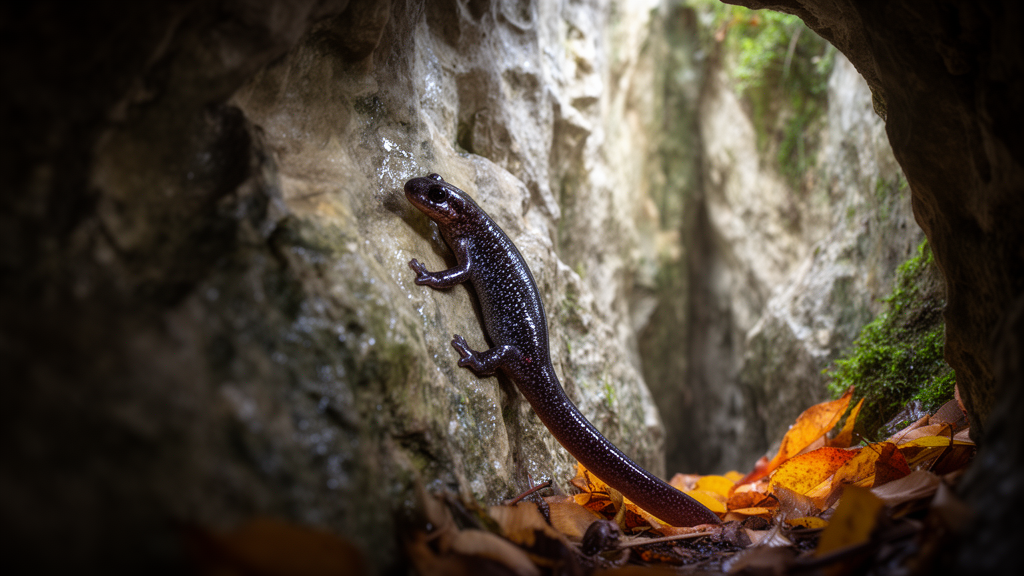
Deep beneath the limestone ridges of Sardinia’s Monte Albo massif lives a lungless salamander found nowhere else on Earth. New research has now delivered the first systematic look at what controls how many of these animals gather inside caves, and the answer turns out to be written in the seasons. Over a full year of surveys across seven natural caves, researchers recorded 831 individual Monte Albo cave salamanders (Speleomantes flavus), finding that their numbers swell in spring and autumn and collapse during the harshest months of summer and winter.
Speleomantes are a biological oddity in Europe. The genus comprises eight species, all endemic or sub-endemic to Italy, and they are the only members of the lungless salamander family Plethodontidae on the continent, a group otherwise dominated by North American lineages. Being entirely terrestrial with direct development, these salamanders skip the aquatic larval stage familiar from most amphibians. Their skin does the breathing, which makes them exquisitely sensitive to temperature and moisture. Cool, humid conditions are essential not only for respiration and osmoregulation but also for the proper development of their eggs, and such conditions appear on the surface only briefly in spring and autumn. Caves, by contrast, offer them year-round.
This dependence on microclimate has long made cave salamanders a textbook example of a troglophile, an organism that thrives in subterranean habitats without being fully committed to them. What has been missing, the researchers note, is evidence on abundance. Most ecological work on Speleomantes has focused simply on where the animals are present or absent, leaving open the question of which factors determine how many individuals actually congregate in a given spot. To close that gap, the team designed a study to test three competing ideas, which they framed as the microclimatic selection hypothesis, the best foraging hypothesis, and the predation risk hypothesis.
The fieldwork drew on a previously published dataset collected between October 2015 and June 2016 in seven caves in the Monte Albo massif of northeastern Sardinia. A single researcher carried out 77 surveys, at least two per season, working inward from each cave entrance in three-meter sectors. Every sector was searched for a standardized 7.5 minutes, with all salamanders counted and, where possible, captured for measurement. At the far end of each sector, the team logged air temperature and relative humidity at ground level and at 2.5 meters height, capturing potential microclimatic stratification, along with maximum and minimum illuminance. Sex was determined for captured adults using the mental gland, a male secondary sexual trait, while individuals below 55 millimeters in snout-vent length were classed as juveniles.
The surveys also recorded four cave invertebrates. Crane flies and the snail Oxychilus oppressus were treated as potential prey, while two spiders, the orb-web species Meta bourneti and a Tegenaria species, were treated as potential predators, since both have been documented eating juvenile salamanders. Some 110 salamanders were marked with visual implant tags, but only ten were recaptured over the year, a rate low enough that the authors treat the dataset as a genuine snapshot of population preferences rather than the habits of a few familiar individuals.
Statistical modeling with generalized linear mixed models revealed how dramatically the cave microclimate shifts with the calendar. Sector temperature was significantly lower in winter and spring than in autumn, and the depth profile flipped seasonally: near the entrances, temperatures ran hot in summer, while deeper sectors were relatively warmer in winter. Over a year, temperature in the deepest zones, around 60 to 75 meters from the entrance, fluctuated by only about 5 degrees Celsius, whereas the first 15 meters inside the caves swung by nearly 20 degrees. Humidity generally increased with depth and dropped in spring and summer, while illuminance peaked near entrances, especially in spring.
Against this backdrop, the salamanders’ behavior supported the microclimatic selection hypothesis most clearly. Overall abundance was significantly lower in summer and winter and showed no decline in spring, and individuals clustered in relatively cold, humid sectors not far from the entrances. During the stressful summer months, however, the animals shifted deeper into the caves, where stable conditions persist all year. The best foraging hypothesis was partially supported. Overall abundance was positively linked to the presence of crane flies, and juveniles in particular favored entrance zones where prey availability is highest, apparently accepting sub-optimal microclimates in exchange for food. Adults showed no significant correlation with prey presence, and the authors suggest this may reflect the limits of their data, which recorded only the presence of two prey types rather than their abundance, in a species known to forage opportunistically.
The predation risk hypothesis, by contrast, was not supported at all. No group of salamanders reduced its numbers where the predator spiders were present, and the analysis actually produced positive correlations, with adult males more abundant in sectors occupied by both Meta bourneti and Tegenaria, and juveniles more numerous where Meta bourneti and the snail Oxychilus oppressus occurred. The researchers interpret this as likely reflecting the salamander’s position at the top of the cave food web. Meta spiders, they note, are considered a good proxy for prey availability in subterranean environments, so the association may be indirect. As for documented spider predation on juveniles, the recorded cases involved animals that apparently blundered into webs, suggesting the true risk is lower than the hypothesis predicted.
The seasonal pattern also carried a foraging logic. In winter, when invertebrate abundance in surface environments crashes, adults appear to have little incentive to leave the stable depths of the cave for prey-poor entrance zones. In spring, by contrast, conditions near entrances become mild and prey-rich, and the counts reflected it: 524 of the year’s 831 observed salamanders were recorded in that single season, compared with just 60 in winter.
This is the first study to identify the ecological factors influencing abundance in Speleomantes flavus, and its conclusion is that microclimatic suitability is the dominant driver, followed by the presence of particular invertebrate species. The authors stress that their results are preliminary and call for future work measuring actual prey and predator abundances rather than mere presence, and for testing the same hypotheses across other populations and the remaining species of the genus. For now, the picture that emerges is of a lungless predator quietly tracking the rhythm of the seasons through a twilight world, gathering where the air is cool, the walls are damp, and the food is close.
Subject of Research: Ecological drivers of seasonal abundance in the endemic Monte Albo cave salamander Speleomantes flavus
Article Title: Seasonal abundance of the Monte Albo cave salamander Speleomantes flavus in Italy
Article References: Coppari, L., & Lunghi, E. (2025). Seasonal abundance of the Monte Albo cave salamander Speleomantes flavus in Italy. Subterranean Biology, 51, 103-114. https://doi.org/10.3897/subtbiol.51.141075
Image Credits: AI Generated
DOI: 10.3897/subtbiol.51.141075
Keywords: Speleomantes flavus, cave salamander, Monte Albo, Sardinia, subterranean ecology, microclimate, abundance, Plethodontidae, seasonality, cave invertebrates, predation risk, troglophile
News Source: Margaret Porter. (October 18, 2026). Sardinian Cave Salamanders Follow the Seasons, First Abundance Study Reveals. Scienmag.