• HOME
  • NEWS
  • EXPLORE
    • CAREER
      • Companies
      • Jobs
    • EVENTS
    • iGEM
      • News
      • Team
    • PHOTOS
    • VIDEO
    • WIKI
  • BLOG
  • COMMUNITY
    • FACEBOOK
    • INSTAGRAM
    • TWITTER
Friday, May 8, 2026
BIOENGINEER.ORG
No Result
View All Result
  • Login
  • HOME
  • NEWS
  • EXPLORE
    • CAREER
      • Companies
      • Jobs
        • Lecturer
        • PhD Studentship
        • Postdoc
        • Research Assistant
    • EVENTS
    • iGEM
      • News
      • Team
    • PHOTOS
    • VIDEO
    • WIKI
  • BLOG
  • COMMUNITY
    • FACEBOOK
    • INSTAGRAM
    • TWITTER
  • HOME
  • NEWS
  • EXPLORE
    • CAREER
      • Companies
      • Jobs
        • Lecturer
        • PhD Studentship
        • Postdoc
        • Research Assistant
    • EVENTS
    • iGEM
      • News
      • Team
    • PHOTOS
    • VIDEO
    • WIKI
  • BLOG
  • COMMUNITY
    • FACEBOOK
    • INSTAGRAM
    • TWITTER
No Result
View All Result
Bioengineer.org
No Result
View All Result
Home NEWS Science News Chemistry

Samara Polytech scientists suggest a new way of high viscosity oil recovery

Bioengineer by Bioengineer
July 27, 2020
in Chemistry
Reading Time: 2 mins read
0
IMAGE
Share on FacebookShare on TwitterShare on LinkedinShare on RedditShare on Telegram

The innovative technology is cost-efficient, environmentally friendly and efficient
IMAGE

Credit: @SamaraPolytech

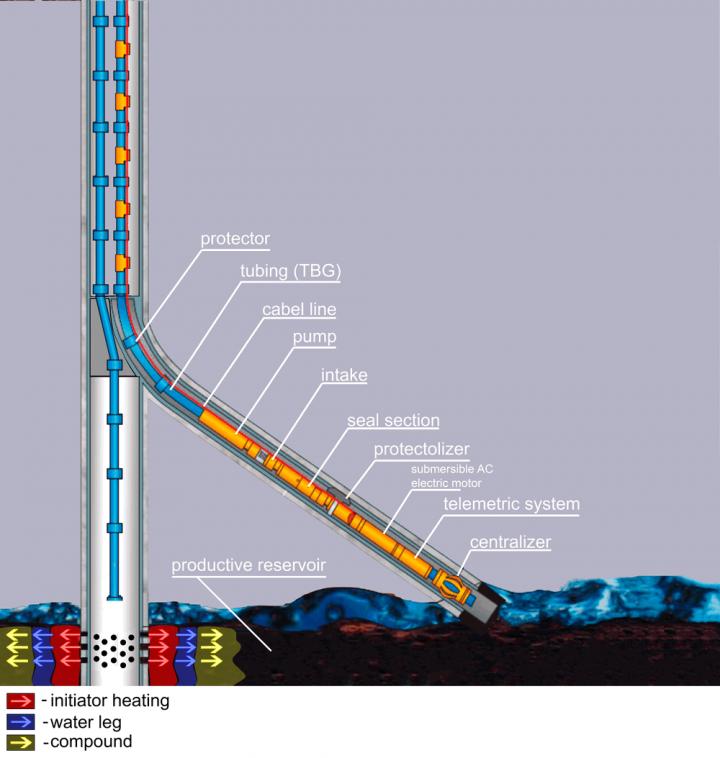
Recently in Russia there has been a significant increase in the share of hard-to-recover oil reserves – these are high-viscosity hydrocarbons or reserves in low-permeability reservoirs (porous or fractured rock). Typically, thermal and chemical methods are used to extract such oil, often in combination with each other. However, the cases of using the thermal methods ones are rather frequent as the only effective, even though high temperatures can damage the formation. The technology of a dual-well system, suggested by the research team that includes a graduate student of Samara Polytech Sergey Gubanov, will help to avoid this. The latest research results are published in the Journal of Petroleum Science and Engineering (doi.org/10.1016/j.petrol.2020.107554).

“Through one shaft we will heat the formation, and through the other one we will obtain oil”, Sergey Gubanov, a graduate student of the Department of Development and Operation of Oil and Gas Fields of Samara Polytech explains. “This technology will significantly increase the process of “difficult” oil recovery and reduce the cost of traditional wells construction”.

The economic benefit of the Polytech methodology is based on the fact that it’s not the steam that is injected into the formation in order to heat it and liquefy oil (dissolving heavy components in it), as provided by the traditional technology, but the special organic compounds that are capable of heating the reservoir up to 110-130 ° C by interacting with each other. The technology does not require a large amount of specialized equipment. In addition, the use of exclusively organic substances makes the technology quite environmentally friendly.

“Of course, my cherished dream is to obtain an artificial oil – to learn how to create it in the laboratory conditions in order to stop “picking” the Earth and use the oil not as a raw material. Indeed, for example, high-viscosity and bituminous oils contain rare earth metals such as vanadium and nickel. As Mendeleev said, ‘burning oil is the same as burning banknotes’,” the young scientist shares his plans.

The research on the development of oil production technology using the dual-well system is carried out with the financial support of the RFBR.

###

For reference:

Samara State Technical University (SSTU, Samara Polytech) as a flagship university offers a wide range of education and research programs and aims at development and transfer of high-quality and practically-oriented knowledge. The university has an established reputation in technical developments and focuses on quality education, scientific and pragmatic research, combining theory and practice in the leading regional businesses and enterprises. Education is conducted in 30 integrated groups of specialties and areas of training (about 200 degree programs including bachelor, master programs and 55 PhD programs) such as oil and gas, chemistry and petrochemistry, mechanics and energy, transportation, food production, defense, IT, mechanical and automotive engineering, engineering systems administration and automation, material science and metallurgy, biotechnology, industrial ecology, architecture, civil engineering and design, etc.

Media Contact
Roman Naumov
[email protected]

Tags: Earth ScienceEnergy SourcesGeology/SoilResearch/Development
Share12Tweet8Share2ShareShareShare2

Related Posts

New Review Explores Electrolyte Design Strategies to Enhance Stability of Lithium Metal Battery Interfaces — Chemistry

New Review Explores Electrolyte Design Strategies to Enhance Stability of Lithium Metal Battery Interfaces

May 8, 2026
Unlocking Aptamer Diversity via DNA Barcodes — Chemistry

Unlocking Aptamer Diversity via DNA Barcodes

May 8, 2026

Review Highlights Overlooked Health Risks of Wildfire Smoke

May 7, 2026

BMFTR Awards Multi-Million Funding for Fusion Research – Dr. Yannik Zobus of GSI/FAIR Leads New Young Investigators Group

May 7, 2026
Please login to join discussion

POPULAR NEWS

  • Research Indicates Potential Connection Between Prenatal Medication Exposure and Elevated Autism Risk

    837 shares
    Share 335 Tweet 209
  • New Study Reveals Plants Can Detect the Sound of Rain

    725 shares
    Share 290 Tweet 181
  • Scientists Investigate Possible Connection Between COVID-19 and Increased Lung Cancer Risk

    68 shares
    Share 27 Tweet 17
  • Salmonella Haem Blocks Macrophages, Boosts Infection

    61 shares
    Share 24 Tweet 15

About

We bring you the latest biotechnology news from best research centers and universities around the world. Check our website.

Follow us

Recent News

Nanoscale Directional Dark Field X-Ray Microscopy

Turning Forestry and Farms Toward Conservation in Southeast Asia

Loneliness Among Older Chinese Adults: Key Risk Factors

Subscribe to Blog via Email

Enter your email address to subscribe to this blog and receive notifications of new posts by email.

Join 82 other subscribers
  • Contact Us

Bioengineer.org © Copyright 2023 All Rights Reserved.

Welcome Back!

Login to your account below

Forgotten Password?

Retrieve your password

Please enter your username or email address to reset your password.

Log In
No Result
View All Result
  • Homepages
    • Home Page 1
    • Home Page 2
  • News
  • National
  • Business
  • Health
  • Lifestyle
  • Science

Bioengineer.org © Copyright 2023 All Rights Reserved.