• HOME
  • NEWS
  • EXPLORE
    • CAREER
      • Companies
      • Jobs
    • EVENTS
    • iGEM
      • News
      • Team
    • PHOTOS
    • VIDEO
    • WIKI
  • BLOG
  • COMMUNITY
    • FACEBOOK
    • INSTAGRAM
    • TWITTER
Wednesday, June 24, 2026
BIOENGINEER.ORG
No Result
View All Result
  • Login
  • HOME
  • NEWS
  • EXPLORE
    • CAREER
      • Companies
      • Jobs
        • Lecturer
        • PhD Studentship
        • Postdoc
        • Research Assistant
    • EVENTS
    • iGEM
      • News
      • Team
    • PHOTOS
    • VIDEO
    • WIKI
  • BLOG
  • COMMUNITY
    • FACEBOOK
    • INSTAGRAM
    • TWITTER
  • HOME
  • NEWS
  • EXPLORE
    • CAREER
      • Companies
      • Jobs
        • Lecturer
        • PhD Studentship
        • Postdoc
        • Research Assistant
    • EVENTS
    • iGEM
      • News
      • Team
    • PHOTOS
    • VIDEO
    • WIKI
  • BLOG
  • COMMUNITY
    • FACEBOOK
    • INSTAGRAM
    • TWITTER
No Result
View All Result
Bioengineer.org
No Result
View All Result
Home NEWS Science News Biology

Safe distance: How to make sure our outdoor activities don’t harm wildlife

Bioengineer by Bioengineer
September 6, 2025
in Biology
Reading Time: 2 mins read
0
IMAGE
Share on FacebookShare on TwitterShare on LinkedinShare on RedditShare on Telegram

Spending time outdoors is good for a person’s body and soul, but how good is it for the wildlife around us?

Outdoor recreation has become a popular activity, especially in the midst of a pandemic, where access to indoor activities might be limited. Long known to have negative behavioural and physiological effects on wildlife, outdoor recreation is one of the biggest threats to protected areas. Human disturbance to animal habitats can lower their survival and reproduction rates, and ultimately shrink populations or eradicate them from areas where they would otherwise thrive. Still, park planners and natural resource managers often can’t find clear recommendations on how to limit these impacts.

A new scholarly article in the open-access, peer-reviewed journal Nature Conservation from researchers at the Wildlife Conservation Society looked at nearly 40 years of research on recreation impacts on wildlife to try to find the point where recreation starts to impact the wildlife around us. Knowing when and to what extent a species is being disturbed can ultimately allow for more informed and effective management decisions and increase the chances of its successful conservation.

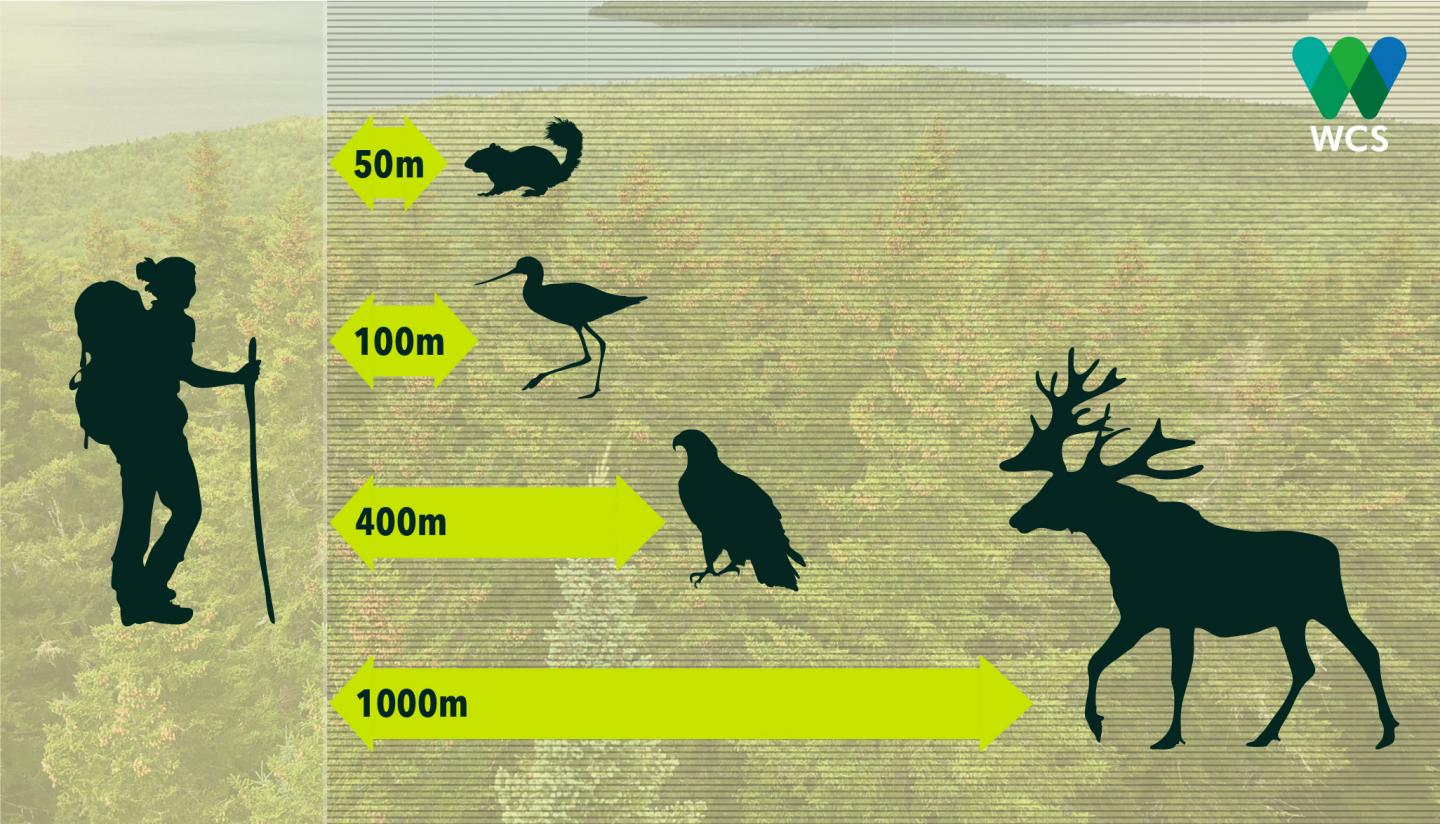
The researchers found that the impact or uncomfortable distance to humans, vehicles or trails for shorebirds and songbirds was as short as 100 meters or even less, whereas for hawks and eagles it was greater than 400 meters. For mammals, it varied even more widely, with an impact threshold of 50 meters for medium-sized rodents. Large ungulates – like elk – would rather have to stay 500 to 1,000 meters away from people.

While human disturbance thresholds can vary widely, large buffer zones around human activities and controlled visitation limits should always be considered during planning and maintenance of parks and protected areas. Based on their findings, the authors recommend that human activities should be considered to be impacting wildlife at least 250 metres away. Further, they call for future research to explicitly identify points where recreation begins or ends to impact wildlife.

###

Dertien JS, Larson CL, Reed SE (2021) Recreation effects on wildlife: a review of potential quantitative thresholds. Nature Conservation 44: 51-68. https://doi.org/10.3897/natureconservation.44.63270

Media Contact
Jeremy Dertien
[email protected]

Related Journal Article

http://dx.doi.org/10.3897/natureconservation.44.63270

Tags: Animal Behavior PreservationBiologyEcology/EnvironmentHuman Disturbance ThresholdsOutdoor Recreation ImpactProtected Areas Managementwildlife conservation
Share12Tweet8Share2ShareShareShare2

Related Posts

Decades of Data Reveal Which Orcas Call Puget Sound Home

June 24, 2026
Copal Tree Genetics Reveal Tropical Forest Connectivity — Biology

Copal Tree Genetics Reveal Tropical Forest Connectivity

June 24, 2026

How Intestinal Mucus Influences Klebsiella pneumoniae Colonization and Antibiotic Effectiveness

June 24, 2026

From Darkness to Light: How Blind Mexican Cavefish Reveal Brain Evolution

June 24, 2026
Please login to join discussion

POPULAR NEWS

  • Saying Goodbye to PGY-6: Pediatric Fellowship Realities

    103 shares
    Share 41 Tweet 26
  • Multi-Hospital Study Reveals Long Covid Burden Is Twice as High as Current Estimates

    92 shares
    Share 36 Tweet 23
  • Detection of EDCs in Breast Milk and Infant Urine Up to Six Months Highlights Early Exposure Risks

    77 shares
    Share 31 Tweet 19
  • New Drug Candidate Developed at McMaster Shows Potential for Treating Brain Cancer

    58 shares
    Share 23 Tweet 15

About

We bring you the latest biotechnology news from best research centers and universities around the world. Check our website.

Follow us

Recent News

Late Neanderthal Genetic Diversity in Northwest Europe

Global Mining Threatens Forest Conservation Inside, Outside Protected Areas

Gene Variant rs11030119 Impacts BDNF Platelet Function

Subscribe to Blog via Email

Enter your email address to subscribe to this blog and receive notifications of new posts by email.

Join 82 other subscribers
  • Contact Us

Bioengineer.org © Copyright 2023 All Rights Reserved.

Welcome Back!

Login to your account below

Forgotten Password?

Retrieve your password

Please enter your username or email address to reset your password.

Log In
No Result
View All Result
  • Homepages
    • Home Page 1
    • Home Page 2
  • News
  • National
  • Business
  • Health
  • Lifestyle
  • Science

Bioengineer.org © Copyright 2023 All Rights Reserved.