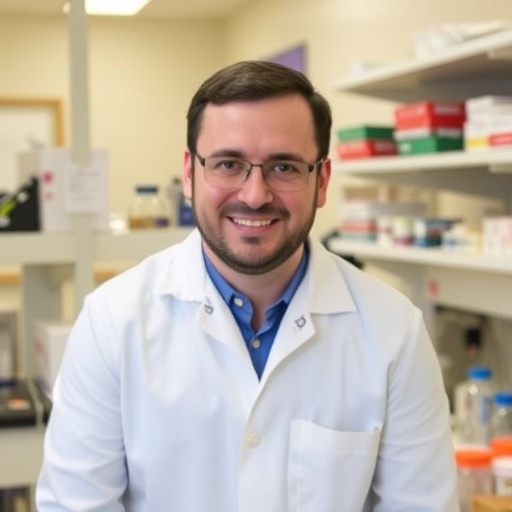
In a monumental leap for inorganic chemistry, researchers from Saarland University have succeeded in synthesizing pentasilacyclopentadienide—a silicon-based aromatic compound that has eluded chemists for decades. This breakthrough marks a pivotal advancement in the realm of organosilicon chemistry, expanding the boundaries of molecular design by substituting carbon atoms in aromatic systems with silicon, a significantly more metallic element. The significance of this achievement lies not only in its synthetic challenge but in the potential for new catalysts and materials with unprecedented properties.
Aromatic compounds have long held a cornerstone position in chemistry due to their exceptional stability, governed by delocalized electrons residing evenly over carbon rings. Classic examples include benzene and cyclopentadienide, whose planar ring structures and conjugated pi-electron clouds obey the well-established Hückel’s rule. This rule dictates that planar cyclic molecules with (4n + 2) π electrons exhibit aromaticity—imbuing them with remarkable chemical resilience and unique reactivity patterns.
Nevertheless, replacing carbon atoms in aromatic rings with silicon atoms has historically been a formidable challenge. Silicon’s larger atomic radius and markedly different electron affinity greatly complicate the formation of stable, planar aromatic rings. Previous successes in organosilicon chemistry had been limited to smaller ring systems, notably the aromatic silicon analogue of cyclopropenium, synthesized in 1981. Attempts to scale these efforts to larger silicon-based rings had repeatedly stalled due to the inherent instability and reactivity of silicon clusters.
The research team led by Professor David Scheschkewitz, along with doctoral researcher Ankur and crystallographer Bernd Morgenstern, has now overturned this long-standing obstacle. Their synthesis of pentasilacyclopentadienide, a five-membered silicon ring exhibiting Hückel aromaticity, represents an unprecedented milestone. Crucially, the newly formed ring maintains planarity—a characteristic essential for the delocalization of electrons responsible for aromatic stability—despite the intrinsic challenges posed by silicon’s atomic nature.
This accomplishment was facilitated through meticulous design of reaction pathways and careful control of reaction conditions, coupled with high-resolution X-ray diffraction methods to conclusively characterize the molecular architecture. Bernd Morgenstern’s expertise in X-ray crystallography affirmed the planar structure and delocalized electron density consistent with aromatic character, validating the experimental success at an atomic level.
The implications of this finding stretch far beyond academic curiosity. Aromatic systems underpin numerous industrial processes, notably in catalysis for polymer production such as polyethylene and polypropylene manufacturing. Silicon’s more metallic behavior suggests that its aromatic analogues might exhibit very different electronic and catalytic properties compared to traditional carbon-based counterparts. This could herald the advent of novel catalysts with enhanced durability, tunability, and reactivity tailored for industrially relevant chemical transformations.
Interestingly, the synthesis reported by the Saarland group coincides with a near-simultaneous discovery achieved by Takeaki Iwamoto’s laboratory at Tohoku University, Japan. The two teams, upon recognizing this synchronicity, coordinated to publish their findings simultaneously in the prestigious journal Science, underscoring the global significance and validation of the discovery.
At the core of the excitement lies the unusual positioning of pentasilacyclopentadienide within the delicate balance of resonance and equilibrium. Unlike conventional organics, the silicon ring straddles the edge between different resonance structures, offering a unique glimpse into chemical bonding phenomena at this frontier. Such insights pave the path to deeper fundamental understanding of aromaticity and its modulation via element substitution.
From a technological perspective, access to silicon-based aromatics opens avenues for designing entirely new materials with tailored electronic, optical, and mechanical properties. Potential applications range from advanced semiconductor development to smart materials whose behavior can be finely tuned by altering the silicon ring framework. This landmark discovery could catalyze shifts in how chemists conceptualize molecular architecture and functional materials.
The journey to this breakthrough underscores the interplay between theoretical prediction and experimental perseverance. While the concept of silicon-based aromatics existed in scientific speculation, realizing them in the laboratory demanded innovations in synthetic protocols and characterization techniques. The collaborative synergy between synthetic chemists and crystallographers was indispensable in elucidating the molecular structures that had long remained hypothetical.
Moreover, this work reinvigorates research into heavier element analogues of classical organic molecules, encouraging the scientific community to rethink established paradigms. It challenges assumptions about aromatic stability and electron delocalization beyond carbon frameworks, potentially reshaping curricula and inspiring a new generation of chemists.
In conclusion, the synthesis of pentasilacyclopentadienide by Scheschkewitz, Ankur, and Morgenstern stands as a landmark achievement in chemistry—a testament to human ingenuity and the relentless pursuit of knowledge. This accomplishment not only solves a decades-old puzzle but opens a frontier brimming with scientific and technological potential, underscoring the profound impact of fundamental research on future innovation.
Subject of Research: Not applicable
Article Title: Pentasilacyclopentadienide: A Hückel aromatic species at the border of resonance and equilibrium
News Publication Date: 5-Feb-2026
Web References: DOI: 10.1126/science.aed1802
Image Credits: Thorsten Mohr/Saarland University
Keywords
Pentasilacyclopentadienide, silicon aromatic compounds, organosilicon chemistry, Hückel aromaticity, aromaticity, silicon ring synthesis, molecular stability, X-ray crystallography, chemical catalysis, polymer production, resonance structures, inorganic chemistry breakthrough
Tags: aromatic compound stabilitychallenges in silicon aromaticitydelocalized electrons in siliconHückel’s rule applicationinnovative materials from silicon chemistrymolecular design in inorganic chemistrynew catalysts from silicon compoundsorganosilicon chemistry advancementspentasilacyclopentadienide synthesisSaarbrücken chemistry breakthroughsilicon atom substitution in ringssilicon-based aromatic compounds