

• HOME
  • NEWS
  • EXPLORE
    • CAREER
      • Companies
      • Jobs
    • EVENTS
    • iGEM
      • News
      • Team
    • PHOTOS
    • VIDEO
    • WIKI
  • BLOG
  • COMMUNITY
    • FACEBOOK
    • INSTAGRAM
    • TWITTER
Friday, May 22, 2026
BIOENGINEER.ORG
No Result
View All Result
  • Login
  • HOME
  • NEWS
  • EXPLORE
    • CAREER
      • Companies
      • Jobs
        • Lecturer
        • PhD Studentship
        • Postdoc
        • Research Assistant
    • EVENTS
    • iGEM
      • News
      • Team
    • PHOTOS
    • VIDEO
    • WIKI
  • BLOG
  • COMMUNITY
    • FACEBOOK
    • INSTAGRAM
    • TWITTER
  • HOME
  • NEWS
  • EXPLORE
    • CAREER
      • Companies
      • Jobs
        • Lecturer
        • PhD Studentship
        • Postdoc
        • Research Assistant
    • EVENTS
    • iGEM
      • News
      • Team
    • PHOTOS
    • VIDEO
    • WIKI
  • BLOG
  • COMMUNITY
    • FACEBOOK
    • INSTAGRAM
    • TWITTER
No Result
View All Result
Bioengineer.org
No Result
View All Result
Home NEWS Science News Biology

Rutgers researchers develop automated robotic device for faster blood testing

Bioengineer by Bioengineer
June 13, 2018
in Biology
Reading Time: 2 mins read
0
Share on FacebookShare on TwitterShare on LinkedinShare on RedditShare on Telegram
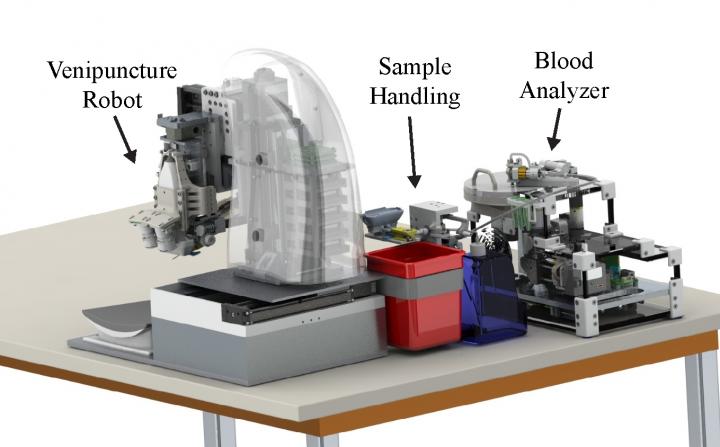
IMAGE

Credit: Max Balter

Rutgers researchers have created an automated blood drawing and testing device that provides rapid results, potentially improving the workflow in hospitals and other health-related institutions to allow health care practitioners to spend more time treating patients.

A study describing the fully automated device is published online in the journal TECHNOLOGY.

"This device represents the holy grail in blood testing technology," said Martin L. Yarmush, senior author of the study and Paul & Mary Monroe Endowed Chair & Distinguished Professor in the Department of Biomedical Engineering at Rutgers University-New Brunswick. "Integrating miniaturized robotic and microfluidic (lab-on-a-chip) systems, this technology combines the breadth and accuracy of traditional blood drawing and laboratory testing with the speed and convenience of point-of-care testing."

Diagnostic blood testing is the most commonly performed clinical procedure in the world, and it influences most of the medical decisions made in hospitals and laboratories. But the success rate of manually drawing blood samples depends on clinicians' skill and patient physiology, and nearly all test results come from centralized labs that handle large numbers of samples and use labor-intensive analytical techniques.

So, a Rutgers biomedical engineering research team created a device that includes an image-guided robot for drawing blood from veins, a sample-handling module and a centrifuge-based blood analyzer. Their device provides highly accurate results from a white blood cell test, using a blood-like fluid spiked with fluorescent microbeads. The testing used artificial arms with plastic tubes that served as blood vessels. The device could provide rapid test results at bedsides or in ambulances, emergency rooms, clinics and doctors' offices.

"When designing the system, our focus was on creating a modular and expandable device," said Max Balter, who led the study and holds a doctorate in biomedical engineering from Rutgers. "With our relatively simple chip design and analysis techniques, the device can be extended to incorporate a broader panel of tests in the future."

###

Study co-authors include doctoral student Josh Leipheimer; Alvin Chen, who received his doctorate in biomedical engineering; and Anil Shrirao and Tim Maguire, both assistant research professors in biomedical engineering.

Media Contact

Todd Bates
[email protected]
848-932-0550
@RutgersU

http://www.rutgers.edu

Original Source

https://news.rutgers.edu/rutgers-researchers-develop-automated-robotic-device-faster-blood-testing/20180612#.Wx_OvO4vy70 http://dx.doi.org/10.1142/S2339547818500048


Share24Tweet8Share2ShareShareShare2

Related Posts

How the Gut Reprograms the Brain to Crave Essential Nutrients — Biology

How the Gut Reprograms the Brain to Crave Essential Nutrients

May 22, 2026
Decoding the Mechanisms Behind Collective Cell Movement — Biology

Decoding the Mechanisms Behind Collective Cell Movement

May 22, 2026

Harvard Scientists Develop Innovative Methods to Detect the Body’s “Orphan” Signaling Receptors

May 22, 2026

Seasonal Lake Denitrification Shifts Amid Climate Warming

May 22, 2026
Please login to join discussion

POPULAR NEWS

  • blank

    New Study Reveals Plants Can Detect the Sound of Rain

    734 shares
    Share 293 Tweet 183
  • ESMO 2025: mRNA COVID Vaccines Enhance Efficacy of Cancer Immunotherapy

    310 shares
    Share 124 Tweet 78
  • Research Indicates Potential Connection Between Prenatal Medication Exposure and Elevated Autism Risk

    847 shares
    Share 339 Tweet 212
  • Breastmilk Balances E. coli and Beneficial Bacteria in Infant Gut Microbiomes

    58 shares
    Share 23 Tweet 15

About

We bring you the latest biotechnology news from best research centers and universities around the world. Check our website.

Follow us

Recent News

Stable Circulating Proteins in Older Adults Over Time

Engineered Superconducting Diamonds Pave Way for Multi-Modality Quantum Chips, Researchers Reveal

Global Rice Paddy Emissions Double in Six Decades

Subscribe to Blog via Email

Enter your email address to subscribe to this blog and receive notifications of new posts by email.

Join 82 other subscribers
  • Contact Us

Bioengineer.org © Copyright 2023 All Rights Reserved.

Welcome Back!

Login to your account below

Forgotten Password?

Retrieve your password

Please enter your username or email address to reset your password.

Log In
No Result
View All Result
  • Homepages
    • Home Page 1
    • Home Page 2
  • News
  • National
  • Business
  • Health
  • Lifestyle
  • Science

Bioengineer.org © Copyright 2023 All Rights Reserved.
