• HOME
  • NEWS
  • EXPLORE
    • CAREER
      • Companies
      • Jobs
    • EVENTS
    • iGEM
      • News
      • Team
    • PHOTOS
    • VIDEO
    • WIKI
  • BLOG
  • COMMUNITY
    • FACEBOOK
    • INSTAGRAM
    • TWITTER
Friday, June 26, 2026
BIOENGINEER.ORG
No Result
View All Result
  • Login
  • HOME
  • NEWS
  • EXPLORE
    • CAREER
      • Companies
      • Jobs
        • Lecturer
        • PhD Studentship
        • Postdoc
        • Research Assistant
    • EVENTS
    • iGEM
      • News
      • Team
    • PHOTOS
    • VIDEO
    • WIKI
  • BLOG
  • COMMUNITY
    • FACEBOOK
    • INSTAGRAM
    • TWITTER
  • HOME
  • NEWS
  • EXPLORE
    • CAREER
      • Companies
      • Jobs
        • Lecturer
        • PhD Studentship
        • Postdoc
        • Research Assistant
    • EVENTS
    • iGEM
      • News
      • Team
    • PHOTOS
    • VIDEO
    • WIKI
  • BLOG
  • COMMUNITY
    • FACEBOOK
    • INSTAGRAM
    • TWITTER
No Result
View All Result
Bioengineer.org
No Result
View All Result
Home NEWS Science News

Russian scientists have found a way to make laser optics more effective and cheaper

Bioengineer by Bioengineer
December 20, 2019
in Science News
Reading Time: 2 mins read
0
IMAGE
Share on FacebookShare on TwitterShare on LinkedinShare on RedditShare on Telegram

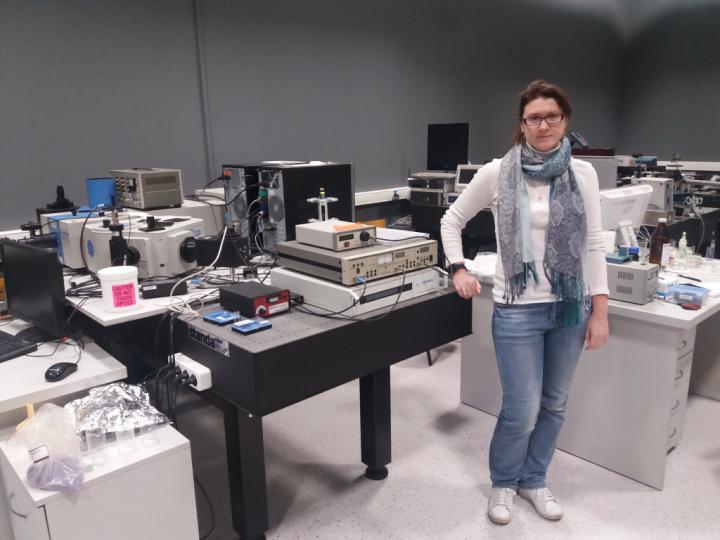
The research team of the IKBFU developed a fundamentally new method of manufacturing laser optics, which is based on the use of rare-earth metal ions of ytterbium and its oxide
IMAGE

Credit: Immanuel Kant Baltic Federal University


The research team of the IKBFU developed a fundamentally new method of manufacturing laser optics, which is based on the use of rare-earth metal ions of ytterbium and its oxide. The results of the work of scientists were recently published in the scientific journal Optics Communications.

Senior Researcher of the “Fabrika” Science and Technology Park, Ph.D. in Physics Anna Tsibulnikova told us:

“During the experiments, it was found that the trivalent ytterbium ion, interacting with the same ion, glows red under infrared radiation. Previously, such a glow mechanism was observed only in systems containing several ions of various rare earth elements. For example, ytterbium, thulium, holmium, erbium. This means that it has become possible to significantly simplify and cheapen the production of laser optics. Rare earth metals are very expensive material, so using only ytterbium oxide in the production of laser media can provide significant savings”

However, the new method is not only good for this. According to Anna Tsibulnikova, the obtained fine powder is easily incorporated into the glass medium, giving it new optical properties. And its ability to withstand ultra-high temperatures (up to a thousand degrees Celsius) and low temperatures (77K) allows generation of powerful red laser radiation.

The scientist thinks that the new technologies may be used not only in laser construction but also in night-vision goggles production. Powdered on the basis of ytterbium oxide, the powder will be able to generate a strong stream of red light, which will make the image much sharper than in devices whose lenses are made using traditional technologies.

The creation of this “Wonder Powder” was possible thanks to cutting-edge equipment of the “Fabrika” Science and Technology Park. Now the IKBFU scientists work on creating new optical environments, that will increase the power of lasers. New discoveries and publications are yet to come.

###

Media Contact
Sergey Bulanov
[email protected]
7-921-268-5362

Original Source

http://eng.kantiana.ru/news/261159/

Related Journal Article

http://dx.doi.org/10.1016/j.optcom.2019.125006

Tags: Electrical Engineering/ElectronicsHardwareTechnology/Engineering/Computer ScienceTheory/Design
Share12Tweet8Share2ShareShareShare2

Related Posts

Tracking Lanthanide-Labeled Microplastics in Plants

June 25, 2026

POSTECH Researchers Slash Cost of Reconstituted Cell-Free Systems by 95%

June 25, 2026

AI and Physics Collaborate to Design Advanced Hydrogen Storage Materials

June 25, 2026

Natural Hallucinogens: Evolution’s Ecological Tools, Not Mere Chemical Byproducts

June 25, 2026
Please login to join discussion

POPULAR NEWS

  • Saying Goodbye to PGY-6: Pediatric Fellowship Realities

    103 shares
    Share 41 Tweet 26
  • Multi-Hospital Study Reveals Long Covid Burden Is Twice as High as Current Estimates

    92 shares
    Share 36 Tweet 23
  • Detection of EDCs in Breast Milk and Infant Urine Up to Six Months Highlights Early Exposure Risks

    77 shares
    Share 31 Tweet 19
  • New Drug Candidate Developed at McMaster Shows Potential for Treating Brain Cancer

    58 shares
    Share 23 Tweet 15

About

We bring you the latest biotechnology news from best research centers and universities around the world. Check our website.

Follow us

Recent News

Tracking Lanthanide-Labeled Microplastics in Plants

POSTECH Researchers Slash Cost of Reconstituted Cell-Free Systems by 95%

AI and Physics Collaborate to Design Advanced Hydrogen Storage Materials

Subscribe to Blog via Email

Success! An email was just sent to confirm your subscription. Please find the email now and click 'Confirm' to start subscribing.

Join 82 other subscribers
  • Contact Us

Bioengineer.org © Copyright 2023 All Rights Reserved.

Welcome Back!

Login to your account below

Forgotten Password?

Retrieve your password

Please enter your username or email address to reset your password.

Log In
No Result
View All Result
  • Homepages
    • Home Page 1
    • Home Page 2
  • News
  • National
  • Business
  • Health
  • Lifestyle
  • Science

Bioengineer.org © Copyright 2023 All Rights Reserved.