Credit: RUDN University
Mathematicians from RUDN University suggested and tested a new method to assess the productivity of fifth-generation (5G) base stations. The new technology would help get rid of mobile access stations and even out traffic fluctuations. The results of the study were published in the IEEE Conference Publication.
Stations of the new 5G New Radio (NR) communication standard developed by the 3GPP consortium are expected to shortly be installed in large quantities all over the world. First of all, the stations will be deployed in places with high traffic use and at public event locations (e.g. shopping malls, city squares, or stadiums). In these conditions, the number of active communication sessions continually changes, and such traffic fluctuations can dramatically reduce network capacity. Traditionally, this issue has been solved with mobile stations (drones or cars), but they cannot be used in a closed space such as a shopping mall. Moreover, they are unable to even out traffic fluctuations on the sub-minute scale (i.e. within periods less than 1 minute). A team of mathematicians from RUDN University suggested a 5G network deployment scheme that provides for the mitigation of traffic fluctuations on the sub-minute level and can be rolled out in closed spaces.
“The 5G NR technology promises exceptionally high speed on the final mile–a channel that connects a user’s device with a provider’s access point. The connection is expected to be extremely fast within the millimeter waves range. The new technology is supposed to satisfy the growing needs of users. Our approach could help deploy 5G in busy public places and effectively even out traffic fluctuations,” explained Anastasia Daraseliya, a postgraduate student at the Institute for Applied Mathematics and Telecommunications, RUDN University.
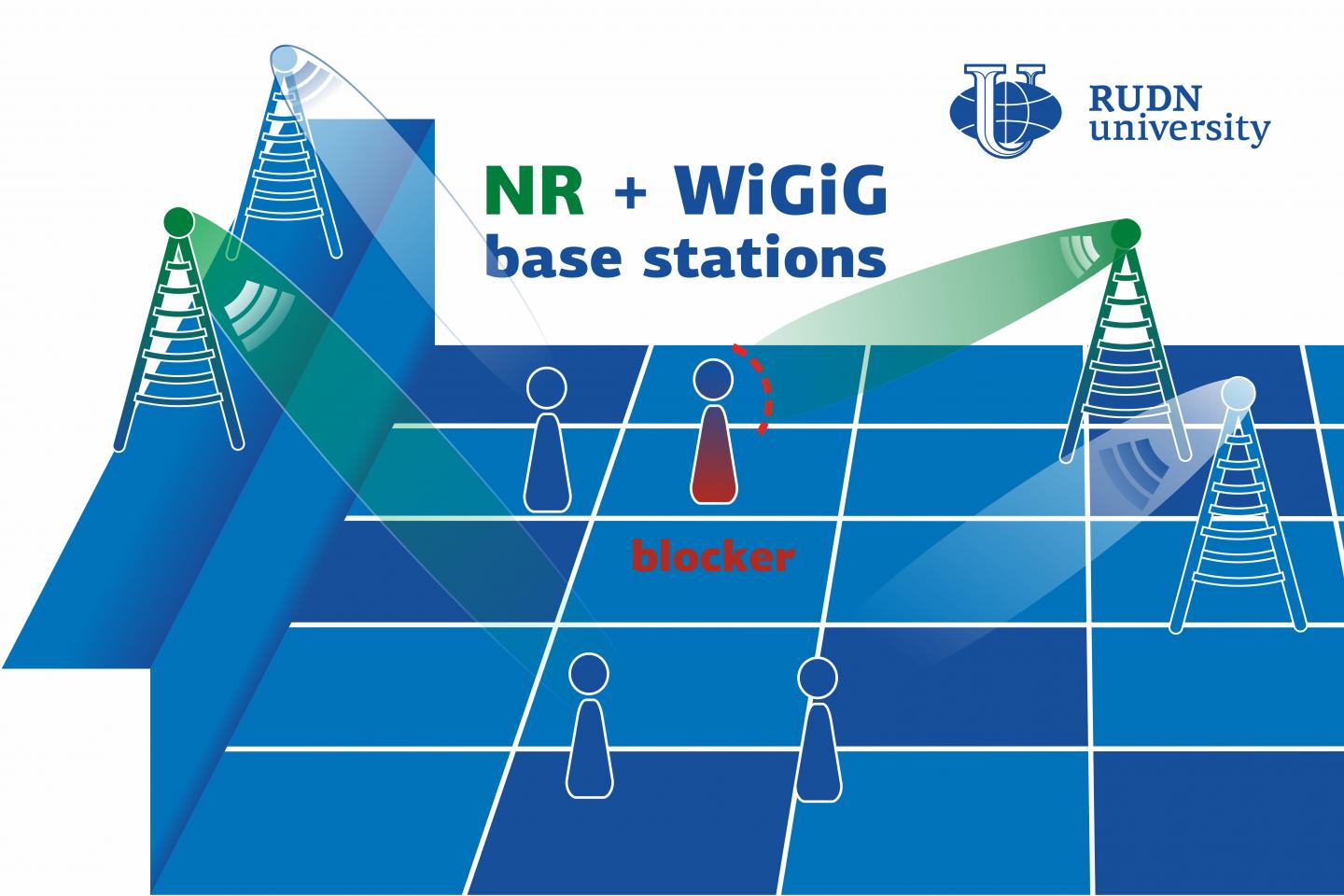
The idea suggested by RUDN mathematicians lies in using two technologies at once: NR and the so-called WiGig–60-gigahertz Wi-Fi with a data transmission rate up to 7 Gb/sec. By aggregating a licensed and a non-licensed band spectrum, one could shed some of the load to the non-licensed band and thus increase the transmission speed. Both technologies operate in the millimeter waves range and therefore are adjusted to each other by default. The team also assumed that both technologies would be widely supported by modern-day and future devices.
The team studied the joint user traffic query serving by base stations using a combination of NR and WiGig and analyzed the future applicability of this system. To do so, they used several methods of stochastic geometry, Markovian chain theory, and queueing theory. The team described the methodology of interaction between the two standards in one base station and concluded that the new approach would support continuous 5G communication in busy public places without losing transmission capacity even in cases of sub-minute traffic drops
“Having determined the density of base station and taking into account the density of user devices, we suggested a performance assessment structure for joint use of NR and WiGig. Although in the model the two systems are located close to each other, they do not exchange data. Therefore, such a structure can be deployed in any necessary configuration depending on conditions and requirements,” added Anastasia Daraseliya from RUDN Unviersity.
###
Media Contact
Valeriya Antonova
[email protected]
Related Journal Article
http://dx.