• HOME
  • NEWS
  • EXPLORE
    • CAREER
      • Companies
      • Jobs
    • EVENTS
    • iGEM
      • News
      • Team
    • PHOTOS
    • VIDEO
    • WIKI
  • BLOG
  • COMMUNITY
    • FACEBOOK
    • INSTAGRAM
    • TWITTER
Thursday, May 21, 2026
BIOENGINEER.ORG
No Result
View All Result
  • Login
  • HOME
  • NEWS
  • EXPLORE
    • CAREER
      • Companies
      • Jobs
        • Lecturer
        • PhD Studentship
        • Postdoc
        • Research Assistant
    • EVENTS
    • iGEM
      • News
      • Team
    • PHOTOS
    • VIDEO
    • WIKI
  • BLOG
  • COMMUNITY
    • FACEBOOK
    • INSTAGRAM
    • TWITTER
  • HOME
  • NEWS
  • EXPLORE
    • CAREER
      • Companies
      • Jobs
        • Lecturer
        • PhD Studentship
        • Postdoc
        • Research Assistant
    • EVENTS
    • iGEM
      • News
      • Team
    • PHOTOS
    • VIDEO
    • WIKI
  • BLOG
  • COMMUNITY
    • FACEBOOK
    • INSTAGRAM
    • TWITTER
No Result
View All Result
Bioengineer.org
No Result
View All Result
Home NEWS Science News Chemistry

RUDN University chemists found a way to increase the efficiency of metathesis reactions

Bioengineer by Bioengineer
March 24, 2021
in Chemistry
Reading Time: 2 mins read
0
IMAGE
Share on FacebookShare on TwitterShare on LinkedinShare on RedditShare on Telegram

IMAGE

Credit: RUDN University

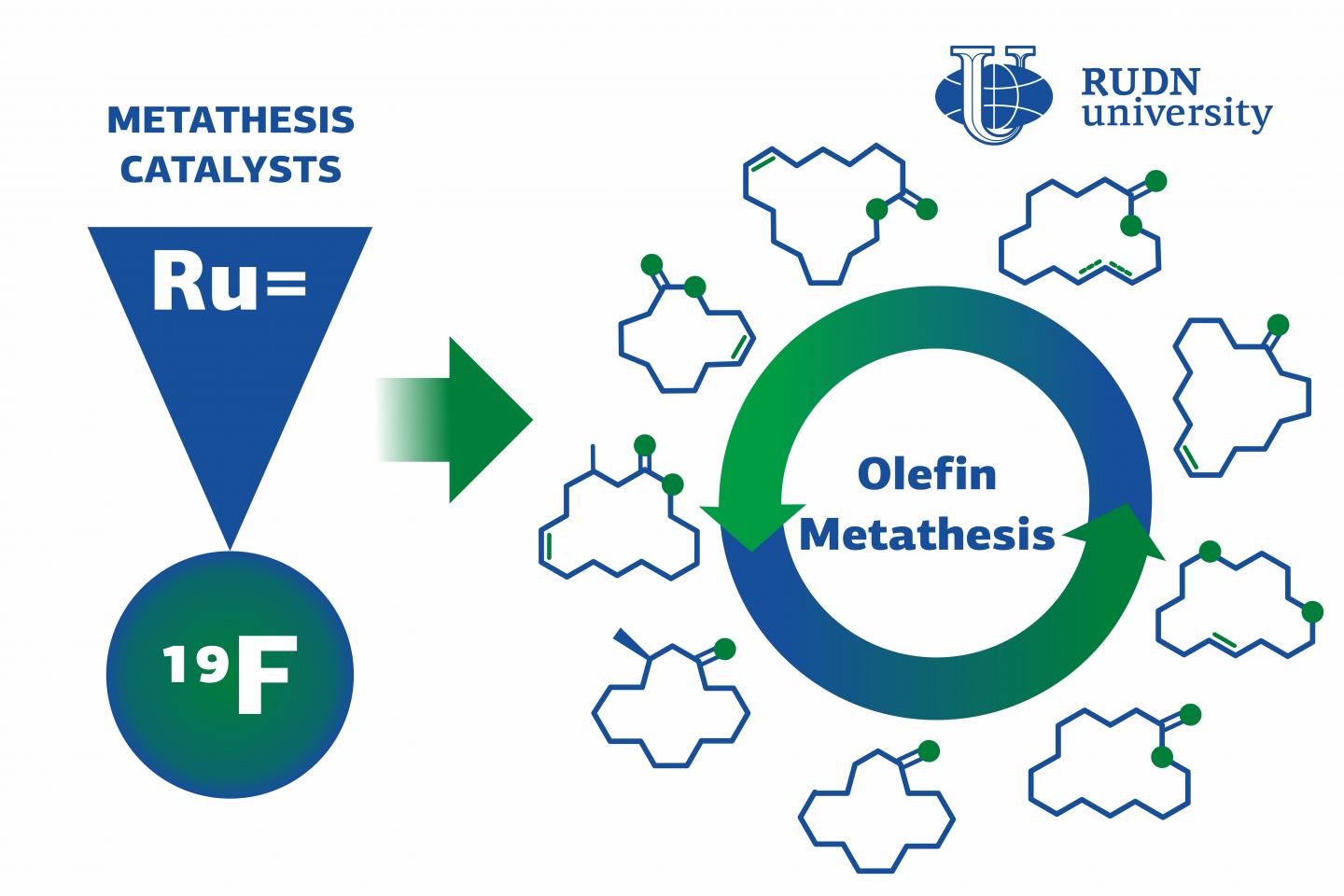
Chemists from RUDN University found out that fluorine and fluoroalkyl groups increase the efficiency of catalysts in metathesis reactions that are used in the pharmaceutical industry and polymer chemistry. The team also identified fluorine-containing compounds that can simplify the purification of the catalyst from the reaction product, making it reusable. The results of the study were published in the Russian Chemical Reviews journal.

Many medicinal drugs and polymers are based on olefins, organic compounds with a double bond between carbon atoms. To obtain useful substances from them, scientists used the metathesis reaction. In the course of metathesis, double bonds in the molecules are broken, and groups of different molecules attached to them are redistributed. However, this reaction requires powerful catalysts called ruthenium-carbene complexes. A team of chemists from RUDN University found a way to increase their catalytic activity with fluorine. The results of their work could be used in the pharmaceutical industry and industrial chemistry.

“We studied the scientific literature and summarized the data on the methods of adding fluorine atoms and fluoroalkyl groups into different ligands. This technology is used to create ruthenium-carbene complexes that would be active in the metathesis reaction. We have also analyzed the catalytic activity of complexes with different additives,” said Sergey Osipov, PhD, researcher at the Joint Institute for Chemical Research, RUDN University.

Ruthenium-based complexes consist of the transition metal ruthenium and different types of ligands, including carbene ligands (unstable bivalent carbon compounds). When donor ligands react with the electrophilic atom of ruthenium, they bring the parts of the complex together. Electrophilicity is the ability to receive electrons, and it is this quality of the atom of ruthenium in the middle of a complex that determines the activity of a catalyst. The team summarized the data from other studies and found out that electrophilicity could be increased by adding fluorine to the ligands. This method works because both fluorine and fluoroalkyl groups that contain it have a high accepting ability.

By changing the types and structures of fluoroalkyl groups, one can create a catalyst with desired qualities. For example, when the team added fluorine to asymmetrical ligands, an additional reaction between ruthenium and the atom of fluorine was observed. It added stability to the whole complex and increased its catalytic activity. By adding polyfloroalkyl groups to ligands, one can simplify the purification of the catalyst from reaction products and make it reusable.

The results of the study can help chemists improve ruthenium-based catalysts by choosing specific floroalkyl additives for particular requirements.

“Fluorine in ligands speeds up the beginning of catalysis because the bond between ruthenium and the atom of ligand weakens in the course of metathesis. Moreover, adding polyfloroalkyl groups to ligands solves the issue of purification of the catalyst from reaction products. This way, an expensive catalyst can be reused several times,” added Sergey Osipov from RUDN University.

###

Media Contact
Valeriya Antonova
[email protected]

Related Journal Article

http://dx.doi.org/10.1070/RCR4984

Tags: Chemistry/Physics/Materials Sciences
Share12Tweet8Share2ShareShareShare2

Related Posts

Scientists Achieve Breakthrough in Molecular ‘Sandwich’ Assembly — Chemistry

Scientists Achieve Breakthrough in Molecular ‘Sandwich’ Assembly

May 21, 2026
Advancing In Vivo and In Situ Monitoring: Science Bulletin Highlights Host-Based Antifouling Gold Nanotube Sensor for Selective Detection of Mechanically Sensitive Serotonin Release in Intestinal Mucosa — Chemistry

Advancing In Vivo and In Situ Monitoring: Science Bulletin Highlights Host-Based Antifouling Gold Nanotube Sensor for Selective Detection of Mechanically Sensitive Serotonin Release in Intestinal Mucosa

May 20, 2026

How Magnetic Orientation Could Influence the Building Blocks of Life

May 20, 2026

Breaking a 200-Year-Old Belief: Novel Surface Design Achieves Two Distinct Wetting States on One Substrate

May 20, 2026
Please login to join discussion

POPULAR NEWS

  • blank

    New Study Reveals Plants Can Detect the Sound of Rain

    733 shares
    Share 292 Tweet 183
  • ESMO 2025: mRNA COVID Vaccines Enhance Efficacy of Cancer Immunotherapy

    304 shares
    Share 122 Tweet 76
  • Research Indicates Potential Connection Between Prenatal Medication Exposure and Elevated Autism Risk

    846 shares
    Share 338 Tweet 212
  • Breastmilk Balances E. coli and Beneficial Bacteria in Infant Gut Microbiomes

    58 shares
    Share 23 Tweet 15

About

We bring you the latest biotechnology news from best research centers and universities around the world. Check our website.

Follow us

Recent News

Innovative Reusable Brick Walls Revolutionize Construction Industry

Nonlinear Atomic Tunneling Enhanced by Bright Squeezed Vacuum

Label-Free Super-Resolution Imaging of Live Cells

Subscribe to Blog via Email

Enter your email address to subscribe to this blog and receive notifications of new posts by email.

Join 82 other subscribers
  • Contact Us

Bioengineer.org © Copyright 2023 All Rights Reserved.

Welcome Back!

Login to your account below

Forgotten Password?

Retrieve your password

Please enter your username or email address to reset your password.

Log In
No Result
View All Result
  • Homepages
    • Home Page 1
    • Home Page 2
  • News
  • National
  • Business
  • Health
  • Lifestyle
  • Science

Bioengineer.org © Copyright 2023 All Rights Reserved.