• HOME
  • NEWS
  • EXPLORE
    • CAREER
      • Companies
      • Jobs
    • EVENTS
    • iGEM
      • News
      • Team
    • PHOTOS
    • VIDEO
    • WIKI
  • BLOG
  • COMMUNITY
    • FACEBOOK
    • INSTAGRAM
    • TWITTER
Sunday, July 12, 2026
BIOENGINEER.ORG
No Result
View All Result
  • Login
  • HOME
  • NEWS
  • EXPLORE
    • CAREER
      • Companies
      • Jobs
        • Lecturer
        • PhD Studentship
        • Postdoc
        • Research Assistant
    • EVENTS
    • iGEM
      • News
      • Team
    • PHOTOS
    • VIDEO
    • WIKI
  • BLOG
  • COMMUNITY
    • FACEBOOK
    • INSTAGRAM
    • TWITTER
  • HOME
  • NEWS
  • EXPLORE
    • CAREER
      • Companies
      • Jobs
        • Lecturer
        • PhD Studentship
        • Postdoc
        • Research Assistant
    • EVENTS
    • iGEM
      • News
      • Team
    • PHOTOS
    • VIDEO
    • WIKI
  • BLOG
  • COMMUNITY
    • FACEBOOK
    • INSTAGRAM
    • TWITTER
No Result
View All Result
Bioengineer.org
No Result
View All Result
Home NEWS Science News Chemistry

RUDN University chemist created coordination polymers with up to 99.99% antibacterial efficiency

Bioengineer by Bioengineer
September 6, 2025
in Chemistry
Reading Time: 2 mins read
0
IMAGE
Share on FacebookShare on TwitterShare on LinkedinShare on RedditShare on Telegram

RUDN University chemist with his colleagues from Portugal has developed two types of coating based on new coordination polymers with silver. Both compounds were successfully tested against four common pathogens. The results are published in ACS Publications (ACS Appl. Mater. Interfaces).

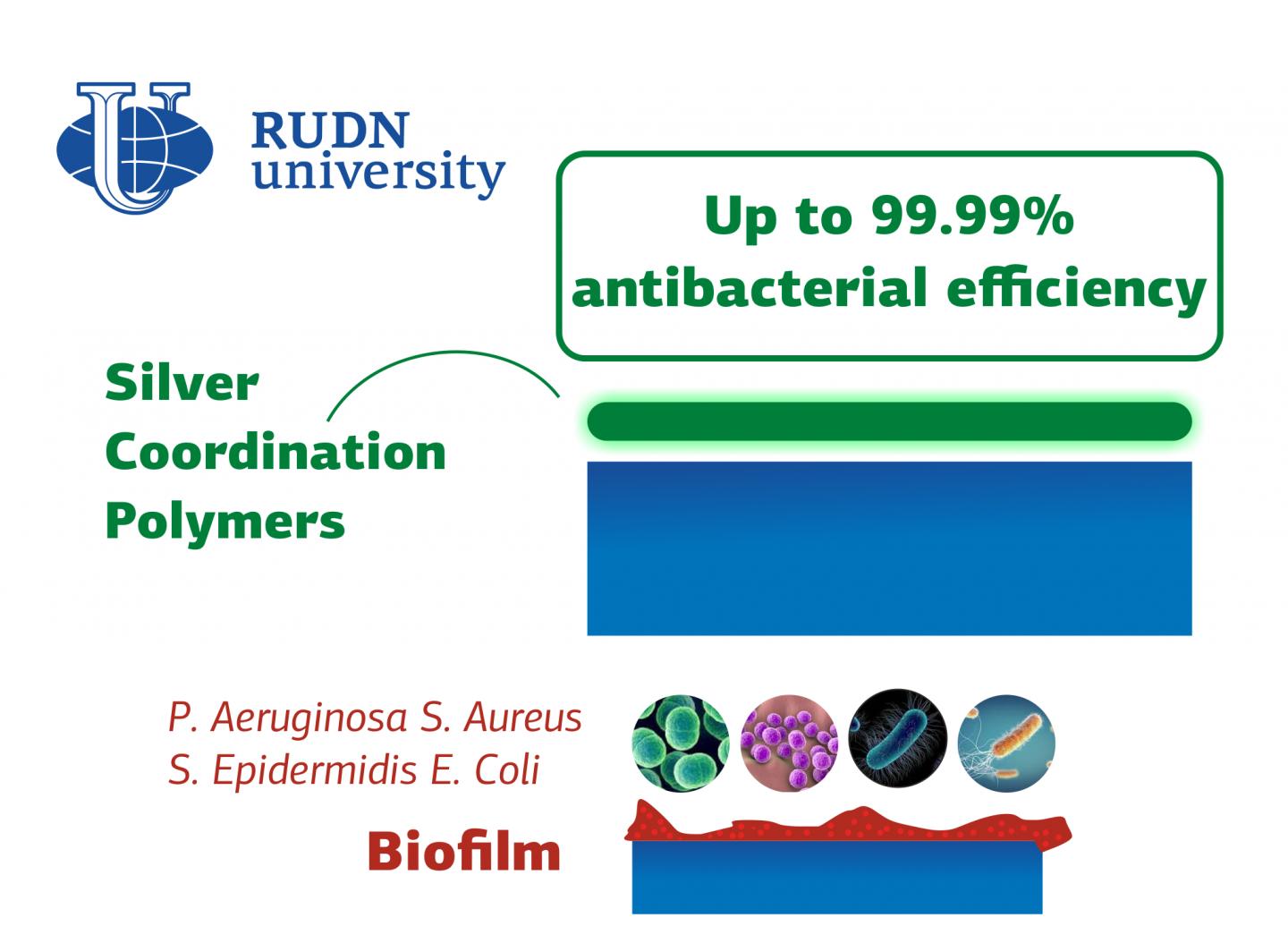
Due to the rapid mutation, harmful microorganisms constantly adapt to new antibiotics and antiseptics. It is especially difficult to destroy bacteria when they form a biofilm. They stick together and create a community ready to fight antimicrobial agents back. Coordination polymers (scaffolds made of metal ions and organic ligands) can solve this problem. They prevent pathogens from forming biofilms and replicating on the surfaces. RUDN University chemists have created two coordination polymers with silver ions with almost 100% antibacterial activity.

“We developed a synthesis protocol and described the characteristics and structural features of two new silver-based bioactive coordination polymers. We immobilized these compounds acrylated epoxidized soybean oil and created a hybrid material for antimicrobial use”, Alexander Kirillov, PhD, an associate of the Joint Institute for Chemical Studies at RUDN.

Coordination polymers consist of cyclic structures. Their central element is an atom or an ion. Scientists used silver nitrate and pyromellitic or trimesic acid to synthetise silver-based polymers. The polymers were obtained by self-assembly, it means that cyclic components themselves interacted to form a pattern which was then added to the substrate made of soybean oil. Chemists have created three types of films with different concentrations of the coordination polymer-0.05%, 0.1% and 0.5%.

RUDN chemists have tested whether the bacteria can form biofilms on surfaces that are coated with new polymers. For the experiment, they used four pathogens that can form biofilms in the human body and cause diseases. Staphylococcus epidermidis causes sepsis, endocarditis, conjunctivitis, Staphylococcus aureus causes purulent inflammatory processes in almost all organs and tissues, Pseudomonas aeruginosa is the agent of nosocomial infections in humans, and the mostly harmless Escherichia coli can sometimes cause severe food poisoning. The new polymers appeared to be active against all four bacteria. The effectiveness of protection depended on the concentration. One of the coatings proved to be more promising — a film with 0.05% of the active polymer destroyed 99.99% of the bacteria of all four species.

“Our work opens up antibiofilm applications of CP-doped biopolymers, providing new perspectives and very promising results for the design of functional biomaterials”, Alexander Kirillov, PhD, an associate of the Joint Institute for Chemical Studies at RUDN.

###

Media Contact
Valeriya Antonova
[email protected]

Related Journal Article

http://dx.doi.org/10.1021/acsami.0c19446

Tags: Chemistry/Physics/Materials Sciences
Share12Tweet8Share2ShareShareShare2

Related Posts

Blue Light and Chemistry Simplify Complex Drug Production Steps

Blue Light and Chemistry Simplify Complex Drug Production Steps

July 10, 2026
New Discovery Promises Brighter, More Energy-Efficient Digital Displays

New Discovery Promises Brighter, More Energy-Efficient Digital Displays

July 10, 2026

New Crystalline 3D Frameworks Linked by Spiroborates Developed

July 10, 2026

IBEC Joins Major European Grant on Living Matter Physics

July 10, 2026
Please login to join discussion

POPULAR NEWS

  • Detection of EDCs in Breast Milk and Infant Urine Up to Six Months Highlights Early Exposure Risks

    77 shares
    Share 31 Tweet 19
  • New Drug Candidate Developed at McMaster Shows Potential for Treating Brain Cancer

    58 shares
    Share 23 Tweet 15
  • KTU Researchers Explore Ultrasound’s Role in Enhancing Blood Flow Beyond Diagnostics

    53 shares
    Share 21 Tweet 13
  • 高齢者の骨粗鬆症治療の持続性比較

    51 shares
    Share 20 Tweet 13

About

We bring you the latest biotechnology news from best research centers and universities around the world. Check our website.

Follow us

Recent News

Nationwide Study Reveals Multimorbidity Factors in Older Chinese Adults

Clinicopathologic Study Reveals Amyloid Clearance in Alzheimer’s Disease

Long-Term Kidney Outcomes After Living Donation in Older Adults Explored

Subscribe to Blog via Email

Enter your email address to subscribe to this blog and receive notifications of new posts by email.

Join 85 other subscribers
  • Contact Us

Bioengineer.org © Copyright 2023 All Rights Reserved.

Welcome Back!

Login to your account below

Forgotten Password?

Retrieve your password

Please enter your username or email address to reset your password.

Log In
No Result
View All Result
  • Homepages
    • Home Page 1
    • Home Page 2
  • News
  • National
  • Business
  • Health
  • Lifestyle
  • Science

Bioengineer.org © Copyright 2023 All Rights Reserved.