• HOME
  • NEWS
  • EXPLORE
    • CAREER
      • Companies
      • Jobs
    • EVENTS
    • iGEM
      • News
      • Team
    • PHOTOS
    • VIDEO
    • WIKI
  • BLOG
  • COMMUNITY
    • FACEBOOK
    • INSTAGRAM
    • TWITTER
Saturday, February 7, 2026
BIOENGINEER.ORG
No Result
View All Result
  • Login
  • HOME
  • NEWS
  • EXPLORE
    • CAREER
      • Companies
      • Jobs
        • Lecturer
        • PhD Studentship
        • Postdoc
        • Research Assistant
    • EVENTS
    • iGEM
      • News
      • Team
    • PHOTOS
    • VIDEO
    • WIKI
  • BLOG
  • COMMUNITY
    • FACEBOOK
    • INSTAGRAM
    • TWITTER
  • HOME
  • NEWS
  • EXPLORE
    • CAREER
      • Companies
      • Jobs
        • Lecturer
        • PhD Studentship
        • Postdoc
        • Research Assistant
    • EVENTS
    • iGEM
      • News
      • Team
    • PHOTOS
    • VIDEO
    • WIKI
  • BLOG
  • COMMUNITY
    • FACEBOOK
    • INSTAGRAM
    • TWITTER
No Result
View All Result
Bioengineer.org
No Result
View All Result
Home NEWS Science News Chemistry

Routing valley exciton emission of a WS2 monolayer via in-plane inversion-symmetry broken PhC slabs

Bioengineer by Bioengineer
August 24, 2020
in Chemistry
Reading Time: 2 mins read
0
IMAGE
Share on FacebookShare on TwitterShare on LinkedinShare on RedditShare on Telegram

IMAGE

Credit: by Jiajun Wang, Han Li, Yating Ma, Maoxiong Zhao, Wenzhe Liu, Bo Wang, Shiwei Wu, Xiaohan Liu, Lei Shi , Tian Jiang, and Jian Zi

The valleys of two-dimensional transition metal dichalcogenides (TMDCs) offer a new degree of freedom for information processing and have attracted tremendous interest for their possible applications in valleytronics. To develop valleytronics devices based on TMDCs, effective approaches to separate valleys in the near or far field are indispensable. In recent researches, kinds of nanostructures are proposed to separate valleys and much progress has been made.

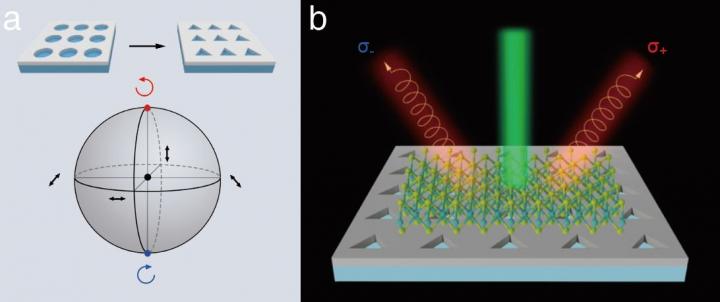
In a new paper published in Light Science & Application, a team of scientists, led by Professor Jian Zi, Professor Lei Shi from Fudan University and Professor Tian Jiang from National University of Defense Technology, and co-workers demonstrate that two-dimensional all-dielectric PhC slabs without in-plane inversion symmetry can be used to efficiently separate valley exciton emission of a WS2 monolayer in the far field at room temperature. Based on circularly polarized delocalized Bloch modes, the valley exciton emission is routed with high directionality and high degree of valley polarization. The delocalized Bloch modes not only play a critical role in separating and enhancing directional valley exciton emission, but also lead to spatial coherence properties of the emission field, which are neglected to be discussed in the past studies. This property of PhC slab extends the coherence control on PL of WS2 monolayer from temporal coherence to spatial coherence.

Due to the powerful ability of manipulating light, PhCs have been widely applied in various researches, such as PhC lasers and spontaneous emission control of TMDCs. However, to date, there are no reports of effective valley separation in TMDCs by using PhCs. The scientists introduce their method:

“For the radiative modes of PhC slabs, their polarization states in the far field are strictly defined. However, owing to high rotation symmetry, the polarization field is nearly linear in most PhC slabs. In our recent research, we reported that by breaking in-plane inversion symmetry of PhC slabs, circularly polarized states would emerge in photonic bands. This lays the foundation for us to control valley exciton emission via PhC slabs.”

“Especially, the PhCs’ Bloch modes are delocalized, which would lead to the coherence properties of TMDCs’ emission field. We performed the Young’s double-slit experiment to directly observe the interference fringes.”

“Our method could be extended to manipulate valley exciton emission of other TMDCs monolayers. The ability of this PhC slabs to transport valley information from the near field to the far field would help to develop photonic devices based on valleytronics.” They added.

###

Media Contact
Lei Shi
[email protected]

Related Journal Article

http://dx.doi.org/10.1038/s41377-020-00387-4

Tags: Chemistry/Physics/Materials SciencesOptics
Share12Tweet8Share2ShareShareShare2

Related Posts

blank

Breakthrough in Environmental Cleanup: Scientists Develop Solar-Activated Biochar for Faster Remediation

February 7, 2026
blank

Cutting Costs: Making Hydrogen Fuel Cells More Affordable

February 6, 2026

Scientists Develop Hand-Held “Levitating” Time Crystals

February 6, 2026

Observing a Key Green-Energy Catalyst Dissolve Atom by Atom

February 6, 2026
Please login to join discussion

POPULAR NEWS

  • Robotic Ureteral Reconstruction: A Novel Approach

    Robotic Ureteral Reconstruction: A Novel Approach

    82 shares
    Share 33 Tweet 21
  • Digital Privacy: Health Data Control in Incarceration

    63 shares
    Share 25 Tweet 16
  • Study Reveals Lipid Accumulation in ME/CFS Cells

    57 shares
    Share 23 Tweet 14
  • Breakthrough in RNA Research Accelerates Medical Innovations Timeline

    53 shares
    Share 21 Tweet 13

About

We bring you the latest biotechnology news from best research centers and universities around the world. Check our website.

Follow us

Recent News

Florida Cane Toad: Complex Spread and Selective Evolution

Exploring Decision-Making in Dementia Caregivers’ Mobility

Succinate Receptor 1 Limits Blood Cell Formation, Leukemia

Subscribe to Blog via Email

Enter your email address to subscribe to this blog and receive notifications of new posts by email.

Join 73 other subscribers
  • Contact Us

Bioengineer.org © Copyright 2023 All Rights Reserved.

Welcome Back!

Login to your account below

Forgotten Password?

Retrieve your password

Please enter your username or email address to reset your password.

Log In
No Result
View All Result
  • Homepages
    • Home Page 1
    • Home Page 2
  • News
  • National
  • Business
  • Health
  • Lifestyle
  • Science

Bioengineer.org © Copyright 2023 All Rights Reserved.