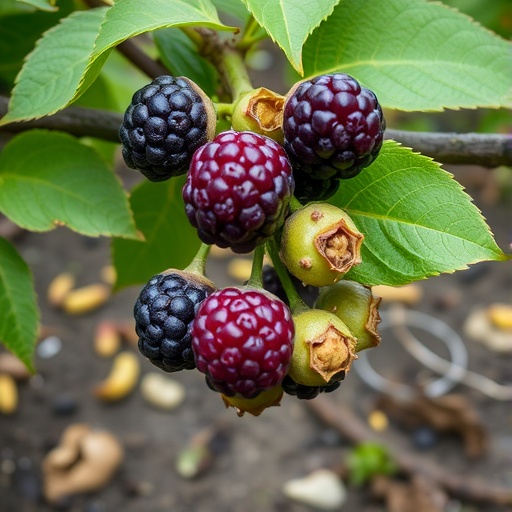
Beneath the soil of a millennium-old mulberry grove in China, scientists have recovered a bacterium that may rewrite how one of the world’s oldest crops defends itself against its most destructive fungal enemy. The microbe, isolated from the roots of roughly 1,000-year-old mulberry trees and named Bacillus velezensis ZJU_268, suppressed gray mold disease caused by Botrytis cinerea while simultaneously accelerating mulberry seedling growth, according to a study published in the Journal of Advanced Research. What distinguishes the work is not merely the discovery of another biocontrol strain, but the depth to which the researchers traced its influence, from the bacterium’s genome to the architecture of the entire root-associated microbial community and the chemical language of root metabolism.
Botrytis cinerea, the gray mold pathogen, is among the most formidable adversaries in agriculture. It infects more than 200 plant species, kills host cells by secreting toxic compounds, and breaches plant defenses using cell wall-degrading enzymes, resulting in substantial yield losses across crops worldwide. For mulberry, the cornerstone of the silk industry and a plant of significant medicinal value due to its rich secondary metabolites, current control strategies rely heavily on chemical fungicides such as thiophanate-methyl and on resistant cultivars, approaches that are costly, environmentally damaging, and increasingly limited in effectiveness. The search for sustainable alternatives has driven attention toward endophytes, the bacteria, fungi, and actinomycetes that colonize internal plant tissues and are sometimes described as a plant’s second genome.
The research team, led by Lixue Wang, Yixuan Zhang, Wanting Li, and colleagues at Zhejiang University and Southwest University, subjected ZJU_268 to a battery of technical characterizations. Electron microscopy revealed rod-shaped cells with wrinkled outer surfaces, a feature associated with surface adhesion and stress tolerance in Bacillus species. Because 16S rRNA gene sequences are too conserved to reliably separate closely related Bacillus species, the team turned to the gyrB gene, which showed 99.7 percent similarity to B. velezensis, and confirmed the identification with average nucleotide identity analysis. Whole-genome sequencing on PacBio and Illumina platforms showed a compact circular chromosome of 3.93 megabases with no plasmids, containing 3,748 protein-coding genes. Functional annotation revealed extensive machinery for carbohydrate utilization, amino acid metabolism, cofactor and vitamin biosynthesis, biofilm formation, and stress response, along with several strain-specific biosynthetic gene clusters predicted to encode secondary metabolites, including antimicrobial lipopeptides.
Perhaps the most striking technical demonstration involved tagging ZJU_268 with a green fluorescent protein and tracking its journey through mulberry seedlings. Confocal laser scanning microscopy showed that the bacterium established stable populations on root surfaces, penetrated internal tissues, spread through the cortex and vascular system, and eventually migrated upward into stems and leaves. Quantitative recovery of GFP-labeled colonies from homogenized tissues over 35 days confirmed that roots served as the primary reservoir while aerial tissues were colonized later and at lower densities, establishing ZJU_268 as a genuine systemic endophyte rather than a transient surface dweller.
In laboratory antagonism assays, ZJU_268 proved devastatingly effective against fungi. Inhibition rates against most Ascomycetous pathogens exceeded 85 percent, and mycelial growth of Botrytis cinerea was nearly eliminated, with an inhibition rate of 98.09 percent. Scanning electron micrographs showed treated hyphae distorted, folded, twisted, and locally swollen, in sharp contrast to the smooth, intact filaments of untreated controls. The antifungal activity emerged about nine hours after incubation, peaked at 24 hours, and remained chemically robust: the cell-free culture supernatant retained its potency after heating at temperatures up to 121°C and across a pH range from 2 to 10, indicating that the active compounds are unusually stable molecules.
The greenhouse results translated this potency into disease control. In sterilized soil, mulberry seedlings treated with ZJU_268 cell suspensions showed a disease incidence of 41.67 percent, and those treated with the cell-free supernatant 66.67 percent, compared with severe disease in untreated pathogen-challenged plants and 25.00 percent in the fungicide-treated positive control. Quantitative PCR confirmed that pathogen abundance in roots was significantly lower in both bacterial treatments. Critically, efficacy persisted in non-sterilized natural soil containing intact indigenous microbial communities, with control efficacies of 47.62 percent for the live bacterium and 28.57 percent for the supernatant. Growth promotion was equally dramatic: at an optimal dose of 10⁶ CFU/mL, treated seedlings showed increases of roughly 74 percent in root length, 81 percent in shoot length, 173 percent in total fresh weight, and 136 percent in total dry weight, while seed germination rates rose by up to 24 percent.
To understand how these effects arose, the researchers sequenced the root microbiome of treated plants using 16S rRNA and ITS amplicon profiling. Bacterial communities clustered distinctly between treated and control plants on Bray-Curtis ordination, whereas fungal communities shifted less in composition but changed markedly in their ecological structure: fungal co-occurrence networks lost connectivity, with fewer nodes linked and fewer positive associations, while bacterial network topology remained largely intact. Taxonomically, the treatments depleted several potentially harmful taxa, including the bacterial genera Pantoea, Afipia, and Rhizorhapis and the fungal genera Verruconis and Exobasidium, while enriching beneficial bacteria such as Streptomyces, Flavobacterium, Rhizobium, Pseudomonas, and Novosphingobium, and fungi including Cladosporium, Arthrobotrys, Meyerozyma, and Xenoacremonium. The team then cultured 223 bacterial and 42 fungal isolates from treated roots and validated their functions directly. Selected Pseudomonadaceae strains inhibited B. cinerea by 85 to 96 percent in dual cultures, reduced lesion sizes on detached mulberry leaves, and boosted seedling fresh weight and shoot height, while fungal isolates from the Cladosporiaceae and Nectriaceae families suppressed the pathogen by roughly 50 percent and promoted plant growth. Compatibility assays showed ZJU_268 could work synergistically with these enriched partners, suggesting a path toward engineered microbial consortia.
Metabolomics added the final layer of the mechanism. Untargeted liquid chromatography–mass spectrometry detected 3,431 metabolites in mulberry roots and identified 625 that changed significantly across treatments. Both the live bacterium and its supernatant elevated a suite of compounds, including the cytokinin trans-zeatin, thioinosine monophosphate, L-galactose, uridine, L-serine, and the fungicide carbendazim. When these purified metabolites were fed to representative enriched isolates in vitro, bacterial growth measured by optical density and fungal colony expansion both increased significantly. Tellingly, none of the same metabolites stimulated Botrytis cinerea; L-serine and uridine actually inhibited it. This selectivity suggests the root itself becomes a chemical gatekeeper, feeding friendly microbes while starving or repelling the pathogen. Quantitative PCR of plant genes supported this interpretation, with upregulation of CYP735A, consistent with zeatin accumulation, and of PSP and PAL, reflecting shifts in amino acid and phenylpropanoid metabolism. Live cells and supernatant also diverged in their metabolic signatures: the supernatant drove a large accumulation of ascorbate, an antioxidant buffer, whereas live colonization promoted dynamic turnover of ascorbate metabolism, hinting at complementary modes of protection, rapid chemical defense from secreted metabolites and sustained physiological reprogramming from an established endophyte.
The authors frame their findings at the level of the holobiont, the plant plus its microbial constellation, arguing that ZJU_268 functions less as a lone assassin of fungi and more as a microbiome architect, reshaping who lives in the root, rewiring interaction networks, and editing the chemical environment so that the resulting community suppresses disease and fuels growth. With its efficacy demonstrated in natural soil, its stability under heat and pH extremes, and its dual biocontrol and growth-promoting repertoire encoded on a single plasmid-free chromosome, ZJU_268 represents a promising candidate for biological products aimed at sustainable sericulture. For an industry seeking to cut pesticide use without sacrificing yield, a bacterium plucked from the roots of a tree that has stood for a thousand years may prove an unexpectedly modern ally.
Subject of Research: Mulberry-derived endophytic Bacillus velezensis strain ZJU_268 and its suppression of gray mold disease and promotion of mulberry growth through root microbiome and metabolome reshaping
Subject of Research: Medicine
Article Title: Mulberry-derived endophytic Bacillus velezensis suppresses gray mold and promotes mulberry growth via reshaping the root metabolism and microbiome
Article References: Wang, L., Zhang, Y., Li, W., Zhang, X., Li, C., Liu, Y., Su, Z., Wang, Y., Sun, C., & Huang, L. (2026). Mulberry-derived endophytic Bacillus velezensis suppresses gray mold and promotes mulberry growth via reshaping the root metabolism and microbiome. Journal of Advanced Research. https://doi.org/10.1016/j.jare.2026.09.002
Image Credits: AI Generated
DOI: 10.1016/j.jare.2026.09.002
Keywords: Bacillus velezensis, ZJU_268, Botrytis cinerea, gray mold, mulberry, endophyte, biocontrol, root microbiome, metabolomics, plant growth promotion, sericulture, sustainable agriculture
Cite Scienmag News
APA MLA Chicago
Morgan Morrow. (September 7, 2026). Root-dwelling bacterium shields mulberries from gray mold while boosting growth. Scienmag. https://scienmag.com/root-dwelling-bacterium-shields-mulberries-from-gray-mold-while-boosting-growth/
Morgan Morrow. “Root-dwelling bacterium shields mulberries from gray mold while boosting growth.” Scienmag, 7 September 2026, https://scienmag.com/root-dwelling-bacterium-shields-mulberries-from-gray-mold-while-boosting-growth/. Accessed 7 September 2026.
Morgan Morrow. “Root-dwelling bacterium shields mulberries from gray mold while boosting growth.” Scienmag. September 7, 2026. https://scienmag.com/root-dwelling-bacterium-shields-mulberries-from-gray-mold-while-boosting-growth/
Copy citation Download RIS
Tags: ancient mulberry cultivation and disease managementBacillus velezensisBacillus velezensis for fungal pathogen suppressionbiocontrol bacteriabiocontrol bacteria in mulberry cultivationbiological growth promotion in mulberry treesBotrytis cinereacontrol of Botrytis cinerea in fruit cropsenvironmentally friendly crop protection strategiesfungal pathogen controlgray mold suppressionmicrobial genomicsmicrobial genomics and root metabolismmicrobial influence on root microbiomeMulberry disease resistancenatural plant defense mechanisms against gray moldplant growth promotionplant-microbe interactionsplant-microbe interactions in soil healthroot-associated microbial communitiesRoot-dwelling bacteria for plant disease resistancesilkworm crop protectionsustainable agriculturesustainable agriculture with beneficial microbes