• HOME
  • NEWS
  • EXPLORE
    • CAREER
      • Companies
      • Jobs
    • EVENTS
    • iGEM
      • News
      • Team
    • PHOTOS
    • VIDEO
    • WIKI
  • BLOG
  • COMMUNITY
    • FACEBOOK
    • INSTAGRAM
    • TWITTER
Sunday, May 10, 2026
BIOENGINEER.ORG
No Result
View All Result
  • Login
  • HOME
  • NEWS
  • EXPLORE
    • CAREER
      • Companies
      • Jobs
        • Lecturer
        • PhD Studentship
        • Postdoc
        • Research Assistant
    • EVENTS
    • iGEM
      • News
      • Team
    • PHOTOS
    • VIDEO
    • WIKI
  • BLOG
  • COMMUNITY
    • FACEBOOK
    • INSTAGRAM
    • TWITTER
  • HOME
  • NEWS
  • EXPLORE
    • CAREER
      • Companies
      • Jobs
        • Lecturer
        • PhD Studentship
        • Postdoc
        • Research Assistant
    • EVENTS
    • iGEM
      • News
      • Team
    • PHOTOS
    • VIDEO
    • WIKI
  • BLOG
  • COMMUNITY
    • FACEBOOK
    • INSTAGRAM
    • TWITTER
No Result
View All Result
Bioengineer.org
No Result
View All Result
Home NEWS Science News

Room temperature superconductivity creeping toward possibility

Bioengineer by Bioengineer
July 29, 2020
in Science News
Reading Time: 2 mins read
0
IMAGE
Share on FacebookShare on TwitterShare on LinkedinShare on RedditShare on Telegram

IMAGE

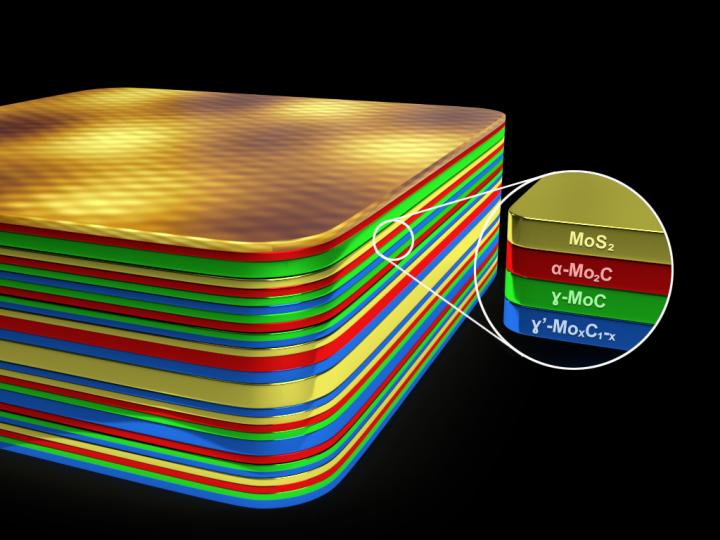
Credit: Elizabeth Flores-Gomez Murray/ Penn State

The possibility of achieving room temperature superconductivity took a tiny step forward with a recent discovery by a team of Penn State physicists and materials scientists.

The surprising discovery involved layering a two-dimensional material called molybdenum sulfide with another material called molybdenum carbide. Molybdenum carbide is a known superconductor — electrons can flow through the material without any resistance. Even the best of metals, such as silver or copper, lose energy through heat. This loss makes long-distance transmission of electricity more costly.

“Superconductivity occurs at very low temperatures, close to absolute zero or 0 Kelvin,” said Mauricio Terrones, corresponding author on a paper in Proceedings of the National Academy of Sciences published this week. “The alpha phase of Moly carbide is superconducting at 4 Kelvin.”

When layering metastable phases of molybdenum carbide with molybdenum sulfide, superconductivity occurs at 6 Kelvin, a 50% increase. Although this is not remarkable in itself — other materials have been shown to be superconductive at temperatures as high as 150 Kelvin — it was still an unexpected phenomenon that portends a new method to increase superconductivity at higher temperatures in other superconducting materials.

The team used modeling techniques to understand how the effect occurred experimentally.

“Calculations using quantum mechanics as implemented within density functional theory assisted in the interpretation of experimental measurements to determine the structure of the buried molybdenum carbide/molybdenum sulfide interfaces,” said Susan Sinnott, professor of materials science and engineering and head of the department. “This work is a nice example of the way in which materials synthesis, characterization and modeling can come together to advance the discovery of new material systems with unique properties.”

According to Terrones, “It’s a fundamental discovery, but not one anyone believed would work. We are observing a phenomenon that to the best of our knowledge has never been observed before.”

The team will continue experimenting with superconductive materials with the goal of someday finding materials combinations that can carry energy through the grid with zero resistance.

###

In addition to Terrones and Sinnott, authors on the PNAS paper, titled “Superconductivity enhancement in phase-engineered molybdenum carbide/sulfide vertical heterostructures,” are doctoral students or graduated doctorate recipients Fu Zhang, Yanfu Lu, Lavish Pabbi, Anna Binion, Tomotaroh Granzier-Nakajima, Tiany Zhang and Zhong Lin; and postdoctoral scholars Kazunori Fujisawa And Yu Lei, Professor Eric Hudson and former Research Assistant Professor Laura Elias, all of Penn State, and Wenkai Zhang and Luis Balcas of Florida State.

The Department of Energy, funded this research which was recently renewed to continue their research.

Media Contact
A’ndrea Elyse Messer
[email protected]

Related Journal Article

http://dx.doi.org/10.1073/pnas.2003422117

Tags: Chemistry/Physics/Materials SciencesSuperconductors/Semiconductors
Share12Tweet8Share2ShareShareShare2

Related Posts

Urdu Fall Risk Questionnaire Adapted for Elderly

May 10, 2026

Key Pharmacological Markers for HIV Prevention in MSM

May 10, 2026

Taking 8,500 Steps Daily May Aid Long-Term Weight Management, Study Finds

May 10, 2026

Group Exercise Boosts Cognition, Fitness in Dementia

May 10, 2026
Please login to join discussion

POPULAR NEWS

  • Research Indicates Potential Connection Between Prenatal Medication Exposure and Elevated Autism Risk

    840 shares
    Share 336 Tweet 210
  • New Study Reveals Plants Can Detect the Sound of Rain

    727 shares
    Share 290 Tweet 181
  • Scientists Investigate Possible Connection Between COVID-19 and Increased Lung Cancer Risk

    68 shares
    Share 27 Tweet 17
  • Salmonella Haem Blocks Macrophages, Boosts Infection

    61 shares
    Share 24 Tweet 15

About

We bring you the latest biotechnology news from best research centers and universities around the world. Check our website.

Follow us

Recent News

Urdu Fall Risk Questionnaire Adapted for Elderly

Key Pharmacological Markers for HIV Prevention in MSM

Taking 8,500 Steps Daily May Aid Long-Term Weight Management, Study Finds

Subscribe to Blog via Email

Success! An email was just sent to confirm your subscription. Please find the email now and click 'Confirm' to start subscribing.

Join 82 other subscribers
  • Contact Us

Bioengineer.org © Copyright 2023 All Rights Reserved.

Welcome Back!

Login to your account below

Forgotten Password?

Retrieve your password

Please enter your username or email address to reset your password.

Log In
No Result
View All Result
  • Homepages
    • Home Page 1
    • Home Page 2
  • News
  • National
  • Business
  • Health
  • Lifestyle
  • Science

Bioengineer.org © Copyright 2023 All Rights Reserved.