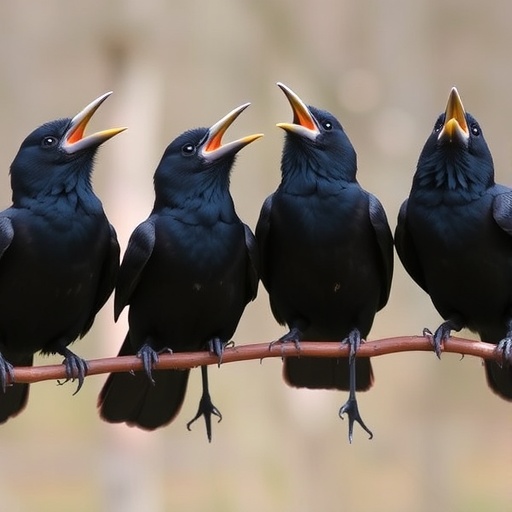
In an intriguing new study that is likely to capture both the attention of animal behaviorists and the general public, researchers have revealed that rooks, a species of bird belonging to the corvid family known scientifically as Corvus frugilegus, demonstrate a surprising level of vocal flexibility when exposed to dynamically changing rhythmic sounds. This groundbreaking research, set to be published in the journal Animal Cognition in 2026, invites us to consider the complexities of avian communication and cognition.
Corvids are renowned for their intelligence, often likened to that of primates due to their advanced problem-solving abilities and tool use. The research led by a team that includes prominent figures such as K. Martin and M. Tomasek, has taken their understanding of these birds’ cognitive capabilities to a new level. The now-highlighted spontaneous vocal flexibility suggests that rooks may possess inherent capabilities for vocal mimicry, which could serve various purposes in social interactions or environmental adaptations.
The study meticulously builds upon existing knowledge of avian vocalizations, previously established mainly among songbirds. It highlights how rooks manage to adapt their calls in response to rhythmic stimuli, which is a notable departure from fixed calling patterns typically associated with most birds. The challenges these researchers undertook in isolating the effects of rhythm on vocalization reveal the intricate mechanisms underpinning how birds communicate and interact with their environment.
In a controlled experimental setting, the rooks were presented with a series of rhythmic sounds that varied both in tempo and intensity. The results were astonishing. Rather than simply reacting with pre-determined vocalizations, the rooks exhibited adaptability in their responses, altering pitch, volume, and even the rhythm of their calls. This spontaneous improvisation indicates a higher level of cognitive processing than formerly attributed to them, revealing a newfound complexity in their behavioral repertoire.
What makes this discovery even more compelling is its implications for understanding the evolution of communication among avian species. If rooks can demonstrate such sophisticated vocal flexibility, it prompts further inquiry into the extent to which other corvids and perhaps even more broadly, other bird families, are capable of similar adaptive behaviors. The findings position rooks as key players in research aimed at exploring the cognitive evolution of vocal communication.
The question arises—what could be the ecological advantages of such spontaneous vocal adaptability? Researchers speculate that vocal flexibility might enhance the rooks’ abilities to function within social groups, improve their foraging efficiency, or even allow them to evade predators through more varied warnings. The study opens a window to exploring the evolutionary benefits that such cognitive traits afford these intelligent birds in their natural habitats.
Moreover, this research aligns with burgeoning discussions in the field regarding the ‘cultural’ aspects of animal behavior. Just as humans adopt varied speech patterns or dialects based on social situations, so too may rooks adjust their calls based on their social context or environmental stimuli. This perspective adds a layer of social complexity to our understanding of avian interactions and challenges the previously held ideas of fixed behavioral traits in the animal kingdom.
In addition, the investigation has stimulated interdisciplinary collaborations among ornithologists, cognitive scientists, and neurobiologists. A deeper understanding of vocal flexibility could further illuminate the neurological underpinnings of such behavior. Researchers are eager to explore how variations in brain structure among corvids relate to their advanced cognitive functions, paving the way for additional studies focusing on the neural mechanisms of communication.
As this exciting exploration unfolds, it becomes apparent that the significance of the findings reaches beyond avian studies. The implications of vocal flexibility in rooks may resonate with parallels found in other species, including primates and cetaceans, known for their sophisticated communication systems. Understanding these systems can influence conservation efforts, animal welfare considerations, and our broader comprehension of intelligence across species.
As public interest in animal cognition grows, the appeal of studies like this one increases. The captivating narrative of rooks’ ability to improvise and adapt their vocalizations resonates with audiences who are eager to learn about the intricacies of non-human intelligence. Engaging visual content and accessible explanations derived from these studies hold the potential to captivate a wide audience, fostering a greater appreciation for avian life.
In summary, the research conducted by Martin, Tomasek, Hivet, and their colleagues represents a significant contribution to our understanding of bird behavior and cognition. The study not only showcases the remarkable capabilities of rooks but also invites a closer examination of the potential for vocal flexibility across diverse species. As scientists continue to unravel the myths surrounding animal intelligence, we may find ourselves reevaluating the ways in which we honor and protect these incredible creatures.
As anticipation builds for its full release in Animal Cognition, the study sets a foundation for future explorations of animal vocalizations, cognitive evolution, and the rich social lives of birds. The knowledge that rooks can display spontaneous vocal flexibility may inspire new conservation initiatives or insights that deepen our connection with the natural world.
In conclusion, the narrative that emerges from this research heralds a transformative understanding of avian communication. With continued exploration and cognitive studies, we stand at the threshold of uncovering not only the languages spoken by our feathered friends but also the profound connections they share within their species and the environments they inhabit.
Subject of Research: Vocal flexibility and communication in rooks (Corvus frugilegus)
Article Title: Rooks (Corvus frugilegus) can show spontaneous vocal flexibility when exposed to dynamically changing rhythmic sounds
Article References:
Martin, K., Tomasek, M., Hivet, A. et al. Rooks (Corvus frugilegus) can show spontaneous vocal flexibility when exposed to dynamically changing rhythmic sounds.
Anim Cogn (2026). https://doi.org/10.1007/s10071-025-02038-w
Image Credits: AI Generated
DOI: https://doi.org/10.1007/s10071-025-02038-w
Keywords: Vocal flexibility, rooks, animal cognition, corvids, avian communication.
Tags: animal cognition advancementsavian communication researchbird vocalization patternscognitive capabilities of corvidscorvid intelligence studiesCorvus frugilegus behaviordynamic rhythmic soundsrhythmic stimuli response in birdsRooks vocal flexibilitysocial interactions in avian speciesspontaneous vocal adaptationsvocal mimicry in birds