• HOME
  • NEWS
  • EXPLORE
    • CAREER
      • Companies
      • Jobs
    • EVENTS
    • iGEM
      • News
      • Team
    • PHOTOS
    • VIDEO
    • WIKI
  • BLOG
  • COMMUNITY
    • FACEBOOK
    • INSTAGRAM
    • TWITTER
Monday, August 10, 2026
BIOENGINEER.ORG
No Result
View All Result
  • Login
  • HOME
  • NEWS
  • EXPLORE
    • CAREER
      • Companies
      • Jobs
        • Lecturer
        • PhD Studentship
        • Postdoc
        • Research Assistant
    • EVENTS
    • iGEM
      • News
      • Team
    • PHOTOS
    • VIDEO
    • WIKI
  • BLOG
  • COMMUNITY
    • FACEBOOK
    • INSTAGRAM
    • TWITTER
  • HOME
  • NEWS
  • EXPLORE
    • CAREER
      • Companies
      • Jobs
        • Lecturer
        • PhD Studentship
        • Postdoc
        • Research Assistant
    • EVENTS
    • iGEM
      • News
      • Team
    • PHOTOS
    • VIDEO
    • WIKI
  • BLOG
  • COMMUNITY
    • FACEBOOK
    • INSTAGRAM
    • TWITTER
No Result
View All Result
Bioengineer.org
No Result
View All Result
Home NEWS Science News

Role for autophagic cellular degradation process in maintaining genomic stability

Bioengineer by Bioengineer
November 28, 2016
in Science News
Reading Time: 2 mins read
0
Share on FacebookShare on TwitterShare on LinkedinShare on RedditShare on Telegram
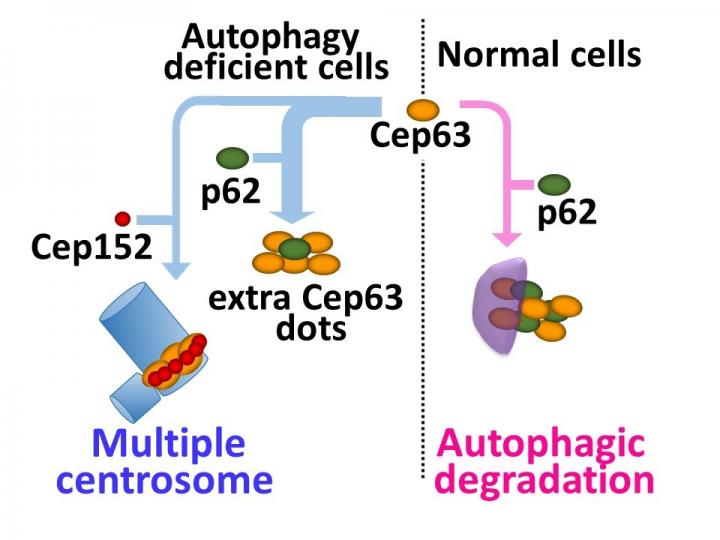
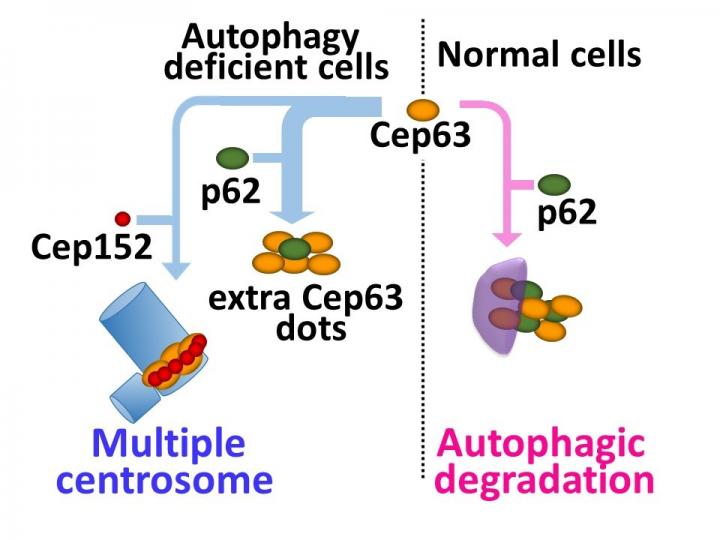
IMAGE

Credit: Department of Pathological Cell Biology,Medical Research Institute,

A research team led by Tokyo Medical and Dental University (TMDU) identified a role for autophagy in determining centrosome number via degradation of the centrosomal protein Cep63.

Tokyo, Japan – Centrosomes play an essential role in cell division by organizing the protein framework on which chromosomes assemble and then separate prior to division into daughter cells. Centrosomes are made up of a pair of centrioles, which are themselves composed of different proteins such as centrosomal protein 63 (Cep63) and polo-like kinase 4. These proteins are thought to regulate the number of centrioles, and thus centrosomes as well, using the ubiquitin-proteasome breakdown pathway that first adds a molecular tag to the protein to be degraded. However, researchers centered at Tokyo Medical and Dental University observed that mouse cells lacking a protein involved in autophagy (a lysosome-based degradation process involving hydrolytic enzymes) contained multiple centrosomes. Their work showed that autophagy is another method of regulating centrosome number. The study was reported in Nature Communications.

Selective autophagy has been shown to break down specific cargos, including proteins and organelles, by delivering them to the lysozyme for digestion. The research team found that cells deficient in autophagy carry extra centrosomes, which was confirmed by the use of autophagy inhibitors in normal cells.

Multiple dots of Cep63 were also visible in cells not undergoing autophagy. Silencing of Cep63 reduced the population of cells with multiple centrosomes while its upregulation increased the centrosome number, thus confirming a role for Cep63 in centrosome number regulation. "Protein staining showed that the Cep63 dots co-localize and directly associate with the p62 protein, which plays a role as a cargo receptor in selective autophagy", first author Yuichiro Watanabe says. "This revealed that p62 is involved in the autophagic degradation of Cep63." In normal cells, most Cep63 dots undergo autophagy to regulate the centrosome number. However, in the absence of autophagy, the Cep63 dots persist and interact with p62 or lead to the generation of additional centrosomes.

"Mice lacking the expression of p62 and those in which autophagy was inhibited were also found to have more centrosomes than wild-type mice," corresponding author Shigeomi Shimizu says. "This suggests a key role for autophagy in preventing genomic instability."

The article "Autophagy controls centrosome number by degrading Cep63" was published in Nature Communications at doi:10.1038/ncomms13508.

###

Media Contact

Shigeomi Shimizu
[email protected]

http://www.tmd.ac.jp/english/

############

Story Source: Materials provided by Scienmag

Share13Tweet8Share2ShareShareShare2

Related Posts

Nirsevimab Immunization Outcomes in the First Two Years

August 10, 2026
Endometriosis Linked to 46% Higher Type 2 Diabetes Risk in Women

Endometriosis Linked to 46% Higher Type 2 Diabetes Risk in Women

August 10, 2026

Slow Electrons Discovered in 2D Material Could Enable New Memory Devices

August 10, 2026

UChicago Medicine Cancer Center and Lilly Partner to Expand Clinical Trial Access

August 10, 2026
Please login to join discussion

POPULAR NEWS

  • Nirsevimab Immunization Outcomes in the First Two Years

    29 shares
    Share 12 Tweet 7
  • Endometriosis Linked to 46% Higher Type 2 Diabetes Risk in Women

    29 shares
    Share 12 Tweet 7
  • Slow Electrons Discovered in 2D Material Could Enable New Memory Devices

    29 shares
    Share 12 Tweet 7
  • UChicago Medicine Cancer Center and Lilly Partner to Expand Clinical Trial Access

    29 shares
    Share 12 Tweet 7

About

We bring you the latest biotechnology news from best research centers and universities around the world. Check our website.

Follow us

Recent News

Nirsevimab Immunization Outcomes in the First Two Years

Endometriosis Linked to 46% Higher Type 2 Diabetes Risk in Women

Slow Electrons Discovered in 2D Material Could Enable New Memory Devices

Subscribe to Blog via Email

Enter your email address to subscribe to this blog and receive notifications of new posts by email.

Join 86 other subscribers
  • Contact Us

Bioengineer.org © Copyright 2023 All Rights Reserved.

Welcome Back!

Login to your account below

Forgotten Password?

Retrieve your password

Please enter your username or email address to reset your password.

Log In
No Result
View All Result
  • Homepages
    • Home Page 1
    • Home Page 2
  • News
  • National
  • Business
  • Health
  • Lifestyle
  • Science

Bioengineer.org © Copyright 2023 All Rights Reserved.