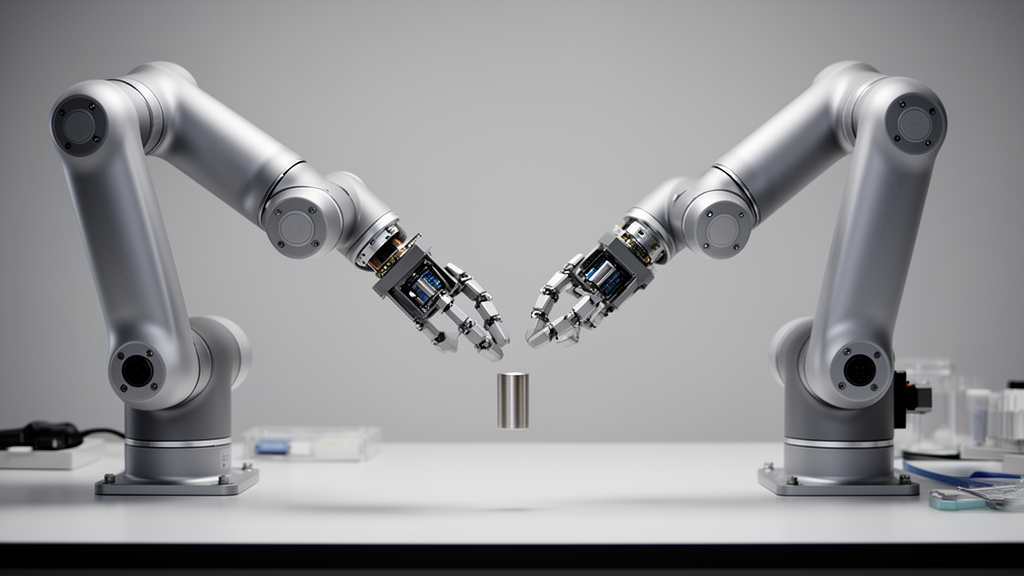
Teaching a robot to use two arms at once is one of the hardest problems in embodied artificial intelligence. Unlike a single-arm system that simply reaches for an object, dual-arm manipulation demands synchronized motion planning, constant collision avoidance between the arms, and a fluid allocation of roles: which arm leads, which follows, and when the two must swap responsibilities mid-task. A new study published in Frontiers in Neurorobotics argues that the missing ingredient is not better motors or more data, but foresight. Researchers from the Northwest Institute of Mechanical and Electrical Engineering in Xianyang and Xi’an Jiaotong University have built a framework that explicitly predicts how the relationships between a robot’s arms, the objects on the table, and the surrounding environment will evolve over the next fraction of a second, and uses those predictions to steer action generation.
The system, called PACE-DP, short for Predictive Affordance and Coordination Evolution Diffusion Policy, addresses a blind spot that the authors identify in much of today’s robot learning research. Diffusion-based policies, which have become a powerful paradigm for generating smooth, temporally consistent robot trajectories, largely treat the environment as a static configuration. Affordance learning methods, which estimate what actions are physically possible on an object, typically operate on single snapshots of the scene. Neither approach captures how the manipulation landscape changes as a task unfolds: an object that is graspable now may be occluded in a moment, a handover that is feasible now may become geometrically impossible once the other arm commits to its trajectory.
PACE-DP integrates three predictive components into a single action-generation pipeline. The first is a Predictive Scene Module that forecasts latent representations of future scene states. Rather than reconstructing explicit future point clouds, the module uses a temporal Transformer architecture to project object-centric features forward in time, encoding anticipated object positions, orientations, and interaction states. The module looks back over a window of eight timesteps and predicts four timesteps into the future, corresponding to 0.4 seconds of anticipated scene evolution at the system’s 10 Hz control frequency. Two auxiliary losses keep these predictions grounded: a temporal consistency loss encourages smooth, physically plausible transitions in the predicted latent space, while a contrastive objective pushes predicted features toward their ground-truth future encodings and away from predictions for unrelated objects.
The second component is the Affordance and Coordination Evolution Module, which is the conceptual heart of the framework. It constructs a temporally evolving interaction graph in which the vertices represent every entity in the manipulation scene: the left arm, the right arm, each object, target regions, and environmental elements such as tabletop surfaces and containers. Edges between these vertices carry relation types drawn from two families. Affordance relations include grasping, contacting, supporting, aligning, and reaching. Coordination relations include co-grasping, handover, co-manipulation, synchronized motion, and role differentiation. A Graph Transformer with four layers and eight attention heads per layer processes this graph, stacking temporal positional encodings so that the network can model how these relationships change over time and predict future relation types, grasp success probabilities, coordination modes, and spatial alignment targets.
Ground truth for these relations is generated automatically from simulator states using heuristic rules based on inter-entity distance, contact, and relative velocity, following the conventions of the RoboTwin 2.0 benchmark. An object is labeled as supporting another when it rests on a surface with zero relative velocity; a handover is labeled when both arms sequentially contact the same object within a short time window; co-grasping is labeled when both end-effectors simultaneously maintain contact with the same object. A dedicated coordination submodule operates on a bipartite graph between the left-arm and right-arm action vectors, computing a coordination embedding that captures the relative motion pattern between the two arms and using a temporal convolution to forecast which coordination mode will be active at each future timestep. This explicit mode prediction allows the policy to anticipate handover transitions and synchronization requirements before they arise.
The third component is a Conditional Diffusion Policy that generates bimanual action sequences as a denoising process. The features from the scene predictor and the evolution module are fused into a unified conditioning vector that combines the current scene encoding with predicted future relation and coordination embeddings. This conditioning is injected into a conditional U-Net denoising network through FiLM layers, ensuring that anticipated future information directly modulates action generation at every denoising step. The training objective augments the standard diffusion loss with three regularization terms: a temporal smoothness loss that penalizes abrupt changes between consecutive actions, a coordination consistency loss that aligns generated actions with predicted coordination modes, and an affordance grounding loss that keeps generated actions compatible with predicted affordance constraints. All modules are trained jointly end-to-end, with gradients flowing from the primary loss back through the conditioning vector to every upstream module.
The evaluation was conducted on the RoboTwin 2.0 platform, a unified simulation environment and scalable benchmark for dual-arm manipulation, using Aloha-AgileX robot configurations. The authors generated 50 expert demonstration trajectories per task and configuration through the platform’s automated task execution pipeline and trained a separate model for each of 10 diverse bimanual tasks, including handover, placement, stacking, and switch operation. For the primary experiments, each method and task was run through five independent training runs with different random seeds, each consisting of 100 evaluation rollouts, with statistical significance assessed via paired two-tailed t-tests at a significance level of 0.05. The baselines included Pi0, ACT, DP, and DP3, all re-implemented under identical conditions using official open-source codebases and recommended hyperparameters.
The results show PACE-DP outperforming the baselines on every task except the saturated handover-mic task, where all methods approach ceiling performance. In the auxiliary comparison, PACE-DP achieved 100 percent success on handover mic, 25 percent on hanging mug, 60 percent on place A2B right, 40 percent on place bread basket, 58 percent on place cans plasticbox, 66 percent on place shoe, 75 percent on press stapler, 73 percent on put object basket, 67 percent on stack bowls three, and 55 percent on turn switch. The gains are most pronounced on coordination-intensive tasks where anticipating the evolution of inter-arm relationships matters most. Crucially, this predictive capability comes at minimal computational cost: average memory usage rose only from 2.292 to 2.307 gigabytes at initialization compared with the DP3 baseline, and average inference time increased from 1.4576 to 1.5748 seconds, an overhead the authors characterize as marginal.
Ablation studies on three representative tasks quantified the contribution of each component. Removing the entire Affordance and Coordination Evolution Module caused the largest performance drop, between 14 and 17 percentage points, confirming that modeling dynamic relationship evolution is the most critical ingredient for complex bimanual tasks. Removing the full coordination submodule led to a 10 to 13 point drop, notably larger than the 4 to 7 point drop from removing only the coordination classifier, indicating that both the coordination representation and its predictive supervision contribute meaningfully. Excluding individual loss terms produced smaller drops of 2 to 5 points. The team also stress-tested robustness on the place-bread-basket task by introducing three to five distractor objects and corrupting instance segmentation labels with probabilities of 0.1 and 0.2. Performance degraded gracefully, from 40 percent in clean conditions to 35 percent with distractors, 37 percent with mild segmentation noise, and 33 percent with heavier noise.
The authors are candid about the limits of the current work. The method has been evaluated exclusively in simulation under relatively clean scenes, and although the robustness analysis shows resilience to clutter and segmentation noise, physical hardware validation in highly cluttered real-world environments remains necessary. The coordination classifier is supervised from demonstrations, which limits adaptability to coordination patterns never seen in training, and the predictive module assumes consistent object tracking across frames. Future work, the team writes, will address sim-to-real transfer, online segmentation, and self-supervised coordination learning. Even so, the central finding stands: explicitly predicting how affordances and coordination patterns will evolve provides an effective inductive bias for bimanual manipulation, offering a promising step toward predictive, temporally aware policies for long-horizon dual-arm tasks.
Subject of Research: Predictive diffusion policy learning for coordinated two-arm robotic manipulation
Article Title: Anticipating interactions: a predictive diffusion framework for evolving bimanual manipulation
Article References: Liu, X., Xie, F., He, X., Liu, A., Yan, L., Yang, J., Huang, H., & Wei, S. (2026). Anticipating interactions: a predictive diffusion framework for evolving bimanual manipulation. Frontiers in Neurorobotics, 20, Article 1927097. https://doi.org/10.3389/fnbot.2026.1927097
Image Credits: AI Generated
DOI: 10.3389/fnbot.2026.1927097
Keywords: bimanual manipulation, diffusion policy, robot learning, affordance learning, Graph Transformer, predictive world model, embodied AI, RoboTwin 2.0, dual-arm coordination, robotics, neurorobotics, imitation learning
News Source: Denise Maddox. (October 15, 2026). Robots That See Ahead: New AI Framework Teaches Two Arms to Predict and Coordinate Their Next Moves. Scienmag.