

• HOME
  • NEWS
  • EXPLORE
    • CAREER
      • Companies
      • Jobs
    • EVENTS
    • iGEM
      • News
      • Team
    • PHOTOS
    • VIDEO
    • WIKI
  • BLOG
  • COMMUNITY
    • FACEBOOK
    • INSTAGRAM
    • TWITTER
Wednesday, August 19, 2026
BIOENGINEER.ORG
No Result
View All Result
  • Login
  • HOME
  • NEWS
  • EXPLORE
    • CAREER
      • Companies
      • Jobs
        • Lecturer
        • PhD Studentship
        • Postdoc
        • Research Assistant
    • EVENTS
    • iGEM
      • News
      • Team
    • PHOTOS
    • VIDEO
    • WIKI
  • BLOG
  • COMMUNITY
    • FACEBOOK
    • INSTAGRAM
    • TWITTER
  • HOME
  • NEWS
  • EXPLORE
    • CAREER
      • Companies
      • Jobs
        • Lecturer
        • PhD Studentship
        • Postdoc
        • Research Assistant
    • EVENTS
    • iGEM
      • News
      • Team
    • PHOTOS
    • VIDEO
    • WIKI
  • BLOG
  • COMMUNITY
    • FACEBOOK
    • INSTAGRAM
    • TWITTER
No Result
View All Result
Bioengineer.org
No Result
View All Result
Home NEWS Science News Health

Robots as tools and partners in rehabilitation

Bioengineer by Bioengineer
August 17, 2018
in Health
Reading Time: 2 mins read
0
Share on FacebookShare on TwitterShare on LinkedinShare on RedditShare on Telegram
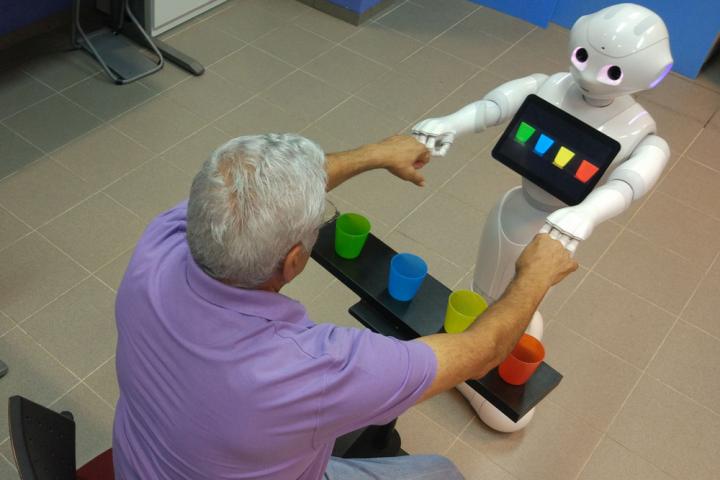
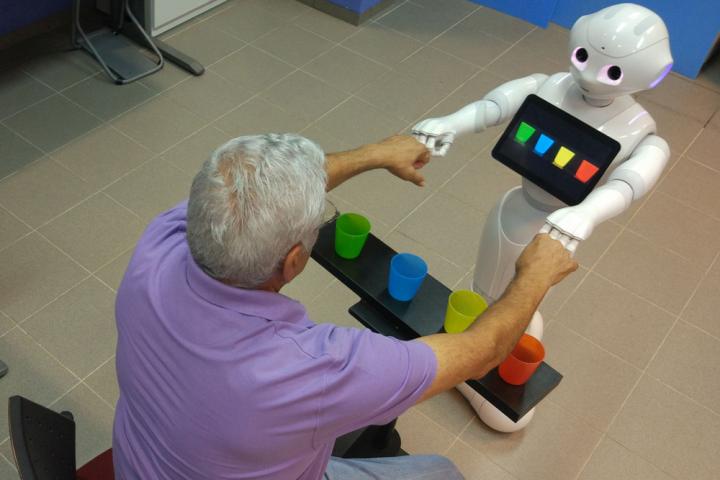
IMAGE

Credit: Shelly Levy-Tzedek

In future decades the need for effective strategies for medical rehabilitation will increase significantly, because patients' rate of survival after diseases with severe functional deficits, such as a stroke, will increase. Socially assistive robots (SARs) are already being used in rehabilitation for this reason. In the journal Science Robotics, a research team led by neuroscientist Dr. Philipp Kellmeyer of the Freiburg University Medical Center and Prof. Dr. Oliver Müller from the Department of Philosophy of the University of Freiburg, analyzes the improvements necessary to make SARs valuable and trustworthy assistants for medical therapies.

The researchers conclude that the development of SARs not only requires technical improvements, but primarily social, trust-building measures. Rehabilitation patients in particular are dependent on a reliable relationship with their therapists. So there must be trust in the safety of the robotic system, especially regarding the predictability of the machines' behavior. Given the ever-growing intelligence of the robots and with it their independence, this is highly important.

In addition, robots and patients can only interact well, the scientists explain, when they have shared goals that they pursue through the therapy. To achieve this, aspects of philosophical and developmental psychology must also be taken into account in the development of SARs: the ability of robots to recognize the aims and motives of a patient is a critical requirement if cooperation is to be successful. So there must also be trust for the participants to adapt to one another. The frustration felt by patients, for instance as a result of physical or linguistic limitations, would be avoided if the robots were adapted to the specific needs and vulnerabilities of the patient in question.

Philipp Kellmeyer and Oliver Müller are members of the Cluster of Excellence BrainLinks-BrainTools of the University of Freiburg. The study also involved Prof. Dr. Shelly Levy-Tzedek and Ronit Feingold-Polak from the Ben Gurion University of the Negev, Israel. In the 2018/19 academic year, the Freiburg researchers together with the legal academic Prof. Dr. Silja Vöneky and the IT specialist Prof. Dr. Wolfram Burgard, both from the University of Freiburg, are developing a Research Focus into normative aspects of interaction between people and autonomous intelligent systems at the Freiburg Institute for Advanced Studies (FRIAS).

###

Contact:

Dr. Philipp Kellmeyer
Translational Neurotechnological Lab (AG Ball)
Department of Neurosurgery at the Freiburg University Medical Center
and BrainLinks-BrainTools
University of Freiburg
Tel.: + 49 761 270-87570
[email protected]

Prof. Dr. Oliver Müller
Department of Philosophy and BrainLinks-BrainTools
University of Freiburg
Tel.: + 49 761 203-2432
[email protected]

Media Contact

Dr. Philipp Kellmeyer
[email protected]
49-761-270-87570

Startseite

Original Source

https://www.pr.uni-freiburg.de/pm-en/press-releases-2018/robots-as-tools-and-partners-in-rehabilitation http://dx.doi.org/10.1126/scirobotics.aat1587


Share13Tweet8Share2ShareShareShare2

Related Posts

IOF Names New Editor-in-Chief for Osteoporosis International’s European Office

August 19, 2026

Neighborhood social and economic opportunity predicts neurodevelopmental outcomes in high-risk infants

August 19, 2026

How Body Mass Index and Waist Size Affect Mortality in Older Adults

August 19, 2026

Could Strength Training Help Prevent Diabetes During Pregnancy?

August 19, 2026
Please login to join discussion

POPULAR NEWS

  • Thermal justice could make urban heat adaptation fairer as cities grow hotter

    29 shares
    Share 12 Tweet 7
  • IOF Names New Editor-in-Chief for Osteoporosis International’s European Office

    29 shares
    Share 12 Tweet 7
  • Aging Alters Skin Gene Activity, Fueling Inflammation

    29 shares
    Share 12 Tweet 7
  • Generating and transferring nitrenes enables unnatural biosynthesis in living cells

    29 shares
    Share 12 Tweet 7

About

We bring you the latest biotechnology news from best research centers and universities around the world. Check our website.

Follow us

Recent News

Thermal justice could make urban heat adaptation fairer as cities grow hotter

IOF Names New Editor-in-Chief for Osteoporosis International’s European Office

Aging Alters Skin Gene Activity, Fueling Inflammation

Subscribe to Blog via Email

Enter your email address to subscribe to this blog and receive notifications of new posts by email.

Join 85 other subscribers
  • Contact Us

Bioengineer.org © Copyright 2023 All Rights Reserved.

Welcome Back!

Login to your account below

Forgotten Password?

Retrieve your password

Please enter your username or email address to reset your password.

Log In
No Result
View All Result
  • Homepages
    • Home Page 1
    • Home Page 2
  • News
  • National
  • Business
  • Health
  • Lifestyle
  • Science

Bioengineer.org © Copyright 2023 All Rights Reserved.
