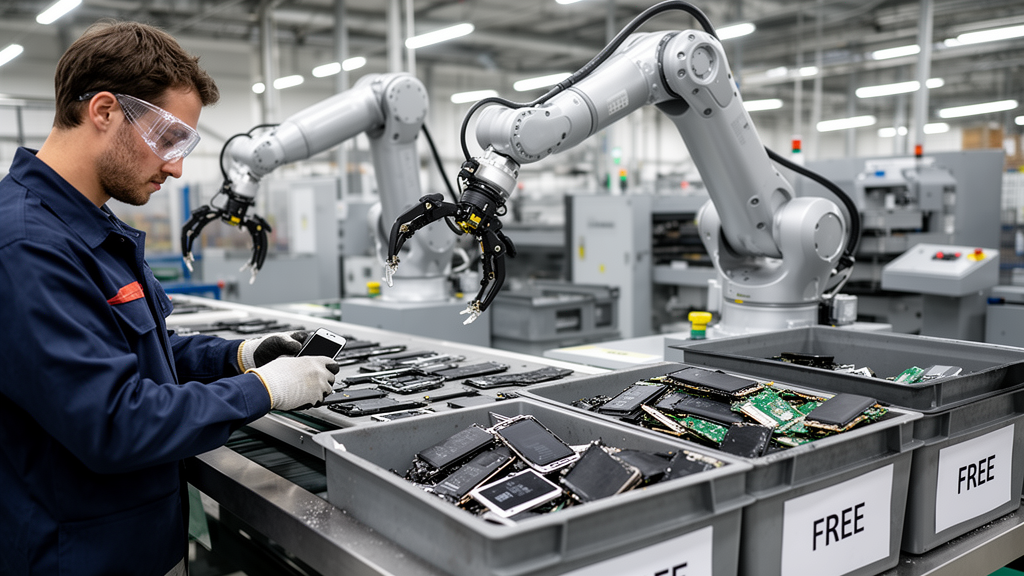
Electronic waste is the fastest-growing solid waste stream in the world, and discarded smartphones are one of its most stubborn contributors. In 2022 alone, the planet produced more than 62 million tons of discarded electronic products, with projections pointing toward roughly 82 million tons per year by 2030. The WEEE Forum estimated that 5.3 billion phones would be discarded in 2022, many of them languishing in drawers or landfills while trapping valuable materials such as gold, cobalt, and rare earth elements, and leaching hazardous additives into soil and water. A new study published in Frontiers in Robotics and AI proposes a way to recover those components more intelligently: a collaborative robotic disassembly system in which humans and robots share the work of tearing down end-of-life phones.
The research team, led by Soufiane Ameur of Hassan II University, LPRI-EMSI Casablanca, and Arts et Métiers Institute of Technology, designed a proof-of-concept framework built around six specialized stations. Each station handles a distinct task: sorting incoming devices, extracting shells, removing batteries, pulling out screens, extracting cameras, and finally unscrewing and removing motherboards. The stated goal is 100 percent component recovery, with every extracted part routed along its own recycling path via conveyors, RFID tagging, and diverter systems. Rather than relying on robots alone, the architecture deliberately mixes human operators and robotic arms, assigning each station a different collaboration type ranging from synchronized cooperation to full human-robot collaboration.
The choice of hardware reflects the delicate nature of the task. The researchers selected the UFactory Lite 6, a compact collaborative robot with a 440-millimeter reach and a 600-gram payload capacity, well suited to handling lightweight components like printed circuit boards and screens in confined workspaces. The six-degree-of-freedom cobot can swap between a conventional gripper and a vacuum gripper depending on the task, while a Logitech C925e camera provides real-time object detection and localization. UF Studio software translates camera data into executable robot commands, allowing the arm to identify and interact with disassembly components dynamically.
A central challenge in disassembling phones is that no two devices arrive in the same condition. Returned or damaged units present design variability, unexpected defects, and sudden deformations that frustrate rigid automation. Fully automated industrial systems such as Apple’s Liam and Daisy achieve impressive throughput, roughly 11 seconds per iPhone 5s for Liam 1.0 and around 200 iPhones per hour for Daisy, but they depend on dedicated equipment limited to specific phone models. The proposed system instead embraces flexibility: the disassembly sequence itself adapts to device architecture, with the process constrained to begin with either shell removal or screen extraction, and battery extraction occupying the second or third position in the sequence. Under these logical constraints, 24 feasible station sequences remain out of 120 possible orderings.
To keep the line safe and functional, the researchers mathematically formulated more than 30 operational and collaborative constraints. These include minimum distances of 40 centimeters between objects on conveyors, robot reachability verified through forward-kinematics modeling with Denavit-Hartenberg parameters, payload torque limits, conveyor and diverter speed synchronization, heater temperature ranges for loosening glued screens, flip-over timing so the phone-turning unit never becomes a bottleneck, and unscrewing time limits for the one to ten screws that may secure a motherboard. Human factors enter the equations too: a cognitive overload constraint caps the workload assigned to operators, and a proximity-aware constraint forces the robot to slow down as it approaches a human, though the authors note that cognitive workload was not actually measured with participants in this study.
Communication between humans and machines relies on two channels. A standardized taxonomy of nine hand signs and matching voice commands covers sorting feedback, stopping and resuming work, task handovers, and tool requests. The gesture recognition module, built on the YOLOv12n model and trained on a custom dataset of 317 annotated images across four gesture classes, achieved a precision of 84.8 percent, with example detections registering confidence scores between 0.91 and 0.94 on a Raspberry Pi 5. Voice commands processed by Whisper-base showed inference times of 2.3 to 2.8 seconds, with real-time factor values below 1, meaning the system processed audio faster than real time. The authors caution, however, that this voice latency could be unsuitable for time-critical robot commands.
The validation proceeded at three levels. A RoboDK digital simulation modeled the full six-station layout and produced a nominal single-phone processing time of 2 minutes and 32.3 seconds, though diverters and tilting mechanisms had to be represented conceptually rather than physically. A single-station bench test with the actual UFactory Lite 6 cobot measured real execution times for detection and robotic manipulation at Station 0. Finally, a constraint-driven Python simulation ran 200 iterations of a 10-phone batch under randomly varying parameters, yielding an average cumulative processing time of 955.37 seconds, or 95.54 seconds per phone. Station 5, the motherboard extraction stage, was the slowest at 177.80 seconds, while Station 0 was the fastest at 127.38 seconds. Error rates ranged from 3.23 to 4.1 percent across stations, with Station 5 showing the highest rate. The researchers emphasize that this per-phone figure is a simulation-based average, not a measured industrial throughput.
The human-robot collaboration scenarios illustrated where the hybrid approach pays off. In Station 0, if the robot mistakenly classifies a phone as unwanted waste, the operator can simply say “bad,” prompting immediate reprocessing instead of waiting for the robot to finish its cycle. In Station 3, where humans extract intact screens and robots handle damaged ones, an operator receiving a broken screen by mistake can say “you take” and hand the task to the robot on the spot, eliminating rerouting queues. In Station 5, if a human steps away mid-task, saying “continue” lets the robot complete both the unscrewing and extraction autonomously, avoiding a standstill. According to the study, these interactions reduced downtime and improved task continuity by letting robots autonomously absorb failed or delayed human operations.
The comparative analysis places the proposed system against both fully automated and semi-automated alternatives. While Liam and Daisy clearly win on raw speed for their targeted iPhone models, the collaborative framework handles heterogeneous phone models with mechanical separation, heating, and unscrewing modules, combining robotic precision with human judgment. Other systems in the comparison table reported error or success rates such as roughly 12 percent for a fully automated circuit-board extraction system and 11.7 percent for a freezing-and-impact disassembly approach, but the authors note that direct comparison of flow errors was not possible because most studies do not report this metric or use equivalent definitions.
The authors are candid about the limits of the work. No economic profitability analysis was performed; a full industrial assessment would need to account for equipment, maintenance, energy, wages, and recovered-component value, none of which were monetized in the simulation. Safety constraints were evaluated conceptually and in simulation only, and real deployment would demand physical risk assessment, emergency-stop testing, and compliance with collaborative-robot safety standards. Future work includes participant-based ergonomic and cognitive-load experiments, reinforcement learning for trajectory planning and task reallocation, and multimodal sensing with 3D vision and tactile feedback. Extending the approach to tablets and other consumer electronics could broaden its impact on circular-economy goals, but for now the study stands as a demonstration of technical feasibility, with industrial-scale validation still to come.
Subject of Research: A simulation-based collaborative robotic disassembly system for recycling end-of-life phones.
Article Title: Design and simulation of an interactive human robot disassembly system for end of life phones
Article References: Ameur, S., Tabaa, M., Karboub, K., Hamlich, M., & Bearee, R. (2026). Design and simulation of an interactive human robot disassembly system for end of life phones. Frontiers in Robotics and AI, 13, Article 1885382. https://doi.org/10.3389/frobt.2026.1885382
Image Credits: AI Generated
DOI: 10.3389/frobt.2026.1885382
Keywords: e-waste, robotics, human-robot collaboration, phone recycling, disassembly, gesture recognition, voice commands, simulation, circular economy, cobots, Design, interactive
News Source: Denise Maddox. (October 27, 2026). Robots and Humans Team Up to Tear Apart Old Phones in Simulated Recycling Line. Scienmag.