In a landmark study poised to revolutionize our understanding of aquatic biomechanics and collective animal behavior, researchers have unveiled groundbreaking insights into fish locomotion, sensory mechanisms, and schooling dynamics through the use of sophisticated robotic swimmers. This innovative research, led by A. Ijspeert, F. Mondada, and E. Standen among others, was recently published in Nature Communications (2026), presenting an unprecedented convergence of robotics, biology, and fluid dynamics poised to reshape how we interrogate natural systems.
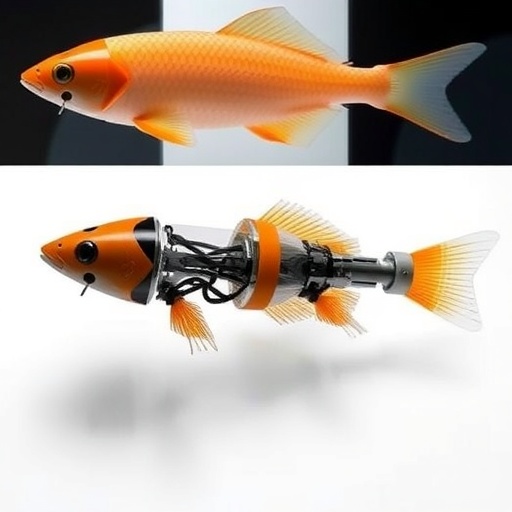
The core of this research lies in the creation and deployment of bioinspired robotic fish that mimic the complex movements and interactive behaviors of real fish in their natural aquatic environments. These robotic swimmers are not mere flap-and-wave machines; rather, they embody an intricate understanding of fish musculature, body flexibility, and tail-fin oscillations which are critical for achieving efficient propulsion and precise navigation. By emulating these biomechanical parameters, the robots bridge the gap between static laboratory observations and the dynamic realities of underwater locomotion.
Significantly, the researchers constructed their robotic swimmers with highly adaptable materials and embedded sensor arrays that replicate the lateral line system—a sensory organ unique to fish that detects water flow and pressure gradients. By integrating artificial lateral line sensors, these robots can perceive their surrounding hydrodynamics, enabling them to react to changes in water currents and the positions of neighboring robots similar to how fish coordinate movements within their schools. This sensory mimicry provides robust data on feedback mechanisms underlying collective swimming.
Perhaps most captivating is the study’s exploration into schooling behavior using these robotic fish. Schooling, a highly coordinated group movement phenomenon, involves complex decision-making processes across multiple scales of spatial and temporal interactions that have eluded full comprehension due to observational challenges in wild settings. The robotic platform enables controlled experiments in which variables such as robot speed, lateral positioning, and sensory input can be independently manipulated to reveal causal relationships governing schooling patterns.
The findings from these experiments underscore the pivotal role of hydrodynamic cues perceived through the lateral line system in maintaining group cohesion and optimal energy expenditure during collective swimming. The robots demonstrated that subtle adjustments in tail-beat synchronization and inter-individual spacing are essential to reduce drag forces and leverage wake vortices generated by leading swimmers. This confirms longstanding hypotheses about energy-efficient swimming in natural fish schools while providing quantifiable evidence through robotic emulation.
By leveraging advanced computational fluid dynamics simulations coupled with real-time sensor feedback on the robots, the team traversed new territory in deciphering the interplay between biomechanics and environmental sensing. The robots’ capacity to detect perturbations and adapt their swimming kinematics allowed the researchers to map how individual sensory inputs integrate within the collective decision-making architecture of fish schools. Such mechanistic insights are challenging to acquire through biological observation alone, highlighting the power of robotic proxies.
Beyond fundamental science, this synergy of biomimetic robotics and neuroethology presents promising translational applications, especially in the fields of underwater robotics and environmental monitoring. Robotic swimmers capable of adaptive and collective movement could be deployed for efficient oceanographic data collection, hazardous substance detection, or even marine life conservation efforts by mimicking natural species without disturbing ecosystems. Their energy-efficient swimming mechanics gleaned from biological systems offer substantial sustainability advantages over conventional underwater vehicles.
Moreover, the interdisciplinary approach of this research opens novel avenues for understanding evolutionary biology and functional morphology. The bioinspired design principles extrapolated from fish locomotion may shed light on how evolutionary pressures shaped muscle architecture, neural control circuits, and sensory modalities, and how these adaptations culminated in the remarkably efficient swimming strategies observed across diverse species.
Incorporating state-of-the-art materials science, the robotic fish benefit from soft robotics technology that enables fluid-like flexibility and durability critical for operating in turbulent aquatic environments. These materials ensure the robots can withstand continuous, repetitive motion and hydrodynamic stresses while replicating the natural undulatory movement patterns more faithfully than rigid-bodied machines.
From a control systems perspective, embedding decentralized neural network models within the robotic swimmers simulates the distributed nervous systems of fish, allowing each robot to operate semi-autonomously yet coherently within a school. This approach simulates biological signal integration and reaction times, providing new insights into how local interactions lead to emergent, coordinated group behaviors without central control.
Furthermore, the researchers investigated sensory noise and environmental variability effects on schooling robustness, demonstrating how biological systems tolerate and adapt to imperfect information. Through calibrated experiments, robotic schools maintained cohesion under changing flow conditions and sensory perturbations, reinforcing the idea that biological groups employ redundancy and feedback to stabilize collective movement.
This research exemplifies how technological innovation can serve as a proxy to unravel complexities in biological systems that conventional observation or measurement techniques cannot easily access. Robotic fish not only replicate but extend the behavioral repertoire of living fish, offering manipulability that enables hypothesis testing under highly controlled conditions, thereby bridging the gap between theoretical modeling and empirical biology.
The societal implications of unveiling how fish navigate, sense, and interact collectively extend beyond academic curiosity. Understanding these principles refines our knowledge of animal behavior, promotes biodiversity preservation strategies, and could inspire novel algorithms for swarm robotics used in industries ranging from agriculture to search-and-rescue missions.
As this pioneering research pushes the frontier of interdisciplinary science, it embodies a paradigm shift—where biology informs engineering and robotics provide a living laboratory for natural phenomena. The successful replication of fish swimming and schooling in robotic form marks a major milestone, underscoring the value of integrated efforts across fields to deepen our grasp of life’s subtle and complex movements beneath the waves.
In conclusion, “Swimming with robots: investigating fish locomotion, sensing, and schooling behavior with robotic swimmers” heralds a new era in the study of aquatic life, merging robotics and biology to unlock secrets hidden in fluid dynamics and animal behavior. The insights derived not only answer long-standing questions about fish movement and social interaction but also pave the way for technological innovations that harmonize with nature’s elegance and efficiency.
The research team’s collaborative efforts exemplify cutting-edge science’s potential to unravel biological complexity through artificial embodiment, illuminating how organisms adapt to their environments and providing a blueprint for sustainable, adaptive robotic designs inspired by evolutionary success stories found in the natural aquatic world.
Subject of Research: Investigation of fish locomotion, sensory mechanisms, and collective schooling behavior through bioinspired robotic swimmers.
Article Title: Swimming with robots: investigating fish locomotion, sensing, and schooling behavior with robotic swimmers.
Article References:
Ijspeert, A., Mondada, F., Standen, E. et al. Swimming with robots: investigating fish locomotion, sensing, and schooling behavior with robotic swimmers.
Nat Commun (2026). https://doi.org/10.1038/s41467-026-72478-6
Image Credits: AI Generated
Tags: aquatic biomechanics researchbiohybrid robotic systemsbioinspired robotic swimmerscollective animal movement studiesfish musculature and flexibilityfish schooling behaviorfish sensory mechanismsfluid dynamics in aquatic animalslateral line sensor technologyrobotic fish locomotionrobotics in biological researchunderwater propulsion techniques