Robot-assisted total hip arthroplasty achieved implant orientation precision in patients with severe Crowe type II through IV dysplastic hip osteoarthritis comparable to outcomes observed in mild Crowe type I cases, according to a retrospective matched-cohort study conducted at Nagoya University Hospital. The investigation evaluated whether advanced anatomical deformities and deficient acetabular bone stock compromise the alignment accuracy of robotic systems during primary reconstruction. While angular placement of the acetabular component matched planned trajectories across both cohorts, the study revealed that vertical displacement of the hip joint centre occurred in sixteen percent of severe cases. Researchers evaluated twenty-five hips affected by Crowe types II through IV deformities alongside seventy-five matched Crowe type I control hips, tracking clinical metrics, complications, and radiographic landmarks. The findings provide quantitative evidence that robotic navigation maintains high angular reliability in complex dysplastic anatomy, while highlighting mechanical challenges presented by inferior osteophytes during reaming.
Dysplastic hip osteoarthritis presents substantial technical challenges during total hip arthroplasty compared to primary osteoarthritis due to deficient acetabular bone coverage, which threatens initial implant fixation and stability. Structural deformities and proliferating osteophytes obscure native anatomical landmarks, complicating accurate cup positioning at the true anatomical hip joint centre. In severe cases classified as Crowe type II or higher, deficient bone stock often requires structural bulk bone grafting or augments to achieve adequate support. Although superior positioning of the acetabular component provides an option to gain bony coverage, elevated hip centres raise biomechanical concerns regarding increased joint reactive forces, anterior impingement, and potential long-term socket loosening. To determine whether robotic assistance overcomes these structural barriers, the investigative team addressed three primary clinical questions examining whether cup orientation accuracy remains equivalent between mild and severe dysplasia, whether postoperative hip centres match planned locations, and whether clinical outcomes differ between groups.
The study protocol was approved by the Ethics Committee of Nagoya University Hospital, and all participating patients provided informed consent. Researchers reviewed twenty-five hips in twenty-two patients with Crowe type II or higher osteoarthritis who underwent robot-assisted total hip arthroplasty between September 2023 and April 2025, with follow-up for one year or longer. From an initial pool of one hundred twelve hips treated with robotic arthroplasty for Crowe type I osteoarthritis during the identical timeframe, seven hips lost to follow-up were excluded, leaving one hundred five eligible cases. Investigators utilized one-to-three propensity score matching with a caliper width of 0.2 based on age, sex, and body mass index to establish a comparison cohort of seventy-five Crowe type I hips. The severe dysplasia cohort comprised three males and nineteen females with a mean age of 60.8 years, while the matched mild cohort included ten males and fifty-three females with a mean age of 61.3 years.
Preoperative planning was executed using the MAKO robotic system, which segmented pelvic computed tomography scans and established coordinate systems using anatomical landmarks. Surgeons planned to seat the acetabular cup at anatomical height using the inferior endpoint of the teardrop as the reference landmark. Medialisation was planned to bring the component into contact with the medial wall. Because superior displacement of the hip joint centre by ten millimetres or more increases the risk of anterior impingement, superior displacement up to ten millimetres was permitted only when necessary to manage superior acetabular bone defects. Surgical plans targeted a centre-edge angle of zero degrees or greater, incorporating autologous bulk bone grafting to reinforce deficient host bone. Notably, every patient in the operative cohort achieved a planned centre-edge angle of zero degrees or higher without exceeding the ten-millimetre superior displacement limit.
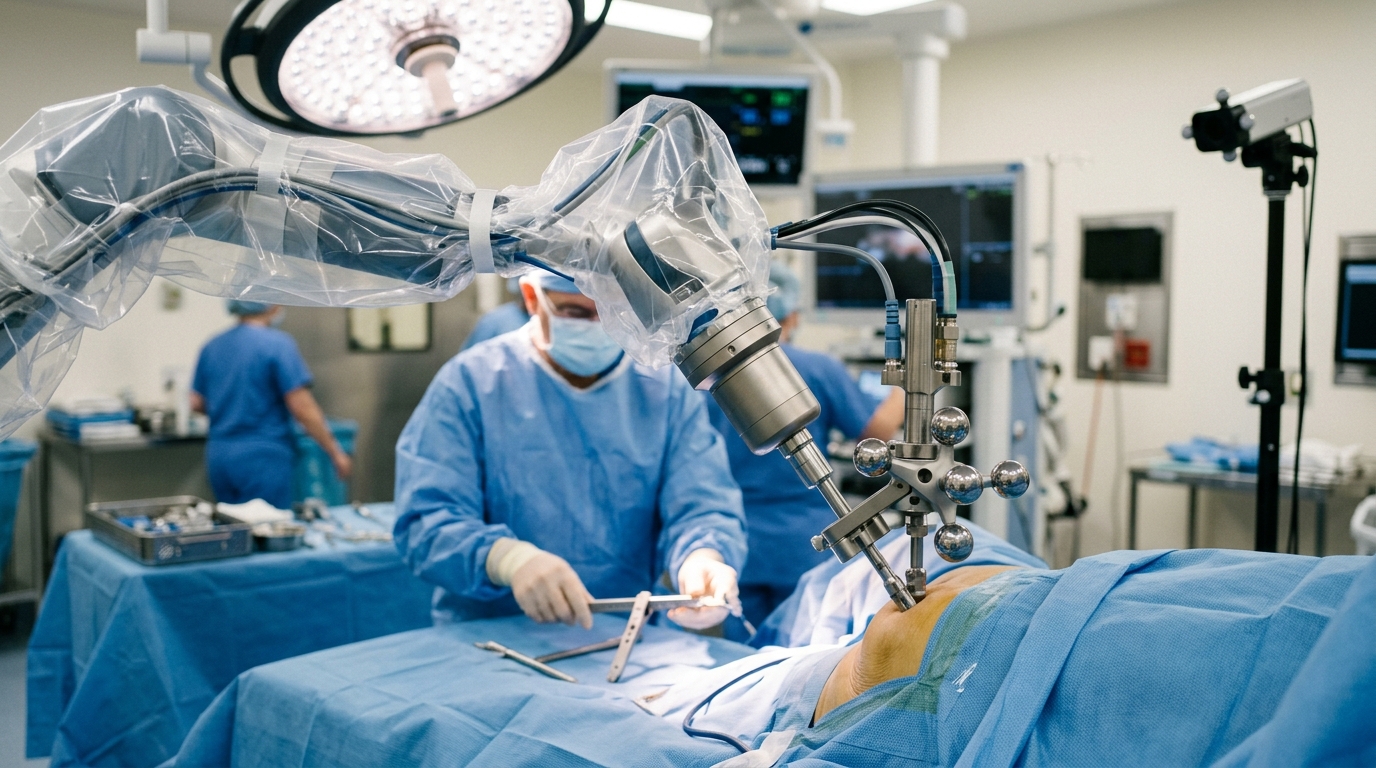
All surgical procedures were performed with patients in the lateral decubitus position using a standard posterior approach. Prior to skin incision, surgeons attached a dedicated tracker to the pelvis using three pins. Following surgical exposure of the acetabulum, registration was completed through thirty-two surface-matching points across the pelvis. After verifying registration accuracy, single-sized acetabular reaming and cup placement were executed under continuous three-dimensional real-time robotic navigation. For cases requiring structural augmentation, initial reaming was completed at the anatomical position, followed by bulk bone transplantation secured with bioabsorbable GrandFix screws, after which repeat reaming contoured the graft before placing the Trident II cup. Planned target alignment was standardized to forty degrees of radiographic inclination and twenty degrees of radiographic anteversion per Murray’s definitions. Femoral stems, including Exeter, Insignia, and Secur-Fit Advanced designs, were manually inserted, and postoperative full weight-bearing ambulation training was initiated.
Postoperative evaluations occurred at one week using computed tomography imaging and standardized anteroposterior radiographs obtained at a distance of 1.1 metres centred on the pubic symphysis. Radiographic cup inclination and anteversion angles were determined relative to the functional pelvic plane using ZedHip three-dimensional templating software. Absolute accuracy error was defined as the difference between target orientation and measured postoperative orientation, while absolute navigation error represented divergence between intraoperative display values and postoperative measurements. Outliers were designated as cases demonstrating navigation errors of five degrees or greater and ten degrees or greater. Radiographic measurements referenced to the inter-teardrop line quantified horizontal and vertical distances from the teardrop to the cup centre, defining high cup placement as a vertical distance of twenty-eight millimetres or greater. Centre-edge angles were measured from the original acetabular rim excluding graft tissue, and leg length discrepancies were recorded.
Radiographic analysis demonstrated comparable angular accuracy between cohorts, with mean postoperative inclination measuring 39.1 degrees in the severe group and 39.8 degrees in the control group, alongside mean anteversion values of 19.0 degrees and 19.4 degrees, respectively. Absolute accuracy errors for inclination and anteversion averaged 2.1 degrees and 2.4 degrees in Crowe type II through IV cases, compared to 1.8 degrees and 1.9 degrees in Crowe type I cases, showing no statistically significant variation. Navigation errors similarly showed no significant differences, averaging 1.6 degrees for inclination and 1.7 degrees for anteversion in the severe cohort, versus 1.3 degrees and 1.4 degrees in the mild cohort. Navigation errors exceeding five degrees occurred in two severe cases, representing eight percent, and two control cases, representing 2.7 percent, demonstrating no significant difference. No patient in either cohort exhibited navigation errors exceeding ten degrees, indicating high placement precision.
In contrast to angular precision, spatial coordinates revealed significant anatomical divergences between cohorts following reconstruction. Horizontal teardrop-to-cup distances averaged 32.0 millimetres in the Crowe type II through IV group compared to 34.4 millimetres in the Crowe type I group, indicating a significantly more medial position. Vertical distances averaged 23.6 millimetres in the severe cohort versus 19.8 millimetres in controls, establishing a statistically significant superior elevation of the prosthetic hip centre. Four hips in the severe cohort, representing sixteen percent, exhibited high cup placement exceeding the twenty-eight millimetre vertical threshold, displaying an average superior displacement of 5.2 millimetres beyond the preoperative surgical plan. No hips in the control group exhibited high cup placement. Furthermore, postoperative cup centre-edge angles were significantly smaller in the severe cohort at 15.4 degrees compared to 29.3 degrees in controls, while residual leg length discrepancy measured minus 4.0 millimetres versus positive 0.3 millimetres.
Surgical and clinical outcomes reflected the heightened complexity of reconstructing dysplastic hips without causing elevated perioperative morbidity. Mean operative duration was significantly longer for the Crowe type II through IV group at 118.2 minutes compared to 95.0 minutes for the Crowe type I cohort, although intraoperative blood loss remained statistically indistinguishable between groups at 395 grams and 318 grams. Complication profiles demonstrated equivalent safety, with the severe cohort experiencing one intraoperative femoral calcar fracture and one greater trochanter fracture, while the mild cohort recorded one calcar fracture and one postoperative infection. Although patients presenting with severe dysplasia exhibited significantly lower preoperative functional scores on the Harris Hip Score at 46.2 compared to 57.7 in controls, both groups achieved substantial postoperative recovery at final follow-up, reaching scores of 83.8 and 89.3, respectively, with no statistically significant difference between cohorts and zero observed dislocations.
The authors attributed superior cup displacement in sixteen percent of severe cases to mechanical interference from proliferating inferior acetabular osteophytes during bone preparation. In robotic milling, osteophyte resistance can trigger haptic boundary containment, but bypassing these limits risks inadvertent superior displacement of the reamer and cup. To prevent unintended elevation, the surgical team recommended meticulous resection of inferior osteophytes prior to acetabular reaming or employing a staged reaming sequence starting with smaller instruments. The investigators noted important limitations, including the retrospective single-centre design, a modest sample size that may not detect minor differences in rare complications, and a mean follow-up of 22.4 months that cannot assess long-term implant survival or polyethylene wear. Additionally, anatomical variation across Crowe types II, III, and IV introduced internal heterogeneity. Nonetheless, the authors concluded that robotic assistance delivers dependable implant orientation in severe dysplastic osteoarthritis, supporting surgical utility despite persistent anatomical constraints.
Subject of Research: Accuracy and clinical outcomes of robot-assisted total hip arthroplasty in severe dysplastic hip osteoarthritis
Article Title: Robot-assisted total hip arthroplasty for Crowe type II or higher hip dysplasia
Article References: Asai, H., Osawa, Y., Takegami, Y., Funahashi, H., Ido, H., & Imagama, S. (2026). Robot-assisted total hip arthroplasty for Crowe type II or higher hip dysplasia. Archives of Orthopaedic and Trauma Surgery, 146(1), Article 407. https://doi.org/10.1007/s00402-026-06552-5
Image Credits: AI Generated
DOI: 10.1007/s00402-026-06552-5
Keywords: total hip arthroplasty, robot-assisted surgery, Crowe classification, hip dysplasia, dysplastic hip osteoarthritis, acetabular cup positioning, radiographic inclination, radiographic anteversion, MAKO robotic system, Harris Hip Score, propensity score matching, bulk bone grafting, inferior acetabular osteophytes, leg length discrepancy, ZedHip software, high cup placement, haptic boundary
News Source: Ophelia Keating. (November 17, 2026). Robotic Hip Arthroplasty Matches Angular Precision in Severe Hip Dysplasia Cases. Scienmag.