…
The distinction between assessment and control is central to understanding why this framework represents a meaningful step forward for collaborative robotics. In many industrial settings, ergonomic evaluation remains a retrospective activity: an analyst observes a task, scores it with a tool such as RULA, and recommends changes after the fact. Even when adjustable fixtures or height-variable tables are introduced, they are typically tuned once at the start of a shift or when a new operator arrives, and then left unchanged. The human body, however, does not hold a single static posture for the duration of a task. As fatigue accumulates, as parts shift position, or as attention moves between subtasks, operators drift into less favorable configurations, often without awareness. A closed-loop system that treats posture as a live signal rather than a periodic checkpoint can intervene at the moment deviation begins, rather than documenting it afterward.
The choice of elbow flexion as the control variable deserves closer examination. Elbow angle sits at an intersection of practical concerns that few other postural measures occupy. It responds quickly and predictably to changes in workpiece height and horizontal reach, which are precisely the two degrees of freedom the collaborative robot can manipulate in this framework. A workpiece placed too low drives elbow flexion beyond comfortable ranges; one placed too far away forces shoulder flexion and trunk lean, which also register in the elbow angle as the arm extends. Because skeletal tracking libraries estimate joint centers reliably from ordinary RGB imagery, elbow flexion can be computed continuously without gloves, markers, or electromagnetic trackers that would interfere with fine manual work such as screw-driving. This makes it an unusually well-behaved feedback variable: sensitive to the manipulated parameters, robustly observable, and directly tied to established ergonomic criteria.
It is worth noting the deliberate separation between the control variable and the evaluation metric. Elbow flexion drives the loop, but the study does not claim that optimizing a single joint angle guarantees overall postural health. Instead, the full RULA score, which aggregates upper-arm, lower-arm, wrist, trunk, neck, and leg postures along with muscle use and force considerations, serves as the outcome measure. This design guards against a common failure mode in automated ergonomic systems, where optimizing one observable quantity inadvertently worsens another. If the robot raised a workpiece to relieve elbow flexion but thereby encouraged neck flexion or an elevated shoulder, the RULA comparison between fixed and adaptive conditions would reveal the trade-off. The reported improvements across the composite score suggest that the adaptation strategy moved the whole posture pattern in a favorable direction rather than merely relocating discomfort.
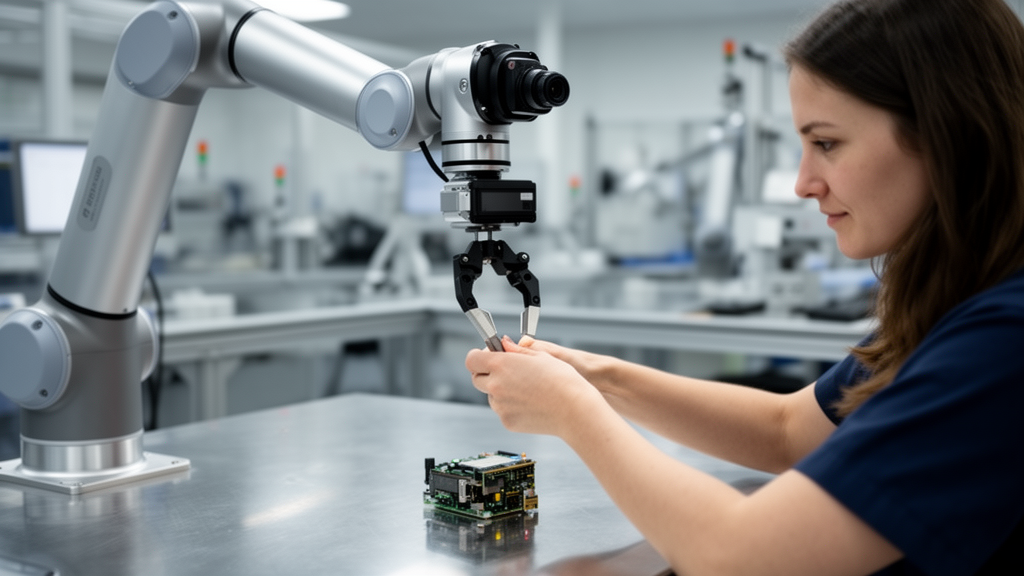
The sensing architecture reflects pragmatic engineering choices that matter for real deployment. Two independent cameras, one facing the operator’s upper body and one mounted above and looking down at the hand, address a genuine occlusion problem in manual assembly. When an operator leans over a workpiece, the torso camera loses sight of the wrist and fingers, yet wrist posture contributes meaningfully to ergonomic risk in precision tasks. Processing each stream separately, without cross-camera registration or triangulation, keeps the pipeline simple and avoids error accumulation from imperfect extrinsic calibration. The trade-off is that the system does not build a unified three-dimensional skeleton; instead, each camera serves its own dedicated analysis. For a task like screw-driving, where upper-body posture and wrist orientation both matter but full-body kinematics are less critical, this division of labor is a reasonable compromise between accuracy, latency, and robustness.
The participant sample of thirty, performing screw-driving under both fixed and adaptive conditions, gives the evaluation a within-subject structure that is well suited to this kind of comparison. Each participant serves as their own control, which reduces the influence of individual differences in baseline posture, task strategy, and anthropometry on the contrast between conditions. Screw-driving is a useful representative task because it combines repetitive upper-limb motion with precision demands, and because workpiece position strongly determines whether the operator works with a neutral arm or a raised, abducted shoulder. The finding that the adaptive condition reduced the influence of participant height on ergonomic outcomes is particularly significant for mixed-workforce environments. Fixed workstations inherently encode an assumed body size; operators far from that assumption absorb the mismatch as postural strain. Continuous adaptation effectively removes much of that hidden penalty.
The psychological measures reported alongside the physical ones add an important dimension to the evidence. Trust and acceptance are not soft add-ons in human-robot collaboration; they determine whether operators actually use adaptive systems as intended or override and avoid them. A robot that moves the workpiece unexpectedly could plausibly unsettle operators, especially during precision tasks where sudden motion near the hands might be perceived as hazardous. The observation that trust and acceptance increased while perceived safety was not compromised suggests that the adaptations were experienced as helpful rather than intrusive. This outcome likely depends on the nature of the adjustments: small, task-relevant repositioning of the workpiece, rather than motion of the robot arm through the operator’s personal space, keeps the interaction within familiar boundaries while still delivering ergonomic benefit.
Placing this work in the context of prior approaches clarifies its contribution. Adjustable workstations, whether manual or motorized, have long been proposed as a remedy for anthropometric variability, but they generally require deliberate operator action or scheduled adjustment. Posture-based robot motion adaptation has been explored, yet much of that literature focuses on planning robot trajectories around human postures rather than reshaping the shared workspace to improve the human posture. Vision-based ergonomic assessment systems demonstrate that camera-derived skeletal data can support RULA-style scoring in real time, but they typically stop at measurement. Optimization frameworks that balance throughput against ergonomic risk operate largely at the planning stage. The present framework closes the gap between these threads by using the same posture estimate both as a diagnostic and as a live feedback signal, converting perception directly into continuous physical adjustment during task execution.
The implications for industrial practice extend beyond the specific screw-driving scenario. Any collaborative task in which the workpiece can be repositioned by a robot, and in which operator posture varies with workpiece location, is a candidate for this control strategy. Assembly of small components, inspection tasks requiring sustained visual attention, and packaging operations all exhibit the same structure: a human performing upper-limb work whose quality depends on where the object sits relative to the body. Because the framework relies on commodity depth cameras operating in RGB mode and an open-source pose estimation library, the sensing cost is modest compared with wearable motion capture or instrumented fixtures. The main requirements are camera placement with adequate sightlines, computational capacity for real-time inference, and a cobot with the payload and workspace envelope to move the workpiece smoothly.
Several limitations and open questions naturally follow from the design. The two-camera architecture leaves gaps in coverage when the operator’s body occludes both views simultaneously, and rapid movements can challenge frame-rate-limited pose estimation. The ergonomic criteria that trigger adaptation are predefined rather than learned, so the system adapts to measured posture but does not personalize thresholds to individual comfort preferences over time. The evaluation focused on a single task type and a relatively short task duration, whereas musculoskeletal risk accumulates over hours and across task variety. Fatigue, which changes both posture and the relationship between posture and discomfort, was not a central variable. Future work could explore longer sessions, multiple task types, learned adaptation policies that incorporate individual history, and richer feedback variables that combine elbow flexion with trunk or neck measures to guide more comprehensive repositioning.
Nevertheless, the study demonstrates a principle with broad relevance: posture can serve as the error signal in a feedback loop whose actuator is the robot itself. This reframes the collaborative robot not merely as a tool-sharing partner but as an active component of the ergonomic infrastructure of the workstation. In traditional ergonomics, the environment is engineered to fit a statistical average of human bodies, and residual mismatch is managed through training, rotation, and breaks. A closed-loop adaptive approach shifts the burden of fit from the operator to the system, continuously negotiating the geometry of the task against the live state of the body. As vision-based pose estimation continues to improve in accuracy and efficiency, and as collaborative robots become more prevalent on factory floors, frameworks of this kind point toward workstations that accommodate human variability not by design assumption but by ongoing measurement and response, making ergonomic support a dynamic property of the collaboration rather than a static feature of the equipment.
Subject of Research: …
Article Title: A vision-based closed-loop framework for adaptive ergonomic human-robot collaboration
Article References: Teeravarunyou, S., Vongbunyong, S., Kamolwit, K., Kitirojpan, P., & Lertwittayanuruk, C. (2026). A vision-based closed-loop framework for adaptive ergonomic human-robot collaboration. Frontiers in Robotics and AI, 13, Article 1948863. https://doi.org/10.3389/frobt.2026.1948863
Image Credits: AI Generated
DOI: 10.3389/frobt.2026.1948863
Keywords: human-robot collaboration, ergonomics, computer vision, collaborative robots, RULA, pose estimation, adaptive workstations, manufacturing, closed-loop control, human-centered robotics, vision-based, closed-loop
News Source: Denise Maddox. (October 16, 2026). Robot Watches Your Elbows: Vision-Guided Cobots Reshape the Workstation in Real Time. Scienmag.