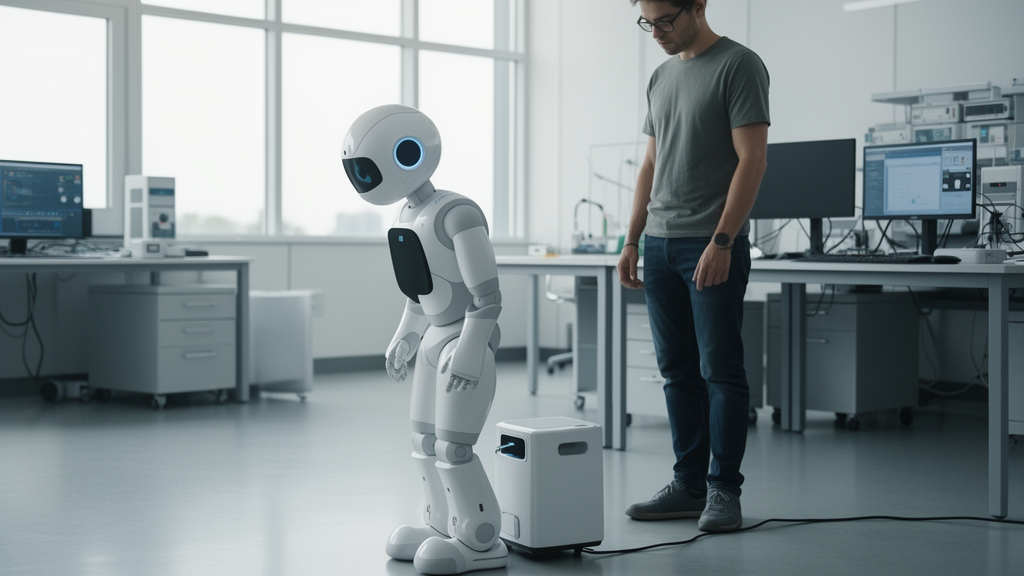
The humanoid robot NAO, a familiar face in hospitals, classrooms and assisted-living facilities, has long been undermined by a mundane problem: its battery. Depending on how hard it works, the robot runs for roughly 90 to 120 minutes before needing a recharge that takes three to four hours through its standard interface, forcing caregivers to interrupt sessions and plug it in by hand. A new open-access study published in Discover Robotics on 23 July 2026 presents an engineered answer: a fully integrated autonomous charging system that lets NAO detect low battery, navigate to a wall-mounted docking station, align itself, connect electrically and resume its tasks without any human assistance.
The work, led by Aatheethyaa Dhanasekaran and Vincenzo Bonaiuto with Andrea Zanela, expands on the authors’ earlier prototype with a complete end-to-end architecture. It combines three hardware elements: a redesigned battery compartment cover fitted with conductive charging pads, a compliant wall-mounted docking station, and an Internet of Things-based control system built around an Arduino MKR WiFi 1010 microcontroller with a NINA-W102 WiFi module. Communication between robot and station runs over an HTTP-based web server on a local network, allowing bidirectional exchange for docking guidance, engagement verification and charging supervision.
The redesigned cover was modelled in computer-aided design and 3D-printed in polylactic acid via fused deposition modelling. Two rectangular conductive pads of adhesive copper tape, each 20 by 100 millimetres and separated by a 15-millimetre insulating gap, sit on its outer surface. The team notes this copper-tape solution suits a prototype operating at up to 2 amperes and 25 volts, with tin-plated copper contacts a candidate for future versions. A raised guide with chamfered edges between the pads helps funnel the robot into correct alignment during docking. The pads connect to the battery through a protected break circuit that isolates them during normal walking, preventing accidental short circuits, and the original charging jack remains accessible for manual charging. The cover’s mass differs from the original by only a few grams, and the authors observed no effects on walking stability or posture transitions, so recalibration of the robot’s dynamic model was deemed unnecessary.
The docking station itself is a wall-mounted cross-shaped frame of 250 by 250 millimetres with four vertical supports 350 millimetres tall carrying a movable contact plate of 120 by 85 millimetres. Two copper contacts, 20 by 90 millimetres, align with the robot’s pads, and a neoprene layer beneath them adds compliance, letting the plate passively adapt to small misalignments. The authors cite prior work showing wall-mounted configurations improve docking reliability by reducing environmental variability compared with floor-mounted designs.
The most distinctive sensing element is a trio of VL53L0X time-of-flight laser distance sensors from STMicroelectronics, mounted horizontally and spaced 16 millimetres apart. These sensors measure distance by timing laser pulses, work reliably up to roughly two metres with about 3 percent accuracy depending on surface reflectivity, and were fitted with a small white reflective shield on the back of the robot’s head plus a recessed trench housing to reduce sunlight interference. Because the three sensors read a flat surface at slightly different distances, the difference between left and right readings yields the surface tilt through a geometric slope model, giving the robot both range and orientation feedback during its final backward approach. A Hall-effect current sensor, the ACS712ELC-05B, monitors charging current to validate electrical contact; if current falls outside predefined thresholds, charging is interrupted and the robot is commanded to retry.
The team chose marker-based localisation over the deep-learning, marker-less perception pipelines that other groups have explored for charging-socket detection, such as YOLO-based detectors. Those approaches need dataset collection, annotation, network training and real-time inference compute, which the small onboard computer of a humanoid like NAO struggles to provide, and detection can degrade under unusual illumination or occlusion. Instead, the system exploits Naomarks natively supported by the NAOqi framework through the ALLandMarkDetection module: markers guide coarse navigation to a pre-docking area, while time-of-flight sensing and current-based validation handle the final alignment and engagement. The authors describe this as a practical compromise between robustness, simplicity and computational efficiency for a structured indoor environment.
Behaviourally, the system plugs into NAO’s existing architecture through three behaviours governed solely by battery state of charge, read via the ALBatteryProxy getBatteryCharge method. At 25 percent, Attention2charge activates: the robot finishes ongoing tasks, cuts energy use and flashes an LED at 1 hertz to warn users. At 10 percent, Go2charge takes priority over all other tasks, signals with a 2-hertz LED pattern and navigates autonomously to the docking area using marker-based localisation with obstacle avoidance. Once docking begins, the Recharging behaviour disables user interaction, indicated by a 0.5-hertz LED pattern, until charging completes and the robot returns to normal operation.
Experimental validation took place at the ENEA Research Centre in Casaccia, inside the Technologies for Quality of Life Laboratory, in an indoor setting representative of healthcare facilities with typical artificial lighting. Sensor characterisation showed calibrated distance errors of -2.01 millimetres at a nominal 150-millimetre target and +0.61 millimetres at 400 millimetres, and tilt estimates of -29.60 and +30.59 degrees against nominal inclinations of -30 and +30 degrees, angular errors of just +0.40 and +0.59 degrees. Measurement variance increased at 500 millimetres, consistent with the known behaviour of low-cost time-of-flight sensors near their effective range limit, but median filtering kept readings stable enough for pre-docking guidance.
The decisive test was a set of 30 autonomous charging trials, distributed across three NAO robots at roughly ten per robot, each starting from a different initial position with no human intervention. In every trial the robot reached the pre-docking position, initiated docking, established electrical contact and completed the full cycle of fine alignment, mechanical engagement, electrical validation and supervised charging, terminating autonomously when the target state of charge was reached and resuming normal operation afterwards. In a limited number of trials the current-monitoring supervision detected minor misalignments on the first engagement attempt; the system disengaged, ran a new alignment cycle and succeeded on retry, which the authors cite as evidence for the robustness of the closed-loop retry strategy.
The authors are candid about limitations. Extremely adverse illumination, such as strong glare or very low light, may destabilise visual marker detection, and they propose integrating complementary sensing such as LiDAR, whose official external support was discontinued in recent NAOqi releases, for illumination-independent perception in future versions. They also flag that the PLA cover may not withstand rigorous healthcare cleaning procedures and suggest ABS as a replacement, noting its slightly lower density would add no weight. Future work will include long-term field evaluations, refined navigation accuracy and additional perception modalities for more cluttered environments. Even so, the study demonstrates that dependable end-to-end autonomous recharging for a small humanoid robot is achievable with inexpensive hardware, and that removing the manual plug-in bottleneck could meaningfully extend the practical daily service that socially assistive robots deliver in real care settings.
Subject of Research: An autonomous charging and docking system enabling the NAO humanoid robot to recharge itself without human intervention.
Article Title: Design of an autonomous charging system for robot NAO
Article References: Dhanasekaran, A., Bonaiuto, V., & Zanela, A. (2026). Design of an autonomous charging system for robot NAO. Discover Robotics, 2(1), Article 21. https://doi.org/10.1007/s44430-026-00036-2
Image Credits: AI Generated
DOI: 10.1007/s44430-026-00036-2
Keywords: NAO robot, autonomous charging, docking station, socially assistive robots, time-of-flight sensors, healthcare robotics, IoT control, marker-based localisation, battery management, humanoid robotics, 3D printing, charging supervision
News Source: Denise Maddox. (October 29, 2026). Robot NAO Learns to Plug Itself In With a Low-Cost Autonomous Charging Dock. Scienmag.