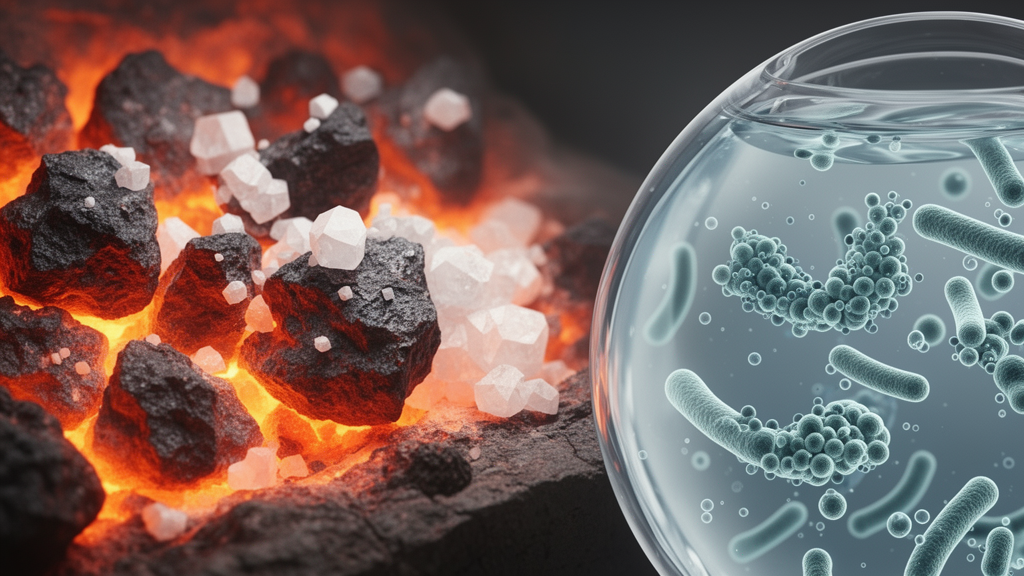
A research team led by scientists from Chengdu University and Chengdu University of Technology has demonstrated that coupling thermal pre-treatment with bacterial leaching unlocks previously trapped vanadium from industrial smelting residue. Vanadium-titanium blast furnace slag, generated during the high-temperature processing of vanadium-titanium magnetite ore, contains substantial quantities of transition metals but holds them locked within resistant silicate and titanate matrices. In raw industrial slag, conventional biological leaching with the acidophilic bacterium Acidithiobacillus ferrooxidans J0506 extracted only twenty milligrams of elemental vanadium per kilogram of solid material, which equates to an extraction efficiency of barely 1.1 percent of the total metal present. By first subjecting the slag to a three-hour roasting regime at 1100 degrees Celsius without adding chemical reagents, the investigators restructured the underlying crystal lattice through reaction with the slag’s intrinsic calcium. When subsequently exposed to bacterial cultures, the reconfigured material released approximately 570 milligrams of vanadium per kilogram of slag, raising overall recovery to approximately 30.0 percent.
Vanadium serves as a transition metal in steel metallurgy, advanced manufacturing, chemical catalysis, and large-scale energy-storage technologies. Because virgin deposits containing pure vanadium mineral phases are exceptionally scarce worldwide, modern supply chains rely heavily on secondary industrial by-products and associated iron ores. Vanadium-titanium blast furnace slag, generated during magnetite smelting in hubs such as Panzhihua, China, represents an abundant secondary resource. However, large-scale generation and long-term stockpiling occupy land and may cause environmental concerns, including dust dispersion and hazardous element migration. Conventional chemical leaching requires substantial energy and reagents, while the slag's alkaline components can cause excessive acid consumption, interfacial passivation, and secondary precipitation.
Direct biological extraction using chemolithoautotrophic microbes has emerged as an environmentally benign alternative, but raw industrial slags present severe crystallographic and geochemical barriers to microbial processing. Chemical analysis by X-ray fluorescence revealed that the Panzhihua slag composition was dominated by silicon dioxide at 26.741 weight percent, calcium oxide at 26.562 weight percent, and titanium dioxide at 22.531 weight percent, alongside magnesium oxide at 7.234 weight percent and iron oxide at 1.254 weight percent. Vanadium pentoxide equivalent accounted for only 0.339 weight percent, translating to an elemental concentration of approximately 1899 milligrams of vanadium per kilogram of dry slag. Initial X-ray diffraction patterns showed that this scarce vanadium was sequestered inside dense, unreactive crystalline networks of perovskite, vanadium dioxide, and trivanadium nonatitanium oxide. Furthermore, scanning electron microscopy revealed compact particle surfaces that offered few accessible interfaces for microbial attachment and rarely showed open mass-transfer channels.
To overcome this solid-phase encapsulation without introducing expensive external chemical additives, the researchers exploited the abundant calcium naturally present inside the waste matrix. The raw slag powder, sieved below 75 micrometers, was heated in a corundum crucible at a controlled ramp rate of two degrees Celsius per minute up to 1100 degrees Celsius and held in air for three hours. The molar ratio of calcium oxide to vanadium pentoxide in the raw material stood at approximately 254 to 1, providing an immense stoichiometric surplus of endogenous calcium. Even if every atom of vanadium within the slag were converted into calcium vanadate, only about 1.2 percent of the slag’s total calcium would be consumed. Post-roasting diffraction patterns confirmed that peaks assigned to unreactive vanadium dioxide and trivanadium nonatitanium oxide diminished, while characteristic peaks representing tricalcium vanadate emerged alongside persistent perovskite and complex calcium-magnesium-aluminum silicates.
This reconstructed mineralogy fundamentally altered the dissolution mechanics during subsequent biological processing in batch shaker flasks. Tricalcium vanadate exhibits far higher proton reactivity than the original refractory titanates, allowing vanadium to dissolve via acid-promoted pathways rather than requiring direct oxidative cleaving by ferric iron. During the bioleaching experiments, carried out at 30 degrees Celsius and 150 revolutions per minute with a 0.5 percent weight-per-volume pulp density, Acidithiobacillus ferrooxidans strain J0506 acted as an in-situ biochemical engine. Harvesting cells during their stationary growth phase and introducing them as a ten percent volumetric inoculum into an iron-supplemented basal salts medium rapidly initiated biological ferrous iron oxidation. As bacteria oxidized ferrous iron during the first three days, the solution oxidation-reduction potential increased from approximately 400 millivolts to 640 millivolts, remaining above 600 millivolts thereafter.
Comparative tests across diverse leaching formulations demonstrated that the biological system significantly outperformed abiotic chemical leaching controls under equivalent initial acidity. The living bacterial culture achieved 570 milligrams of dissolved vanadium per kilogram of slag, outperforming uninoculated hydrochloric acid leaching by 5.7 times, sulfuric acid leaching by 4.8 times, and a cell-free spent microbial medium by 2.85 times. The abiotic mineral acid controls, initially adjusted to pH 1.8 without subsequent acid replenishments, quickly lost leaching efficiency because alkaline calcium and magnesium components neutralized free hydronium ions. In contrast, while the living bacterial culture consumed protons during the initial breakdown of calcium vanadate and early ferrous iron oxidation, subsequent ferric iron hydrolysis and the formation of potassium and hydronium jarosite precipitates continuously generated new protons. This dynamic chemical equilibrium stabilized the solution at a highly acidic pH of approximately 1.6, maintaining favorable leaching conditions without requiring periodic acid titrations.
Microstructural and elemental characterization performed after leaching confirmed profound physical transformation at the solid-liquid interface. Under scanning electron microscopy, the reacted slag particles exhibited noticeable surface roughening, corrosion pits, and dissolution features following bioleaching. Energy-dispersive X-ray spectroscopy indicated qualitative enrichment of iron across these corroded interfaces, corresponding to the deposition of flocculent secondary mineral phases. Complementary powder X-ray diffraction patterns of the bioleaching residues confirmed that dissolved ferric iron had precipitated into crystalline potassium jarosite and hydronium jarosite. The investigators cautioned that while jarosite precipitation releases protons that support leaching, dense surface crusts could potentially encapsulate residual vanadium or trap dissolved metal ions, meaning the reported dissolved values reflect the net aqueous fraction accessible for recovery.
To elucidate the physiological mechanisms enabling Acidithiobacillus ferrooxidans J0506 to thrive within the metal-laden slag leachate, the researchers sequenced and annotated its complete genome. Assembled into a single chromosome and one plasmid totaling 3,451,109 base pairs with a 36-fold sequencing depth, the genomic data revealed the complete enzymatic apparatus required for iron chemolithoautotrophy. The genome encodes the outer-membrane cytochrome Cyc2, periplasmic rusticyanin, downhill cytochrome complexes CoxABC, and reverse electron transport pathways via PetABC and Nuo complexes that drive NAD(P)H generation and ATP synthesis. Crucially, genes dedicated to metal and metalloid detoxification constituted roughly 25 percent of all annotated resistance categories. Seventeen specialized efflux and detoxification systems, including copA, cusAB, czcAC, arsBC, merA, and chrR, work alongside Kdp and NhaA ionic homeostasis regulators to protect cellular machinery against the sudden influx of copper, zinc, nickel, and chromium released during slag breakdown.
Systematic screening of operating parameters identified a suitable operating window for bioleaching the calcified slag. Testing pulp densities from 0.25 percent to 1.0 percent weight-per-volume revealed that peak vanadium extraction occurred at 0.5 percent, yielding 570 milligrams per kilogram; increasing the solids loading to 0.75 percent and 1.0 percent suppressed extraction down to 350 and 170 milligrams per kilogram, respectively. This decline was attributed to the severe buffering capacity of higher solids concentrations, which overwhelmed bacterial acidity generation and accumulated toxic dissolved ions. Varying initial ferrous iron from 1.0 to 7.0 grams per liter showed that 3.0 grams per liter promoted vanadium release, whereas higher concentrations reduced leaching. Testing bacterial inoculum sizes from 5 to 20 percent showed that leaching increased up to 10 percent and plateaued thereafter, supporting 10 percent as a suitable operational level.
Despite these promising bench-scale outcomes, the authors emphasized several fundamental technical constraints that must be addressed before commercial implementation. While utilizing the material’s endogenous calcium avoids the recurring operational expense and supply footprint of external alkaline reagents, roasting at 1100 degrees Celsius for three hours consumes substantial thermal energy. The potential sustainability advantages of the process are strictly confined to eliminating chemical additives and avoiding concentrated acid digestion, rather than reducing overall thermal footprint. Furthermore, the bioleaching cycle required 21 days of incubation at a very dilute 0.5 percent solids loading, which presents engineering challenges for high-throughput industrial bioreactors. Future research must evaluate low-temperature roasting modifications, waste-heat recapture from furnace exhaust, and strategies for intensifying solids loading while tracking time-resolved metal release kinetics across continuous operational systems.
Subject of Research: Bioleaching of vanadium from pretreated vanadium-titanium blast furnace slag using Acidithiobacillus ferrooxidans
Article Title: Endogenous calcification-assisted mineral-phase activation enhances Acidithiobacillus ferrooxidans-mediated vanadium bioleaching from vanadium-titanium blast furnace slag
Article References: Wu, J., Mo, Q., Xi, H., Jiang, M., Zhao, L., Wang, Z., Liang, J., Bai, B., Lei, N., & Zeng, L. (2026). Endogenous calcification-assisted mineral-phase activation enhances Acidithiobacillus ferrooxidans-mediated vanadium bioleaching from vanadium-titanium blast furnace slag. Frontiers in Microbiology, 17, Article 1979054. https://doi.org/10.3389/fmicb.2026.1979054
Image Credits: AI Generated
DOI: 10.3389/fmicb.2026.1979054
Keywords: Vanadium recovery, Acidithiobacillus ferrooxidans, Bioleaching, Blast furnace slag, Endogenous calcification, Thermal activation, Mineral phase reconstruction, Extractive metallurgy, Iron oxidation, Secondary resources, Industrial residue, Solid waste utilization, Microbial leaching, Scanning electron microscopy, Calcium vanadate, Jarosite precipitation, Biomining
News Source: Drew Townsend. (November 26, 2026). Roasting Slag with Endogenous Calcium Boosts Bacterial Vanadium Extraction 28-Fold. Scienmag.