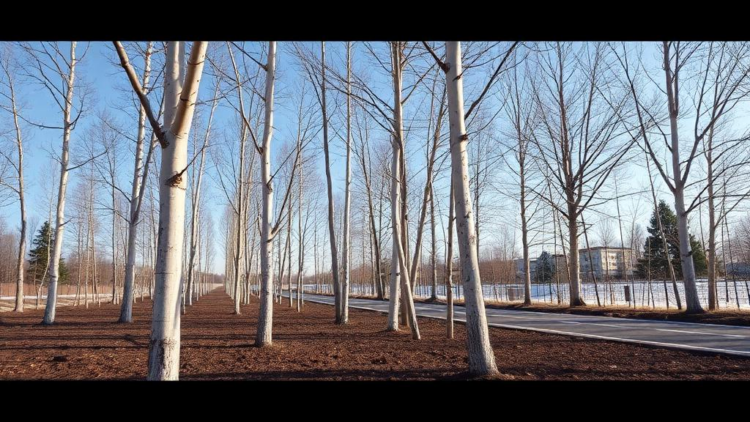
Every week, fleets of road sweepers trundle through cities collecting a gritty, unglamorous slurry of litter, leaves, grit, glass and plastics from the streets. Most of that material, once washed and separated, ends up in landfill or incineration, at considerable cost to councils and the environment. Now a team of researchers in Manchester has shown that the fine residues left over after treatment of these street cleansing residues can do something remarkable: grow healthy trees. In a twelve-month growth trial published in the journal Plant and Soil, silver birch saplings planted in soils manufactured from recovered road sweepings grew as well as, and in some cases slightly better than, saplings planted in commercially certified topsoils and subsoils.
The study, led by Daniel Niepsch of Manchester Metropolitan University and UBU Environmental Ltd, is the first to track tree performance over a full year in growing media derived from road sweeping waste. The researchers planted sixty silver birch (Betula pendula) whips into four waste-derived soil formulations and four commercially available comparator soils, including BS 3882 topsoil, BS 8601 subsoil, Amsterdam tree sand and an enhanced tree sand containing organic fines. By the end of the trial, all sixty trees were alive, and none showed visual signs of nutrient deficiency. Trees in the waste-derived blends were marginally taller on average than those in the commercial soils after eight and twelve months, with statistically significant differences recorded particularly against the subsoil comparator.
The raw material for these experimental soils comes from an unusual industrial source. A fleet of roughly 120 road sweepers collects street cleansing residues within a fifty-mile radius around Greater Manchester. At a physico-chemical treatment plant, the collected material is separated into wet and dry fractions and then washed, sieved and separated by density and attrition. Coarse aggregates larger than four millimetres and sand fractions between 0.075 and 4 millimetres can be reclaimed for construction and landscaping. What remains, a fine residue of silt and clay known as filter cake, currently has no commercial outlet and is typically landfilled. It is this fine fraction, rich in organic matter and plant nutrients, that the researchers identified as a potential soil ingredient.
From this waste-derived material, the team manufactured four test soils. The first was the pure filter cake used on its own. The second mimicked a Stockholm structural soil, blending reclaimed aggregates with 7.5 percent waste-derived material and 7.5 percent PAS100 certified compost. The third and fourth mimicked urban tree sands, one combining equal parts waste material and reclaimed sand, the other adding compost and a small proportion of biochar. Biochar, a carbon-rich product of thermal decomposition of organic matter, was included because it can improve nutrient and moisture retention, sequester carbon and adsorb potentially harmful elements, offering some of the benefits of clay without compromising drainage.
The physico-chemical analysis revealed both promise and caveats. The waste-derived soils showed higher pH, elevated carbon-to-nitrogen ratios and greater organic matter contents than the commercial comparators. Water holding capacity was notably high, and the pure waste material required the least supplementary irrigation of any soil in the trial, needing only 15 litres of additional water over twelve months compared with up to 55 litres for some control soils. However, concentrations of copper, zinc and nickel were approximately ten times higher in the waste-derived soils than in the controls, and zinc exceeded the BS 3882 phytotoxicity threshold of 300 milligrams per kilogram for alkaline soils. The researchers note that the alkaline pH of these materials limits the solubility and plant availability of such elements, and that soil respiration gradually lowers pH over time, so monitoring remains essential.
Tree health was assessed with a combination of destructive and non-destructive techniques. Height and trunk diameter were measured at planting and again after eight and twelve months. Chlorophyll was extracted from leaves in the laboratory and quantified by ultraviolet-visible spectroscopy, yielding total chlorophyll concentrations between 14.7 and 97.1 micrograms per square centimetre, ranges consistent with healthy silver birch reported in earlier studies. Leaf nitrogen contents, measured with an elemental analyser, ranged from 0.95 to 2.98 percent by weight and correlated significantly with chlorophyll concentrations, further indicating that the trees were well nourished regardless of soil type.
Particularly noteworthy is the study’s use of smartphone-based monitoring. By pressing a phone lens directly against a leaf with the flashlight illuminating it from behind, the researchers captured contact images free of background interference, focus variation and distance effects. From the red, green and blue pixel values they calculated chlorophyll estimates and a dark green colour index, a metric originally developed for turfgrass that reflects nitrogen status. These inexpensive, high-throughput measurements tracked the expected seasonal pattern, dipping during winter dormancy and recovering during spring growth, and proved suitable for assessing overall tree health without harming the plants. The approach could make long-term urban tree monitoring far more accessible to researchers and practitioners alike.
The trees were deployed across three environments to test real-world resilience. Twenty-four grew in one-thousand-litre intermediate bulk containers designed to mimic urban tree pits, placed at the treatment plant itself amid heavy traffic and machinery. Another twenty-four grew in thirty-litre bags at a Manchester tree nursery representing an urban background site, and twelve served as greenhouse controls with automated drip irrigation. Trees in the container-based urban setting grew significantly more than greenhouse trees, likely because of the far greater root space, while greenhouse conditions still conferred advantages over the nursery site. These results underline how container volume and environment, not just soil chemistry, shape seedling vigour.
Beyond tree growth, the researchers highlight the carbon implications. UK soils hold an estimated 9.8 billion tonnes of carbon, and soil degradation costs the country around 1.2 billion pounds each year. Digging up and transporting virgin topsoil disturbs soil organic carbon and can stimulate carbon dioxide emissions; one study on the Chinese Loess Plateau recorded a 33 percent increase in CO2 emissions from fields receiving imported topsoil. The waste-derived soils, with their elevated organic matter and carbon-to-nitrogen ratios above 25 to 1, suggest more stable soil organic carbon that could sequester carbon in urban landscapes while avoiding the emissions associated with soil displacement. The authors calculate that technosols of this kind have substantial per-hectare carbon and CO2 storage potential, although they caution that long-term measurements of soil CO2 fluxes and biomass gains are needed to complete the carbon budget.
The path from pilot trial to city streets still requires regulatory clearance. Under the UK’s Publicly Available Specification PAS 115, road sweeping and gully waste can be processed for use in soils, but any commercial product must also satisfy the End-of-Waste Criteria of the Waste Framework Directive, demonstrating that recycled materials meet quality and safety standards before being reclassified as products. The authors also stress that silver birch is relatively tolerant of metal contamination, immobilising metals through deep roots and partnerships with ectomycorrhizal fungi, so longer trials exceeding three years and tests with other common street trees such as lime, plane and sycamore are needed. If those hurdles are cleared, the implications are considerable: a waste stream currently burdening landfills could be transformed into tailored growing media for the urban tree-planting schemes that governments are increasingly mandating, closing a loop that benefits waste management, soil conservation, carbon storage and the canopies that cool and green our cities.
Subject of Research: Use of treated road sweeping residues as manufactured soils for urban tree growth
Article Title: Using recovered road sweepings in manufactured soils: a Betula pendula growth trial
Article References: Niepsch, D., Randviir, E., Murphy-Peers, R., Megson, D., Hackett, D., Stringer, P., & Coulthard, E. (2026). Using recovered road sweepings in manufactured soils: a Betula pendula growth trial. Plant and Soil. https://doi.org/10.1007/s11104-026-09175-2
Image Credits: AI Generated
DOI: 10.1007/s11104-026-09175-2
Keywords: road sweepings, manufactured soils, technosols, Betula pendula, silver birch, urban trees, circular economy, soil degradation, carbon sequestration, chlorophyll monitoring, waste-derived material, urban greening
Cite Scienmag News
APA MLA Chicago
Alan Morgan. (October 3, 2026). Road Sweepings Turned Into Soil Grow Healthy Silver Birch Trees in Year-Long Trial. Scienmag. https://scienmag.com/road-sweepings-turned-into-soil-grow-healthy-silver-birch-trees-in-year-long-trial/
Alan Morgan. “Road Sweepings Turned Into Soil Grow Healthy Silver Birch Trees in Year-Long Trial.” Scienmag, 3 October 2026, https://scienmag.com/road-sweepings-turned-into-soil-grow-healthy-silver-birch-trees-in-year-long-trial/. Accessed 3 October 2026.
Alan Morgan. “Road Sweepings Turned Into Soil Grow Healthy Silver Birch Trees in Year-Long Trial.” Scienmag. October 3, 2026. https://scienmag.com/road-sweepings-turned-into-soil-grow-healthy-silver-birch-trees-in-year-long-trial/
Copy citation Download RIS
Tags: Betula pendulacarbon sequestrationchlorophyll monitoringCircular economycomparison of waste-derived soil vs commercial soilenvironmental benefits of recycling street debrisenvironmental impact of street waste reuseinnovative waste management for urban greenerylong-term tree growth trial with road sweeping residuesmanufactured soilsrecovery of street cleaning byproducts for plantingroad sweepingsroad sweepings as soil for tree growthsilver birchsilver birch growth in waste-derived soilsoil degradationsustainable urban landscapingtechnosolsurban greeningurban street waste recyclingurban tree planting using street waste materialsurban treesuse of street cleaning residues in soil cultivationwaste-derived material