“RISEnergy will create a European ecosystem covering all areas of renewable energy technologies,” says Dr. Olga Sumińska-Ebersoldt, co-coordinator of RISEnergy and researcher at the Helmholtz Institute Ulm (HIU) that was established by KIT and Ulm University. “We want to push the development of promising technologies from the laboratory level to industrial maturity.” Joint research infrastructure projects have already been launched for certain technologies, but RISEnergy is the first project of this dimension in Europe that covers all areas of renewable energy technologies: Photovoltaics, Concentrated Solar Power, Hydrogen, Biofuels, Wind Energy, OceanEnergy, as well as Integrated Grids, Energy Storage, Materials Research, Information and Communication Technologies.
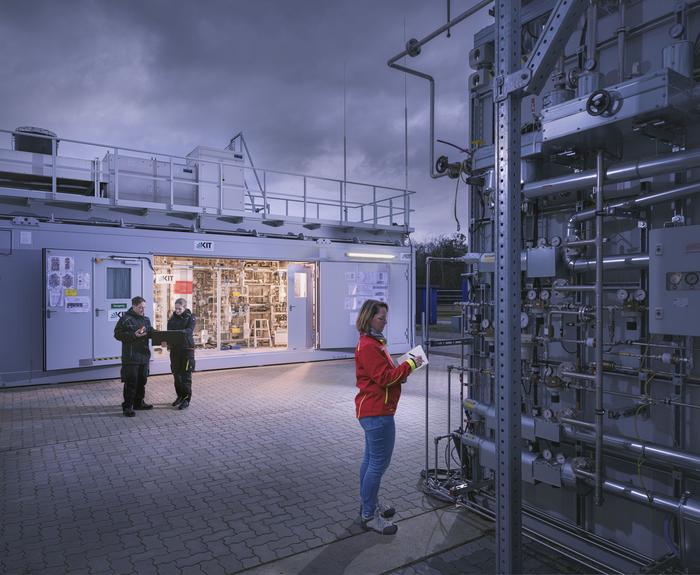
Credit: Amadeus Bramsiepe
“RISEnergy will create a European ecosystem covering all areas of renewable energy technologies,” says Dr. Olga Sumińska-Ebersoldt, co-coordinator of RISEnergy and researcher at the Helmholtz Institute Ulm (HIU) that was established by KIT and Ulm University. “We want to push the development of promising technologies from the laboratory level to industrial maturity.” Joint research infrastructure projects have already been launched for certain technologies, but RISEnergy is the first project of this dimension in Europe that covers all areas of renewable energy technologies: Photovoltaics, Concentrated Solar Power, Hydrogen, Biofuels, Wind Energy, OceanEnergy, as well as Integrated Grids, Energy Storage, Materials Research, Information and Communication Technologies.
Consortium of Institutions from 22 Countries
The RISEnergy consortium consists of 69 technology institutes, universities, and industry partners from 22 countries. The partners contribute with their infrastructures, know-how, or provide organizational support.
The core of the network is the European Energy Research Alliance EERA. EERA provides world-leading expertise via 18 Joint Programmes. “To integrate all major stakeholders, we asked EERA Joint Programmes to propose the best research infrastructures and experts for RISEnergy,” says Dr. Myriam E. Gil Bardají, researcher at HIU, coordinator of the EERA Joint Programme on Energy Storage, and co-coordinator of RISEnergy. Participation of organizations from the USA, Canada, and Japan ensures access to innovation outside of Europe.
Researchers Can Apply
Within the framework of RISEnergy, 84 research infrastructures from 19 European countries, the USA, Canada, and Japan will open their facilities to external researchers and company developers, who can apply for access. An expert committee will decide. If approved, RISEnergy will cover the costs of the research facility as well as travel and accommodation expenses. Most of the project budget will be used for this purpose.
The offer is specifically aimed at small and medium-sized companies. Uncomplicated access to major research infrastructures is expected to boost their innovations. “We offer cost-free use of laboratories. Researchers and experts from companies can travel, exchange ideas, and conduct experiments,” Sumińska-Ebersoldt says.
Networking, Exchange, and Communication
“When we think of using renewable energy sources, we always refer to combinations of technologies,” says Dr. Peter Holtappels, head of a working group at KIT’s Institute for Micro Process Engineering and scientific project coordinator of RISEnergy. He therefore emphasizes the importance of experts from different disciplines understanding each other. “Those designing energy storage systems or studying photovoltaics, wind and tidal energy usually are members of separate communities. We want to bring these people together and to encourage exchange and interdisciplinary collaboration.” There are plans to organize workshops and advisory services on overarching topics, such as lifecycle assessment and projects to standardise terminology and data processing. “Another focus will lie on digital tools for the energy transition: Artificial intelligence will help optimize the properties of materials and instruments and replace critical materials in supply chains,” says Dr. Holger Ihssen from the Helmholtz Association’s Brussels office that helped establish the new research consortium.
The project team will assess funding measures and identify reasonable ones. It will also develop roadmaps for policy makers.
About RISEnergy (Research Infrastructure Services for Renewable Energy)
RISEnergy is part of the Horizon Europe Funding Programme for Research and Innovation and of the module “Materials for Energy” of the global Mission Innovation initiative. The core of the project consortium is the European Energy Research Alliance EERA, the biggest research alliance for low-carbon energy technologies in Europe and major stakeholder in the EU’s strategic energy technologies plan (SET). Within the framework of Transnational Access (TNA) programmes, researchers and companies can apply for access to research infrastructures. The project coordinated by KIT is scheduled to start on March 1, 2024 and to expire on August 31, 2028. The project will be kicked off in Brussels on March 12 and 13, 2024.
More Information:
European Energy Research Alliance
KIT Institute for Micro Process Engineering