In a groundbreaking study recently published in Nature, researchers have unveiled new insights into the remarkable adaptability of myelin sheath formation in the brain’s central nervous system (CNS), shedding light on how the intricate architecture of neuronal axons influences this critical process. The study focuses on parvalbumin-expressing (PV) interneurons, a highly myelinated type of neuron found in the cerebral cortex, which exhibit complex branched axons that challenge traditional understanding of myelin ensheathment.
Using an innovative mouse model that fluorescently labels both oligodendrocytes and PV interneurons, the scientists employed in vivo two-photon microscopy to observe myelination within cortical layers I to III. This approach enabled unprecedented visualization of how myelin sheaths are distributed along the highly branched axons of PV interneurons, revealing a surprisingly high incidence of paranodal paranodal bridges—specialized structures associated with myelin sheath continuity.
The researchers found that nearly one-third of the myelin sheaths ensheathing PV interneuron axons exhibited these enigmatic paranodal bridges, a rate significantly surpassing that observed in other oligodendrocyte populations within the same cortical region. While oligodendrocytes commonly myelinate multiple neuron subtypes, the prevalence of these bridged sheaths was particularly enriched in PV interneurons, suggesting that morphological complexity may be a key driver in this phenomenon.
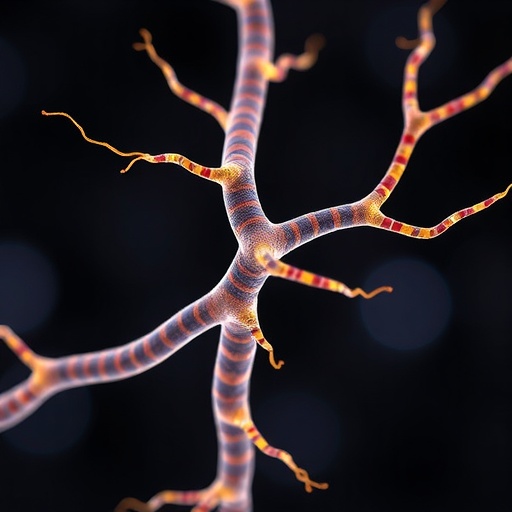
Interestingly, the presence of paranodal bridges was not randomly distributed along the axons but heavily concentrated at branch points where axons bifurcate. Approximately 69% of identified paranodal bridges spanned axonal branch points, indicating a functional importance in maintaining axonal integrity and continuity at these complex junctions. This adaptation likely facilitates effective transmission of neural signals across branched axon networks, preserving the integrity of neural circuits.
Furthermore, the study detected a positive correlation between the degree of axonal branching and the number of paranodal bridges, reinforcing the notion that axon morphology actively shapes the pattern of myelination. The findings suggest that the structural demands imposed by complex axonal geometry prompt oligodendrocytes to adjust their ensheathment strategies, flexibly constructing bridged sheaths to accommodate such intricacies.
This flexibility in oligodendrocyte behavior challenges previous assumptions that myelination patterns were predominantly dictated by oligodendrocyte subtypes alone. Instead, the current data point toward a model where the neuron’s architectural features—branching complexity and spatial organization—play a decisive role in governing how myelin sheaths form and adapt over time.
The researchers also discovered layer-specific variations in sheath bridging frequency, noting that oligodendrocytes located within layers II and III, regions densely populated by PV interneurons, exhibited a higher rate of bridged sheath formation compared to those in layer I. This gradient further highlights the influence of local neuronal circuitry and axonal complexity on myelin patterning.
By shedding light on how oligodendrocytes dynamically adapt to the structural characteristics of their target axons, this work opens new avenues for understanding myelin plasticity in health and disease. The discovery of paranodal bridges as a structural hallmark of complex myelination patterns emphasizes the nuanced interplay between neurons and glial cells that underpins efficient brain function.
Notably, these insights could have profound implications for neurodevelopmental and neurodegenerative conditions, where disrupted myelination and axon-glia interactions are central features. Decoding the principles governing flexible ensheathment might inform novel therapeutic strategies aimed at enhancing remyelination or preserving axonal integrity in disorders such as multiple sclerosis.
While much remains to be explored regarding the molecular mechanisms driving paranodal bridge formation, this research establishes a critical foundation for future studies investigating how myelin adapts to varying neuronal architectures. Understanding this relationship holds promise for unlocking targets to modulate myelin plasticity and repair within complex CNS networks.
In summary, the study by Call, Neely, Early and colleagues dramatically expands our comprehension of myelin dynamics, demonstrating that the complexity of axon morphology directly influences the formation of paranodal bridges and the flexible ensheathment by oligodendrocytes. This discovery redefines the paradigm of CNS myelination, emphasizing adaptability to neuronal structure as a fundamental principle ensuring optimal brain connectivity.
As neuroscientists continue to unravel the intricate dance between neurons and glia, the identification of paranodal bridges as markers of morphological complexity signals a new chapter in the exploration of brain wiring. This work stands as a testament to the brain’s remarkable capacity for structural and functional refinement, accommodating the demands of diverse neuronal networks through sophisticated myelin adaptations.
Subject of Research:
Flexible myelination mechanisms in complex CNS axon networks
Article Title:
Flexible ensheathment of axons enables myelination of complex CNS networks
Article References:
Call, C.L., Neely, S.A., Early, J.J. et al. Flexible ensheathment of axons enables myelination of complex CNS networks. Nature (2026). https://doi.org/10.1038/s41586-026-10312-1
Image Credits: AI Generated
DOI: https://doi.org/10.1038/s41586-026-10312-1
Keywords:
Parvalbumin interneurons, oligodendrocytes, myelin sheath, paranodal bridges, CNS myelination, axon branching, two-photon imaging
Tags: CNS myelination mechanismscomplex axonal branchingcortical layer myelination patternsfluorescent mouse models in neurosciencein vivo two-photon microscopy imaginginterneuron-specific myelination dynamicsmyelin sheath adaptability in the brainneuronal axon morphology and myelin sheath formationoligodendrocyte-neuron interactionsparanodal paranodal bridgesparvalbumin-expressing interneuronsspecialized myelination structures