Light sensor tools help growers make sense of nitrogen
Credit: Guohui Feng
Too much of a good thing can be a bad thing. That’s certainly true for nitrogen fertilizers.
Without enough nitrogen, crops don’t grow well. Yields are reduced significantly.
Applying too much nitrogen fertilizer, on the other hand, can hurt the environment. Nitrogen can enter the watershed, polluting aquatic ecosystems. Microbes can also convert the excess nitrogen into nitrous oxide, a greenhouse gas implicated in climate change.
“Managing nitrogen is vital for global food security,” says Yuxin Miao, an agronomist at the University of Minnesota. “It is also crucial for reducing pollution and climate change.”
Miao and his colleagues have been researching ways to efficiently manage nitrogen in agriculture. They compared several approaches. The researchers found that one approach, active canopy sensor-based nitrogen management, is the most efficient.
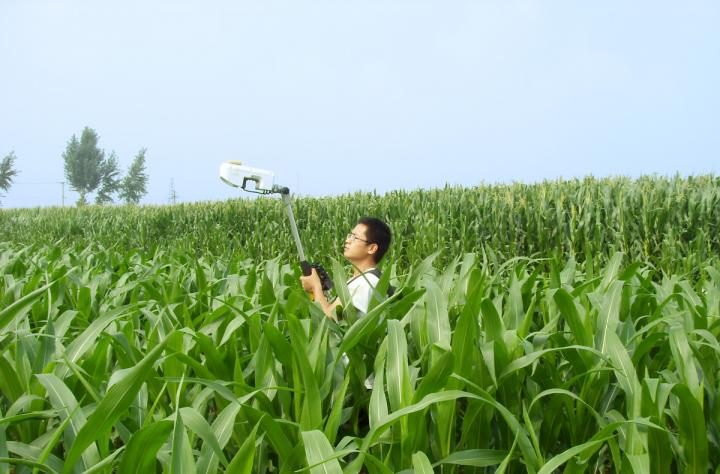
Sensor-based nitrogen management uses light sensors to actively monitor crop health and vitality. The sensors measure different wavelengths of light coming from crop leaves. These measurements serve as proxies for crop health.
Based on field measurements, software in the sensors can calculate how much nitrogen crops need. Farmers can use these data to apply optimal amounts of nitrogen to crops.
The goal is to “match nitrogen supply with crop nitrogen demand,” says Miao. That allows crops to access nitrogen fertilizers exactly when they most need it. In turn, that could increase yields.
This approach has several benefits compared to other nitrogen management strategies. “It reduced overall nitrogen fertilizer application,” says Miao. “It also decreased nitrogen loss into the environment and lowered nitrous oxide emissions.”
Canopy sensor-based systems have several other advantages as well. “Using sensors is fast and non-destructive,” says Miao. “There are no additional costs beyond purchasing the sensors.”
Also, the latest models of sensors are not influenced by environmental light. That means growers can get an accurate measurement no matter the weather–no need for clouds to clear.
There may also be monetary benefits. “This technology can reduce the use of nitrogen fertilizers,” says Miao. “Farmers can lower production costs and increase economic returns.”
To test different nitrogen management strategies, Miao and his colleagues conducted field experiments from 2008 to 2012. The study site was in the Hebei Province in northern China. The researchers tested the different strategies on a winter wheat and summer corn rotation system.
Some of the other nitrogen management strategies tested by Miao also reduced fertilizer use. But they all had drawbacks. For example, one system required testing the soil for nitrogen levels. “However, this system had labor, time, and cost limitations,” says Miao.
Miao is now working to make improvements. Some of the new systems will be more suitable for high-yield cropping systems. Others may be more efficient than the current hand-held ones.
Miao hopes these sensor systems will have global reach. “This strategy of nitrogen management would work with major crops in many countries.”
But Miao thinks that farmers can’t do it alone. Farmers, researchers, and service providers will need to work together. “That can facilitate widespread adoption of this system, especially in developing countries,” he says.
###
Miao presented these results at the November 2018 meeting of the American Society of Agronomy and Crop Science Society of America in Baltimore, MD.
Media Contact
Susan Fisk
[email protected]
608-273-8091