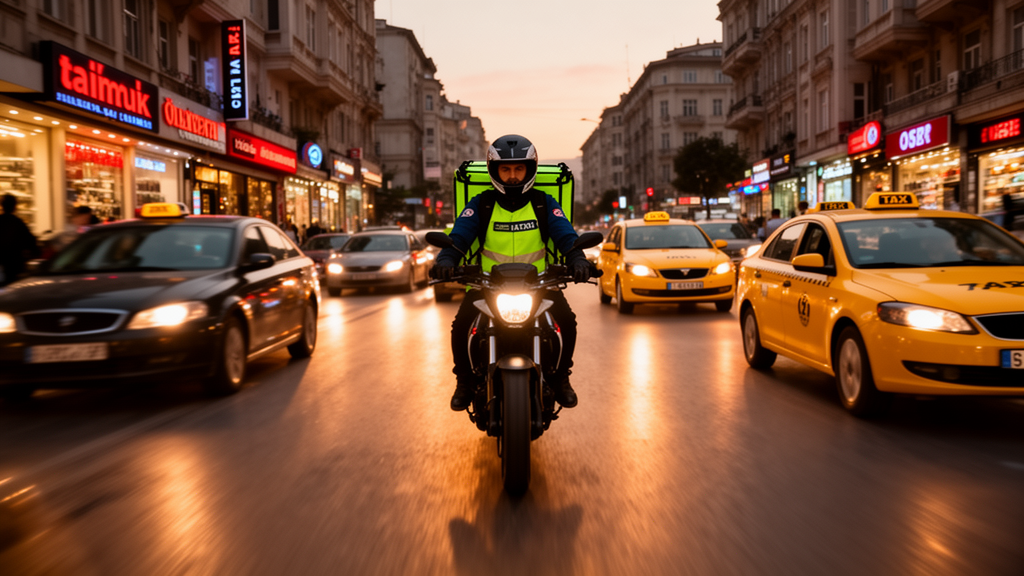
Motorcycle couriers who have spent more years on the road report more accidents, not fewer, according to an exploratory study of delivery riders in Sakarya, Türkiye. The finding, published in European Transport Research Review, comes from a binary logit model fitted to survey responses from 100 motorcycle and moped couriers working in the Serdivan district, and it runs counter to the widely reported protective effect of riding experience. Couriers with prior accident involvement as car drivers and those who perceived public transport drivers as risky, by contrast, showed significantly lower odds of motorcycle accident involvement.
The study was conducted against a backdrop of rapid growth in motorcycle use for fast deliveries, both worldwide and in Türkiye. Motorcycles account for 20 percent of all vehicles in Türkiye, and in 2022, while motorcycles accounted for only 5 percent of the vehicle-kilometers traveled by all vehicles, motorcycle riders represented 39 percent of drivers involved in fatal or injury-related accidents. Globally, the number of motorcycles on the roads nearly tripled between 2011 and 2021, and motorcyclists and riders of other powered two- and three-wheeled vehicles now account for almost one-third of the roughly 1.2 million road traffic deaths occurring each year, with motorcyclist fatalities rising 30 percent over the same period.
The researchers surveyed couriers face to face in Serdivan, the second most populated district of Sakarya, where motorcycles make up approximately 18 percent of registered vehicles, close to the national average of 20 percent. Between 17 and 30 March 2022, the team approached roughly 300 couriers and collected 100 complete responses, a completion rate of 33 percent, using non-probability convenience sampling because no complete list of couriers existed. Participants had to be at least 18 years old and working as motorcycle or moped couriers at the time. The sample ranged in age from 18 to 56 with a mean of 26, included 99 men and one woman, and was predominantly educated: 89 of the 100 respondents had at least a high school level of education.
The dependent variable was self-reported involvement in at least one traffic accident while riding a motorcycle or moped, covering the respondent’s entire riding history and including all accident types and severities, from property damage to injury crashes. Twenty-nine percent of respondents reported such a history. Fifteen variables, covering sociodemographics, working conditions such as payment structure and daily hours, riding behavior, and traffic-related perceptions, were entered into the model after multicollinearity checks. Because of the small sample, most continuous and categorical variables were converted to binary form, a decision the authors supported with roughly 60 to 70 alternative model specifications showing that the qualitative results did not depend on a particular coding choice.
Three variables reached statistical significance at the conventional 90 percent confidence level. Couriers who had previously been involved in an accident as a car driver had approximately 72 percent lower odds of motorcycle accident involvement, with an odds ratio of 0.28 and a 90 percent confidence interval of 0.10 to 0.76. Those who perceived public transport drivers as risky had approximately 82 percent lower odds, with an odds ratio of 0.18 and a confidence interval of 0.03 to 0.96. Each one-unit increase in the motorcycle riding experience variable was associated with approximately 26 percent higher odds of accident involvement, with an odds ratio of 1.26 and a confidence interval of 1.05 to 1.51.
The positive experience association is not without precedent. A Malaysian study of food delivery riders found that those with two or more years of delivery experience had 2.59 times higher odds of crash involvement than less experienced riders, a result the authors attributed to reduced caution over time combined with greater cumulative exposure. A Pakistani study reported that each unit increase in riding experience increased the probability of traffic accidents by 67 percent among drivers who had transitioned from motorcycles to cars. The authors of the new study also note an important limitation of their own design: because the accident measure covered the respondent’s entire riding history rather than a fixed time window, couriers with longer riding histories had more time in which an accident could occur, which may partly account for the positive association between experience and accident involvement.
The inverse association for prior car accident involvement is consistent with the idea that collision experience heightens vigilance. Supporting this interpretation, a study by Van-Huy and colleagues found that higher danger perception among motorcyclists was associated with previous accident involvement. The negative coefficient for perceiving public transport drivers as risky may reflect a more defensive riding style among couriers who see buses and similar vehicles as hazardous, although the survey did not directly assess defensive riding, and the authors flag this explanation as purely speculative. They also caution that only 15 couriers perceived public transport drivers as non-risky, so the result should be interpreted carefully.
Several other variables pointed in plausible directions but did not reach conventional statistical significance and are reported as indicative only. These included age of 25 or older, high school or higher education, order-based payment, perceiving car drivers as risky, perceiving mobile phone use while riding as harmless, exceeding daily working hours of 7.5 hours, and use of reflective equipment. In the raw data, 37 percent of couriers paid per delivery and 34 percent of those exceeding scheduled hours reported accident histories, and 76 percent of couriers with accident histories did not consider phone use while riding problematic. The positive coefficient for reflective equipment use was discussed as consistent with risk compensation theory, but the authors stress that risk perception and confidence were not measured, so this remains a hypothesis rather than an established mechanism.
The team also ran seven scenario simulations, applying hypothetical conditions such as universal training, phone use restrictions, capped working hours, fixed salaries instead of per-order pay, strict rule compliance, minimum education requirements, and universal perception of roads as dangerous, to all respondents. The largest projected shift was a 6.5 percentage point reduction in modeled accident probability, from 0.300 to 0.235, under adherence to daily working hour limits, followed by a 5.6 point reduction for phone use restrictions. However, none of the manipulated coefficients reached conventional statistical significance, and the authors explicitly state that these are illustrative, sign-based projections from cross-sectional, self-reported data, not evidence of intervention effectiveness, and that no policy conclusions can be drawn from them.
The limitations are substantial and acknowledged in detail. With 15 predictors estimated from 100 observations and only 29 accident cases, the number of events per variable falls below recommended levels for stable logistic regression, making the model exploratory rather than confirmatory. No cross-validation or external validation was possible, predictive validity could not be determined, and the convenience sample of couriers on break may have underrepresented high time-pressure workers. The study lacked data on injury severity, road geometry, surface and weather conditions, annual mileage, and alcohol impairment, and it included no non-courier motorcyclist control group, so no conclusions can be drawn about whether couriers face greater risk than other riders. Data from a single district further constrain generalizability. The authors call for larger samples, comparison groups, and multi-region studies to test whether these patterns hold.
Subject of Research: An exploratory survey-based logit model of how motorcycle couriers' characteristics relate to their traffic accident involvement in Türkiye.
Article Title: An analysis of the effect of motorcycle courier characteristics on traffic accidents
Article References: Kuyumcu, Z. C., & Tezcan, H. O. (2026). An analysis of the effect of motorcycle courier characteristics on traffic accidents. European Transport Research Review, 18(1), Article 99. https://doi.org/10.1186/s12544-026-00866-6
Image Credits: AI Generated
DOI: 10.1186/s12544-026-00866-6
Keywords: motorcycle couriers, traffic accidents, road safety, binary logit model, riding experience, gig economy, Türkiye, delivery riders, risk perception, survey study, working hours, order-based pay
News Source: Denise Maddox. (October 27, 2026). Riding Experience Linked to Higher Crash Odds Among Motorcycle Couriers in Türkiye. Scienmag.