The Wiess School of Natural Sciences at Rice University has launched the Center for Nanoscale Imaging Sciences to improve the capture, analysis and interpretation of images at the nanometer scale. The center will push the frontiers of nanoscale imaging, contributing to breakthroughs in fields such as nanotechnology, materials science, biology and biomedicine.
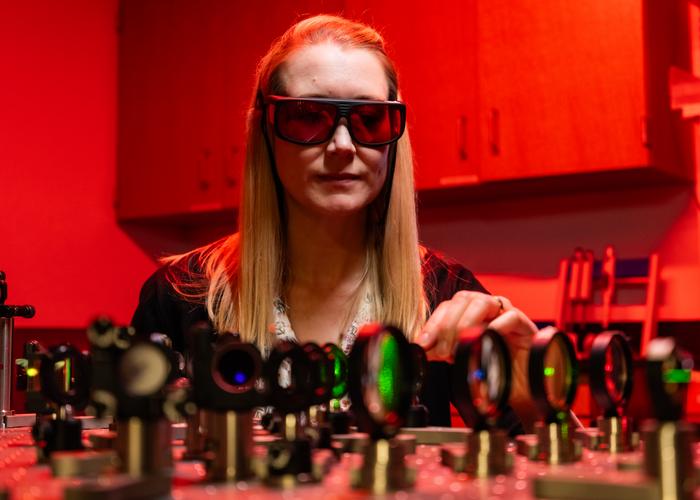
Credit: Jeff Fitlow/Rice University
The Wiess School of Natural Sciences at Rice University has launched the Center for Nanoscale Imaging Sciences to improve the capture, analysis and interpretation of images at the nanometer scale. The center will push the frontiers of nanoscale imaging, contributing to breakthroughs in fields such as nanotechnology, materials science, biology and biomedicine.
“The Center for Nanoscale Imaging Sciences will advance nanoscale imaging sciences and provide invaluable insights for scientific research, health care and industry, while amplifying Rice University’s profile in the field and beyond,” said Thomas C. Killian, dean of the Wiess School of Natural Sciences and the E. Dell Butcher Professor of Physics and Astronomy.
A multidisciplinary field, nanoscale imaging science uses techniques from engineering, physics, chemistry, mathematics and computer science, including super-resolution optical imaging, electron microscopy, scanning probe microscopy and computer vision, to capture, analyze and interpret images at the nanometer scale, or one-billionth of a meter.
“Nanoscale imaging is revolutionizing researchers’ ability to explore and understand the world at the atomic and molecular level,” said Anna-Karin Gustavsson, an assistant professor of chemistry who leads the center.
The center will foster further advancements in nanoscale imaging and will stimulate, enable and incentivize the integration and correlation of diverse approaches and collaborative efforts across different fields. The center’s efforts will address key outstanding challenges that include big data, smart microscopes and multi-modal approaches that go beyond the scope of a single research group.
The mission is to connect researchers with common goals and complementary expertise across department and school boundaries. Current efforts in nanoscale imaging at Rice are primarily driven independently by different research groups scattered between different departments and on-campus buildings without the critical interdisciplinary collaboration to accelerate discovery. This hampers new, groundbreaking innovations within nanoscale imaging.
The center, however, will bring researchers at Rice together and inspire high-impact collaborative efforts to push the frontiers of nanoscale imaging as well as cultivate an environment conducive to innovation where the exchange of ideas will lead to the emergence of fresh perspectives and novel solutions.
Rice faculty will also work with researchers at the Texas Medical Center to enable and drive new discoveries in biology and biomedicine.
“As a cross-disciplinary team, we will hopefully be able to expand upon and contribute to the emerging area of nanoscale imaging sciences and the various application areas they serve from biomedical sciences to material sciences,” said Ashok Veeraraghavan, professor of electrical and computer engineering.
Researchers with common goals and complementary expertise across departments and school boundaries will address multiple key outstanding questions, including challenges related to:
● Multi-modal approaches: To combine multiple imaging modalities to provide complementary information about the structure, function and molecular characteristics of a biological system or materials to address key challenges in this field, such as developing approaches for image registration and fusion, data acquisition and hardware integration and data processing, analysis, interpretation and validation.
● Big data: To develop approaches for real-time analysis of data, real-time filtering of useful data and compressed, fast and efficient readout to remedy large image dataset challenges such as storage, processing, analysis and interpretation.
● Smart microscopes: To advance adaptive imaging where data is analyzed in real time and the results are used to tune and decide the imaging parameters such as acquisition speed, size of the field of view, color and resolution to detect processes or features under study that are rare or difficult to see by the scientist during imaging.
“These advancements will pave the way for innovative and truly adaptive and multi-modal imaging systems capable of handling large data and tackling novel inquiries in nanoscience, materials science and biology,” said Yimo Han, assistant professor of materials science and nanoengineering and chemistry.
Moreover, the center will improve Rice’s visibility both nationally and internationally to make it a nexus for nanoscale imaging sciences that can grow and evolve into an externally funded Rice institute.
The establishment of the center comes at a crucial time as the progress achieved through its endeavors will align synergistically with the research conducted at the newly established Rice Advanced Materials Institute (RAMI). RAMI’s goal is to accelerate fundamental research and applied technology development to address generational challenges in energy, sustainability and national security.
The advanced imaging technologies for atomic and molecular-level material imaging offered by the center at Rice will directly enhance the capabilities of researchers at RAMI, enabling them to gain valuable insights into materials with unprecedented precision and detail.