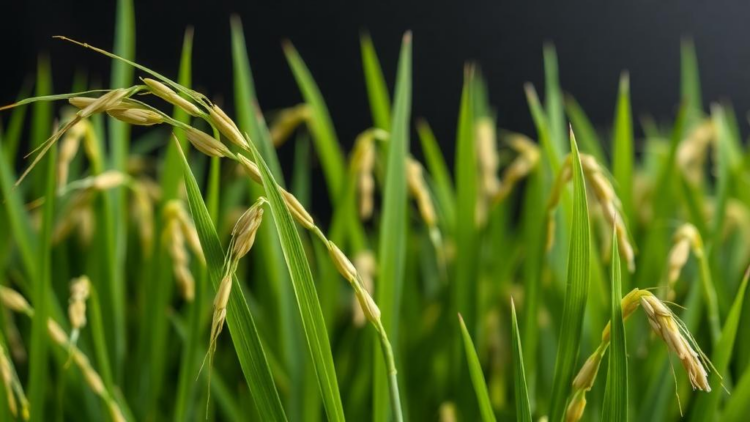
Rice, the staple grain that feeds more than half of humanity, is under constant siege. In China alone, outbreaks of the brown planthopper can sweep across more than thirty million hectares and strip away over two million metric tons of yield in a single year, while the striped stem borer tunnels invisibly through stems, leaving dead hearts and white heads in its wake. Farmers and breeders have long relied on laborious chemical assays to tell whether a plant is mounting a defense, grinding up leaf tissue and measuring hormones with expensive instruments. Now a team of Chinese researchers has shown that the plant itself may be offering a far faster answer, one written in the language of electricity.
In a study published in the journal Crop Health, scientists led by Xinyang Tan, Han Wang, and Rui Ji of Nanjing Agricultural University and the Jiangsu Academy of Agricultural Sciences demonstrated that simple electrical measurements taken from rice leaves can reveal, within hours, which pest is attacking, how severely, and whether the plant’s immune system has switched on. The work, published on 30 September 2025, positions plant bioelectrical signals as a rapid, non-invasive, and potentially scalable alternative to destructive hormone profiling, with implications that stretch from field diagnostics to the breeding of pest-resistant varieties.
The logic behind the approach rests on basic biophysics. A plant cell membrane behaves like a leaky capacitor: conductive fluids inside and outside the cell act as plates, separated by the lipid bilayer that serves as a dielectric. When insects feed, they perturb ion permeability, water potential, and membrane integrity, and those changes alter the leaf’s measurable electrical properties. The team used an LCR meter to record five parameters from leaf sheaths clamped between parallel electrode plates: physiological capacitance, resistance, impedance, capacitive reactance, and inductive reactance. By fitting mathematical models to measurements taken under varying clamping forces, the researchers extracted intrinsic values at zero force, effectively normalizing away the mechanical artifact of the sensor itself.
What emerged was a strikingly specific electrical fingerprint for each pest. When fifteen gravid brown planthopper females were confined to feed on the leaf sheath, the intrinsic resistance and impedance of the leaves climbed by more than 200 percent, with significant elevations detectable as early as three hours after infestation and intensifying through twenty-four hours. The striped stem borer told a different story. Two third-instar larvae left on the plant produced no significant electrical shift at three hours, but by eight hours they had triggered a broader-spectrum surge, raising resistance, impedance, capacitive reactance, and inductive reactance all at once. The phloem-sucking planthopper, with its needle-like mouthparts, inflicted a slow, cumulative interference; the chewing borer caused a delayed but system-wide breakdown of cellular compartmentalization once mechanical damage crossed a threshold.
From those raw electrical parameters, the researchers derived a battery of physiological indices describing intracellular water holding capacity, water transfer rate, nutrient transport capacity, metabolic flux, metabolic rate, and the energy costs of moving dielectric substances across membranes. Both pests depressed nearly every one of these measures. The intracellular water transfer rate fell to roughly a third of control levels under sustained planthopper feeding and to twenty-eight percent after eight hours of borer damage. Nutrient active transport capacity collapsed to between twenty-seven and forty-four percent of untreated plants. Metabolic flux, perhaps the most dramatic indicator, dropped to around four percent of controls in the most heavily stressed plants, a quantified portrait of the energetic toll that defense imposes on a plant’s growth machinery.
To translate these signals into agronomically meaningful numbers, the team built three composite scores. The yield potential score, combining water and nutrient transfer rates with metabolic activity and leaf thickness, plummeted to as little as six percent of control values under severe infestation. The drought resistance score, which weights water retention and holding time, fell to between thirty and sixty-one percent depending on pest and duration. An adaptability score integrating nutrient transport showed similar erosion. These models suggest that a handheld electrical reading could one day estimate not just whether a plant is stressed, but how much of its yield potential and stress resilience has been compromised, without cutting a single leaf.
The most consequential finding, however, was the tight coupling between electrical parameters and the jasmonic acid pathway, the hormonal backbone of anti-herbivore defense in rice. Using liquid chromatography-tandem mass spectrometry, the researchers tracked jasmonic acid and its bioactive conjugate jasmonic acid-isoleucine as they accumulated over the course of infestation. Under planthopper feeding, jasmonic acid rose nearly fivefold and jasmonic acid-isoleucine more than fivefold by twenty-four hours; the borer provoked even sharper surges, with jasmonic acid jumping more than twelvefold at three hours. Across the infestation window, jasmonic acid and jasmonic acid-isoleucine levels correlated strongly and positively with intrinsic resistance and impedance, with Pearson coefficients reaching as high as 0.97. Intriguingly, in the earliest hours of planthopper attack, jasmonic acid-isoleucine correlated best with the reactance parameters, suggesting that capacitive and inductive changes in the membrane may serve as the earliest electrical precursors of immune activation, appearing before large-scale ionic mobilization reshapes resistance and impedance.
The temporal choreography differed by pest in ways that mirror their feeding biology. The borer displayed what the authors describe as a hormone-first, electrical-later pattern: jasmonic acid surged at three hours while the electrical parameters remained quiet, presumably because the physical destruction of stem tissue temporarily disrupted systemic signal propagation. By eight hours, however, nearly every electrical parameter had locked into significant correlation with the defense hormones, marking the plant’s transition to an integrated, whole-plant defense state. Salicylic acid, by contrast, barely moved under either pest and showed no meaningful correlation with any electrical parameter, reinforcing the view that jasmonate signaling, not salicylate, dominates rice’s response to these two insects.
Perhaps the most forward-looking part of the study involved transgenic rice that had never seen a pest at all. The researchers overexpressed two planthopper-derived elicitor proteins in rice: Myosin, a salivary component from the small brown planthopper that acts as a PAMP-like immune trigger recognized through the OsBAK1 co-receptor, and PDI1, a redox-active salivary protein from the brown planthopper that promotes hydrogen peroxide and jasmonate accumulation while destabilizing a host sugar-metabolism regulator. Both transgenic lines, grown normally and untouched by insects, reproduced the electrical signature of actual herbivore attack almost perfectly. Intrinsic capacitance fell to roughly a quarter of wild-type levels while resistance and impedance rose roughly tenfold, water and nutrient transport indicators collapsed, and jasmonic acid accumulated up to twenty-nine times above control levels. The plants had, in effect, been electrically rewired into a defense-primed state by a single insect gene.
That result transforms the electrical readout from a diagnostic tool into a discovery platform. Because elicitor-induced defense states leave the same measurable bioelectrical footprint as real feeding, researchers can now screen candidate resistance-inducing proteins, whether insect-derived, synthetic, or engineered, with a few seconds of electrode contact instead of weeks of bioassays and hormone extractions. The authors argue that this framework establishes electrophysiological traits as fast, integrative, and scalable indicators of crop stress status, opening a path toward precision agriculture in which sensors patrol rice paddies reading the plants’ own electrical broadcasts, and breeders select resistant cultivars by listening to what their seedlings are already saying. For a crop that cannot afford to lose a single season, the ability to hear a plant’s silent alarm in real time may prove one of the quietest revolutions in modern crop protection.
Subject of Research: Electrophysiological monitoring of rice defense responses to herbivorous pests and elicitor-induced immune activation
Article Title: Electrophysiological signatures decode herbivore-specific defense dynamics and elicitor-induced immune activation in rice
Article References: Tan, X., Wang, H., Li, J., Zhang, S., Zheng, S., Zhao, Z., Zhang, B., Wu, Y., Zhao, C., Li, S., & Ji, R. (2025). Electrophysiological signatures decode herbivore-specific defense dynamics and elicitor-induced immune activation in rice. Crop Health, 3(1), Article 19. https://doi.org/10.1007/s44297-025-00058-z
Image Credits: AI Generated
DOI: 10.1007/s44297-025-00058-z
Keywords: rice, electrophysiology, brown planthopper, striped stem borer, jasmonic acid, plant immunity, elicitors, impedance, crop protection, non-invasive sensing, defense hormones, resistance breeding
Cite Scienmag News
APA
MLA
Chicago
Alan Morgan. (October 1, 2026). Rice Plants Broadcast Their Defenses as Electrical Signals Scientists Can Now Read. Scienmag. https://scienmag.com/rice-plants-broadcast-their-defenses-as-electrical-signals-scientists-can-now-read/
Alan Morgan. “Rice Plants Broadcast Their Defenses as Electrical Signals Scientists Can Now Read.” Scienmag, 1 October 2026, https://scienmag.com/rice-plants-broadcast-their-defenses-as-electrical-signals-scientists-can-now-read/. Accessed 1 October 2026.
Alan Morgan. “Rice Plants Broadcast Their Defenses as Electrical Signals Scientists Can Now Read.” Scienmag. October 1, 2026. https://scienmag.com/rice-plants-broadcast-their-defenses-as-electrical-signals-scientists-can-now-read/
Copy citation
Download RIS
Tags: advancements in plant disease diagnosticsbioelectrical analysis for crop protectionbrown planthoppercrop health assessment technologiescrop protectiondefense hormoneselectrical measurement techniques in agricultureelectrical signaling in plantselectrophysiologyelicitorsimpedancejasmonic acidnon-invasive plant health monitoringnon-invasive sensingpest detection in rice cropsplant bioelectrical signalsplant immune response indicatorsplant immunityrapid plant stress detection methodsresistance breedingricerice plant defense mechanismsstriped stem borersustainable pest management strategies