


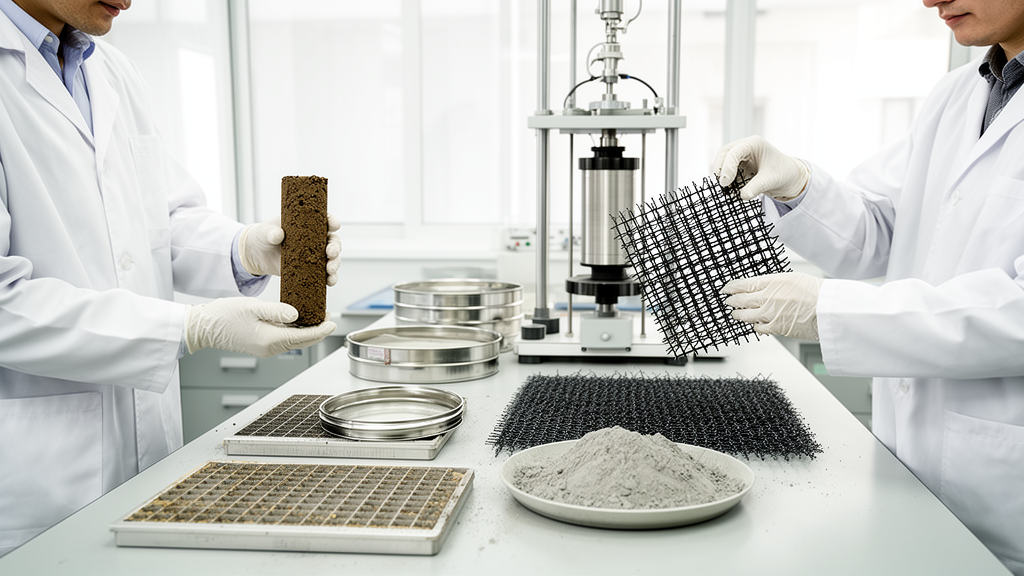
A new laboratory study published in Discover Applied Sciences reports that two waste-derived materials, rice husk ash and basalt fibre mesh, can be combined to improve the shear strength of compacted silty sand, with the best tested configuration nearly doubling the friction angle of untreated soil.
The research, led by Md. Aminul Islam and Zakaria Hossain, was published online on 29 October 2026 as an open-access article. The authors ran a series of laboratory compaction tests and consolidated-drained triaxial compression tests on silty sand mixed with rice husk ash at doses ranging from 0 to 15 percent by weight. Basalt fibre meshes of two aperture sizes, 5 millimetres and 10 millimetres, were embedded at the top, middle or bottom layers of the compacted specimens, allowing the team to isolate how reinforcement placement influenced the measured strength parameters.
Compaction results showed a clear and consistent pattern. As the rice husk ash content rose from 0 to 15 percent, the maximum dry density of the mix fell steadily from 1.79 to 1.09 grams per cubic centimetre, while the optimum moisture content climbed from approximately 15.7 to 27.1 percent.
In the triaxial shear tests, the ash acted mainly on the frictional component of strength. Untreated soil showed an internal friction angle of about 11.5 degrees with an apparent cohesion of roughly 78 kilonewtons per square metre. Adding rice husk ash raised the friction angle, with a 10 percent mix reaching about 19 to 20 degrees, while the effect on cohesion varied with dosage rather than following a simple trend.
The basalt mesh, by contrast, worked primarily on cohesion. Soil reinforced with mesh but containing no ash showed an apparent cohesion of about 147 kilonewtons per square metre, nearly twice the untreated value. The authors attribute this to tensile restraint: the mesh resists lateral deformation of the specimen during shearing, which registers as an increase in apparent cohesion in the strength envelope.
When both materials were combined, the response depended on both the ash dosage and the mesh placement. The strongest frictional performance was recorded for a mix containing 10 percent rice husk ash with the 10 millimetre mesh placed at mid-depth, which achieved a friction angle of about 23.7 degrees — almost double the untreated control — though with a reduced cohesion of about 40 kilonewtons per square metre. The study highlights a trade-off: configurations that maximise frictional resistance do not necessarily maximise apparent cohesion, and the balance between the two shifts with the treatment recipe.
Placement and dosage mattered in both directions. The authors note that improper mesh placement or excessive fines can reduce cohesion, because the mesh apertures can become fouled by fine ash particles and the reinforcement can become strain-incompatible with the surrounding soil. In other words, more stabiliser is not always better, and the geometry of the reinforcement layer is as important as its presence.
Within the tested range, the combination of approximately 10 percent rice husk ash with the 10 millimetre mesh at mid-depth provided the most favourable overall balance of shear strength parameters under the conditions studied. The authors present this as quantitative design guidance for low-carbon ground improvement in pavements, embankments and slopes, where modest gains in friction angle and cohesion can translate into meaningful savings in cement consumption.
As with any laboratory study, the findings are bounded by their scope. The tests were performed on a single silty sand, at ash contents up to 15 percent, with meshes of two aperture sizes and three placement depths, under consolidated-drained triaxial conditions. Field performance, long-term durability, and behaviour under different soil types and loading paths remain to be demonstrated. Nevertheless, the study offers a concrete demonstration that an agricultural byproduct and a natural fibre geotextile can jointly improve weak soils, and it maps out which combinations work best — and which ones backfire.
Subject of Research: Laboratory study of hybrid soil stabilization using rice husk ash and basalt fibre mesh on compaction and shear strength.
Article Title: Investigating the synergistic effects in hybrid sustainable soil stabilization using rice husk ash and basalt mesh on compaction and shear strength development
Article References: Islam, M. A., & Hossain, Z. (2026). Investigating the synergistic effects in hybrid sustainable soil stabilization using rice husk ash and basalt mesh on compaction and shear strength development. Discover Applied Sciences. https://doi.org/10.1007/s42452-026-09672-0
Image Credits: AI Generated
DOI: 10.1007/s42452-026-09672-0
Keywords: soil stabilization, rice husk ash, basalt fibre mesh, shear strength, compaction, triaxial testing, sustainable construction, ground improvement, geotextiles, low-carbon infrastructure, Investigating, synergistic
News Source: Alan Morgan. (October 29, 2026). Rice husk ash and basalt mesh team up to strengthen weak soils. Scienmag.



