• HOME
  • NEWS
  • EXPLORE
    • CAREER
      • Companies
      • Jobs
    • EVENTS
    • iGEM
      • News
      • Team
    • PHOTOS
    • VIDEO
    • WIKI
  • BLOG
  • COMMUNITY
    • FACEBOOK
    • INSTAGRAM
    • TWITTER
Thursday, June 25, 2026
BIOENGINEER.ORG
No Result
View All Result
  • Login
  • HOME
  • NEWS
  • EXPLORE
    • CAREER
      • Companies
      • Jobs
        • Lecturer
        • PhD Studentship
        • Postdoc
        • Research Assistant
    • EVENTS
    • iGEM
      • News
      • Team
    • PHOTOS
    • VIDEO
    • WIKI
  • BLOG
  • COMMUNITY
    • FACEBOOK
    • INSTAGRAM
    • TWITTER
  • HOME
  • NEWS
  • EXPLORE
    • CAREER
      • Companies
      • Jobs
        • Lecturer
        • PhD Studentship
        • Postdoc
        • Research Assistant
    • EVENTS
    • iGEM
      • News
      • Team
    • PHOTOS
    • VIDEO
    • WIKI
  • BLOG
  • COMMUNITY
    • FACEBOOK
    • INSTAGRAM
    • TWITTER
No Result
View All Result
Bioengineer.org
No Result
View All Result
Home NEWS Science News Biology

Rice blast fungus study sheds new light on virulence mechanisms of plant pathogenic fungi

Bioengineer by Bioengineer
May 14, 2019
in Biology
Reading Time: 2 mins read
0
IMAGE
Share on FacebookShare on TwitterShare on LinkedinShare on RedditShare on Telegram

IMAGE

Credit: Lianwei Li, Shengpei Zhang, Xinyu Liu, Rui Yu, Xinrui Li, Muxing Liu, Haifeng Zhang, Xiaobo Zheng, Ping Wang, and Zhengguang Zhang

Rice blast fungus (Magnaporthe oryzae) is a global food security threat due to its destruction of cultivated rice, the most widely consumed staple food in the world. Disease containment efforts using traditional breeding or chemical approaches have been unsuccessful as the fungus can rapidly adapt and mutate to develop resistance. Because of this, it is necessary to understand fungal infection-related development to formulate new, effective methods of blast control.

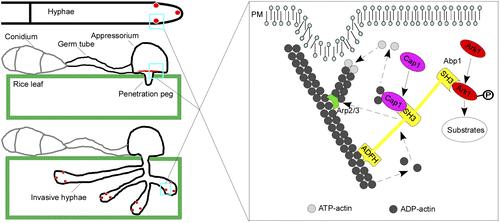
A group of scientists at Nanjing Agricultural University and Louisiana State University Health Sciences Center examined the fungal cell biology of rice blast fungus pathogenesis and recently published the first systematic and comprehensive report on the molecular mechanism of the actin-binding protein (MoAbp1) that plays a crucial role in the pathogenicity of the fungus.

Through ongoing research, these scientists found that rice blast fungus forms a specialized infection structure that applies mechanical force to rupture the rice leaf cuticle. Once inside the host, the infection proliferates by living off the plant’s nutrients. These two processes are enabled by the actin-binding protein (MoABp1) that links an actin-regulating kinase (MoArk1) and a cyclase-associated protein (MoCap1) to an actin protein (MoAct1). These processes are necessary for the growth and perseverance of the fungus.

On a large scale, these findings shed a new light on the eukaryotic cell biology and virulence mechanisms of plant pathogenic fungi. On a smaller scale, these findings could reveal novel approaches or targets for anti-blast fungus management.

###

For additional details, read “Magnaporthe oryzae Abp1, a MoArk1 Kinase-Interacting Actin Binding Protein, Links Actin Cytoskeleton Regulation to Growth, Endocytosis, and Pathogenesis” published in Molecular Plant-Microbe Interactions in April 2019.

About Molecular Plant-Microbe Interactions (MPMI)

Molecular Plant-Microbe Interactions® (MPMI) publishes fundamental and advanced applied research on the genetics, genomics, molecular biology, biochemistry, and biophysics of pathological, symbiotic, and associative interactions of microbes, insects, nematodes, or parasitic plants with plants.

Media Contact
Ashley Bergman Carlin
[email protected]

Related Journal Article

http://dx.doi.org/10.1094/MPMI-10-18-0281-R

Tags: Agricultural Production/EconomicsBiologyCell BiologyFood/Food ScienceMicrobiologyMolecular Biology
Share13Tweet8Share2ShareShareShare2

Related Posts

Natural Hallucinogens: Evolution’s Ecological Tools, Not Mere Chemical Byproducts

June 25, 2026

This Famous Butterfly Revealed: Three Distinct Species Hidden in One

June 25, 2026

Scientists Attack Soybean Cyst Nematode by Starving Its Food Source

June 25, 2026

Decoding the Secret Code of a Crucial Immune Sensor

June 24, 2026
Please login to join discussion

POPULAR NEWS

  • Saying Goodbye to PGY-6: Pediatric Fellowship Realities

    103 shares
    Share 41 Tweet 26
  • Multi-Hospital Study Reveals Long Covid Burden Is Twice as High as Current Estimates

    92 shares
    Share 36 Tweet 23
  • Detection of EDCs in Breast Milk and Infant Urine Up to Six Months Highlights Early Exposure Risks

    77 shares
    Share 31 Tweet 19
  • New Drug Candidate Developed at McMaster Shows Potential for Treating Brain Cancer

    58 shares
    Share 23 Tweet 15

About

We bring you the latest biotechnology news from best research centers and universities around the world. Check our website.

Follow us

Recent News

Tracking Lanthanide-Labeled Microplastics in Plants

POSTECH Researchers Slash Cost of Reconstituted Cell-Free Systems by 95%

AI and Physics Collaborate to Design Advanced Hydrogen Storage Materials

Subscribe to Blog via Email

Enter your email address to subscribe to this blog and receive notifications of new posts by email.

Join 82 other subscribers
  • Contact Us

Bioengineer.org © Copyright 2023 All Rights Reserved.

Welcome Back!

Login to your account below

Forgotten Password?

Retrieve your password

Please enter your username or email address to reset your password.

Log In
No Result
View All Result
  • Homepages
    • Home Page 1
    • Home Page 2
  • News
  • National
  • Business
  • Health
  • Lifestyle
  • Science

Bioengineer.org © Copyright 2023 All Rights Reserved.