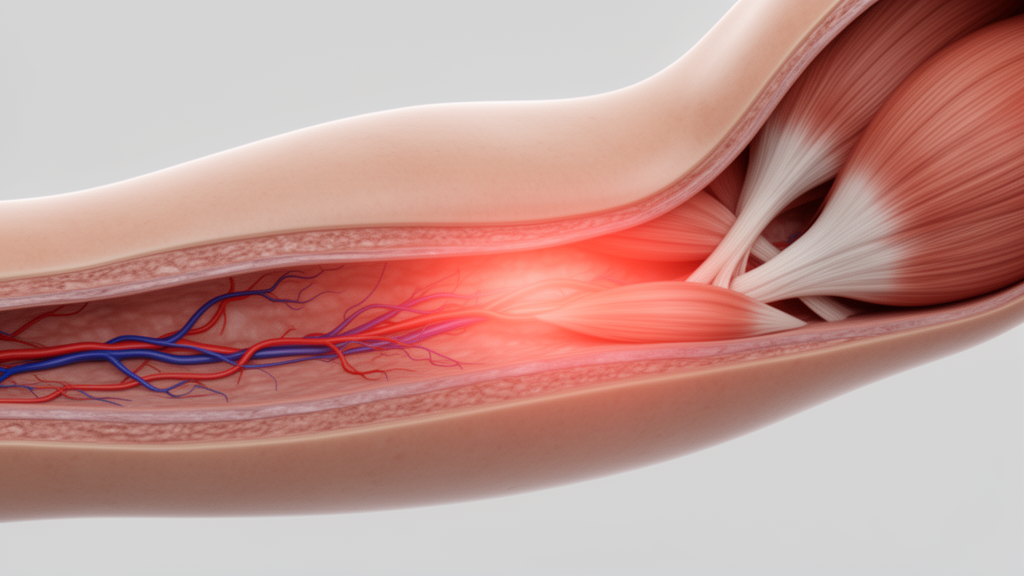
The study, published in BMC Biomedical Engineering, utilized a one-dimensional thermal model to simulate how skin temperature responds to low-power radio frequency exposure across a range of frequencies and tissue thicknesses. The team, led by Georgia E. H. Robles and David A. Nelson, developed a method termed REFLO, or Rapid Electromagnetic Flow, which relies on the physical relationship between the rate of blood flow in underlying tissue and the resulting increase in surface temperature during controlled heating. By analyzing how heat dissipates in the skin, the researchers aimed to determine if a non-invasive device could detect impaired circulation in the legs, a condition that often goes undiagnosed until a serious cardiovascular event occurs.
Peripheral artery disease is a common vascular condition characterized by the narrowing or blockage of arteries in the lower extremities, which reduces microcirculatory flow in the skin. An estimated eight to twelve million people in the United States are affected by the disease, and its prevalence is rising due to an aging population and lifestyle factors such as obesity and diabetes. The standard diagnostic method, the Ankle-Brachial Index, requires six separate systolic pressure measurements and the use of Doppler ultrasound, making it a time-intensive and staff-heavy procedure. Furthermore, ABI measurements can be unreliable in patients with arterial calcification, a condition common in older or diabetic individuals. A simpler, faster method for measuring skin blood flow rate could allow for earlier diagnosis and intervention, particularly for asymptomatic patients who might otherwise remain unaware of their condition.
The REFLO system concept incorporates a radio frequency transmitter and a compact transducer housing a micropatch antenna and an infrared temperature sensor. The underlying principle is that at high radio frequencies, specifically above 6 GHz, tissue heating is confined almost entirely to the skin, without significantly affecting deeper tissues or organs. Because blood flow enhances the ability of tissue to transfer heat, the rate and magnitude of surface temperature increases during low-power, high-frequency radio frequency heating are functions of the volumetric blood flow in the underlying tissue. Thermographic experiments have previously shown that skin with restricted blood flow heats at a faster rate and cools at a slower rate than non-occluded tissue, suggesting that temperature response can serve as a proxy for circulation status.
To evaluate the feasibility of this approach, the researchers constructed a computational model of human skin as a planar, four-layer structure consisting of the stratum corneum, epidermis, dermis, and hypodermis. The model used nominal thicknesses for non-glabrous skin, with the dermis set at 1.5 mm, but also included heterogeneous models to account for natural variations in dermis thickness, which can range from 0.5 to 2.2 mm depending on age, sex, and body location. The team simulated radio frequency absorption using the finite-difference time-domain method at frequencies of 10, 15, 25, 35, and 94 GHz. These frequencies were selected because they provide substantial heating within the highly perfused dermis, where blood flow is concentrated in the dermal plexus.
The specific absorption rate values calculated from the radio frequency simulations were then used as input for a custom thermal solver based on the modified Pennes bioheat equation. This equation relates radio frequency absorption and other relevant factors to predict local tissue temperatures over time, incorporating variables such as volumetric heat capacity, blood flow rate, and metabolic heat production. The model was verified by comparing its results with existing computational simulations at 42.25 GHz, showing a difference in absorptivity of less than 0.07 and consistent surface temperature increases.
The results indicated that it is feasible to measure blood flow rate using REFLO technology, as surface temperature increases were found to be more dependent upon the magnitude of power absorption than the specific location of absorption within the skin. While the surface temperature response did depend on radio wave frequency and the thickness of the dermal layer, these dependencies were found to be mild. For each frequency considered, the magnitude of the temperature change decreased as the simulated skin blood flow rate increased, with blood flow affecting the surface temperature increase by up to 10 degrees Celsius. This inverse relationship between flow rate and temperature rise is the core mechanism that would allow a device to discriminate between healthy and impaired circulation. The sensitivity to blood flow rate was found to be proportional to the magnitude of absorbed power, meaning that higher power densities could enhance the device’s ability to detect subtle differences in flow.
When the researchers normalized the transmitted power at each frequency to ensure equal total absorption of 75 milliwatts per square centimeter, they found that the magnitude of surface temperature increase was less dependent on frequency than on forward power density. All frequencies heated the model surface to approximately the same degree at each blood flow rate, suggesting that the thermal response of skin is not strongly influenced by the frequency of incident radiation within the 10 to 94 GHz range. This finding challenges the initial hypothesis that depositing energy specifically within the dermis would increase the response sensitivity to blood flow. Instead, the results show that sensitivity can be scaled by altering the forward power density, and that all frequencies produced similar levels of sensitivity to blood flow rate despite significant differences in penetration depth.
The study also examined the effect of dermis thickness on the temperature response. The results showed that surface temperature increase was dependent on dermis thickness, with variations in thickness affecting the temperature response by nearly the same amounts at all frequencies. This dependence is attributed to differences in volumetric blood flow and the location of blood flow within the tissue. Although the specific absorption rate profiles for 94 GHz exposure were nearly identical in all three tissue models, the thermal responses varied, suggesting that temperature response is more dependent upon the location of blood flow than the absorption profile. This poses a functional challenge for a clinical device, as it might be necessary to adjust calibration to account for individual variations in dermal thickness. The researchers noted that it may be possible to develop measurement protocols to mitigate this sensitivity to dermis depth, such as using the rate of heating rather than the gross temperature rise as the indicator.
Safety considerations were also addressed in the study, noting that non-glabrous human skin can withstand temperatures as high as 44 to 45 degrees Celsius indefinitely without pain or burning. The simulations showed that after a 300-second heating period by a 94 GHz source, surface temperatures either approached or surpassed this threshold at low blood flow rates, depending on the initial temperature. However, by manipulating the device’s forward power density and exposure time, safe temperatures can be maintained at all analyzed frequencies. The development of subsurface hot spots was identified as a potential concern, although the results showed that maximum temperature increase occurs at the skin surface for all frequencies and power densities. Optimal power density will need to ensure temperatures are high enough for sufficient blood flow differentiation while not exceeding safe temperatures for all skin types.
The authors concluded that while the optimal operating frequency cannot be definitively selected at this time, the choice may be dictated by practical considerations such as hardware costs and availability. Amplifier costs tend to be quite high for frequencies above 35 GHz, while other components like transducers and temperature sensors are inexpensive. The study provides a foundational understanding of how device parameters, skin morphology, and physiologic factors affect localized temperature response, which is essential for the development of a preclinical prototype. The team is currently experimenting with a prototype transducer using volunteer subjects under an Institutional Review Board approved protocol, and they plan to compare their computational results against subsequent experimental data to determine model accuracy and further develop the diagnostic device and measurement protocol.
Subject of Research: Computational modeling of radio frequency skin heating for blood flow detection
Article Title: Relationship between skin temperature and blood flow during exposure to radio frequency energy: implications for device development
Article References: Robles, G. E. H., & Nelson, D. A. (2025). Relationship between skin temperature and blood flow during exposure to radio frequency energy: implications for device development. BMC Biomedical Engineering, 7(1), Article 1. https://doi.org/10.1186/s42490-024-00087-9
Image Credits: AI Generated
DOI: 10.1186/s42490-024-00087-9
Keywords: radio frequency, blood flow, peripheral artery disease, skin temperature, biomedical engineering, thermal modeling, diagnostic device, microcirculation, Relationship, between, skin, temperature
News Source: Denise Maddox. (November 8, 2026). RF Skin Heating Model Tests Blood Flow Detection. Scienmag.