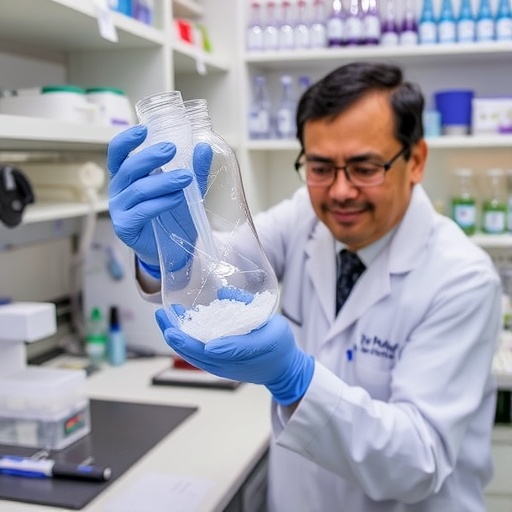
Clean water, safe food and rapid biological threat detection are often treated as separate challenges, but a new research project at George Mason University is attempting to address them through a single materials platform. Pouya Rezai, an associate professor of mechanical engineering in the university’s College of Engineering and Computing, has received $450,000 from the U.S. National Science Foundation to develop synthetic polymers capable of selectively capturing and releasing pathogens. The project, titled “Design and Optimization of Imprinted Superabsorbent Polymers for Selective Pathogen Binding and Release: Integrating Materials Science, Fluid Dynamics, and Explainable AI,” aims to create materials that can recognize biological threats while also drawing in and transporting the fluids in which those threats are found. Rezai is collaborating with Hossein Taheri, an associate professor of manufacturing engineering at Georgia Southern University. Together, the researchers plan to combine polymer chemistry, transport physics, manufacturing science and artificial intelligence to develop a detection technology designed for conditions far beyond the controlled environment of a laboratory.
Pathogenic bacteria and viruses can enter drinking-water systems, contaminate food-processing lines, spread through healthcare environments and threaten industrial or military operations. Detecting them quickly is difficult because real-world samples rarely resemble the clean solutions used in laboratory tests. Water may contain suspended particles, dissolved salts and organic matter, while food and medical fluids can include proteins, fats and other components that interfere with sensing. Conventional biological detection systems often depend on antibodies, enzymes or other fragile recognition molecules. These components can be costly to produce, sensitive to temperature and storage conditions, and prone to losing performance when exposed to complex samples. They may also require multiple preparation steps, specialized equipment or centralized laboratories. Rezai and Taheri are pursuing a synthetic alternative that could maintain selective recognition while offering greater physical durability, lower manufacturing costs and more adaptable operation in flowing environments.
The central technology is based on molecularly imprinted superabsorbent polymers. Superabsorbent polymers are cross-linked networks that can take up and retain large quantities of liquid, swelling as fluid enters their structure. Familiar examples are used in hygiene products and agricultural materials, but the researchers are engineering a more sophisticated version with pathogen recognition built into the polymer network. During fabrication, target biological structures can serve as templates around which the polymer forms. Once the template is removed, the material retains cavities with a particular size, shape and chemical environment. These cavities can act as synthetic binding sites, favoring the return of the target or a closely related structure. The approach resembles a molecular lock-and-key system, but the lock is embedded in a durable, fluid-absorbing material rather than constructed from a delicate biological molecule.
The combination of recognition and fluid management is important because capture performance depends not only on whether a target can bind, but also on whether the target can physically reach the binding sites. In a still sample, diffusion may move microorganisms or viral particles through the liquid relatively slowly. In a flowing system, fluid velocity, pressure, channel geometry and boundary-layer effects can determine how much contact occurs between the target and the polymer. A material that binds strongly under static laboratory conditions may perform poorly when water or a process stream moves rapidly past it. The project will therefore examine how swelling, pore structure and fluid transport influence pathogen capture and release. By adjusting the polymer’s chemical composition and architecture, the researchers hope to control how quickly it absorbs liquid, how targets travel through the material and how efficiently captured targets can later be recovered for analysis.
That release capability could be as important as capture itself. A sensor that traps a pathogen but cannot provide a concentrated, accessible sample may be difficult to use for identification or downstream testing. The researchers are investigating materials that can selectively collect biological targets and then release them under controlled conditions. Such a cycle could concentrate low levels of bacteria or viruses from a large volume of water, improving the sensitivity and speed of detection. It could also enable repeated use or make it easier to connect the polymer to established analytical methods. The ultimate objective is not simply to make a material that absorbs fluid, but to create a responsive platform whose chemical binding, mechanical swelling and transport behavior can be tuned for a specific biological threat and operating environment.
A major part of the work will involve studying the difference between static and dynamic conditions. In a stationary sample, the researchers can evaluate how quickly a target binds, how much material is captured and how selective the interaction is when competing substances are present. Flow experiments will add another layer of complexity by revealing how the polymer behaves when exposed to moving liquids. Fluid dynamics can affect residence time, mixing and the distribution of particles near the material’s surface. Swelling may alter the size and connectivity of pores as the polymer absorbs liquid, changing the pathways available to pathogens. These coupled effects could determine whether a target reaches an interior binding site or passes through the system. Understanding those relationships may allow the team to design materials that remain effective in water-treatment units, food-processing streams and medical-fluid systems rather than only in small test tubes.
The project will also integrate explainable artificial intelligence into the design and optimization process. Advanced models can analyze large numbers of relationships among polymer composition, pore structure, swelling behavior, flow conditions and binding performance. However, a prediction alone does not explain why one material works better than another. Explainable AI methods are intended to identify which design variables have the greatest influence on selectivity, transport and release. This could help researchers distinguish meaningful physical and chemical mechanisms from accidental correlations in experimental data. Instead of treating machine learning as a black box, the team hopes to use it as a tool for interpreting how changes in manufacturing or operating conditions affect the material. Those insights could shorten the process of testing new polymer formulations and guide the production of structures tailored to particular pathogens or sample types.
The researchers’ approach could eventually support several areas in which rapid and dependable biological monitoring is essential. In water purification, an imprinted superabsorbent polymer could help concentrate contaminants before they reach a conventional detector or assist in removing them from a treatment stream. In food safety, the technology could be adapted to monitor processing liquids and identify contamination before products move through the supply chain. Medical facilities could benefit from tools capable of screening complex fluids without relying exclusively on fragile biological reagents. The same principles may also be relevant to defense and national security, where biological threats must be recognized under uncertain conditions and where portable, rugged systems can be more valuable than equipment confined to specialized laboratories. These applications remain goals of the research rather than established outcomes, and performance will depend on how well the materials maintain selectivity in realistic samples.
Rezai’s project is scheduled to begin in August 2026 and continue through late July 2029. During that period, the team will work to establish how synthetic recognition sites interact with biological targets, how fluid flow changes those interactions and how material properties can be optimized for capture and release. The work reflects a broader shift in biosensing toward engineered materials that combine recognition, transport and analysis in one platform. If successful, the research could provide a more durable alternative to conventional biological components while offering a scientifically interpretable route to customization. By bringing together polymer engineering, pathogen detection, fluid mechanics, manufacturing and explainable AI, the project seeks to turn a molecular lock-and-key concept into a practical technology for monitoring threats in the complex fluids that shape public health, food security and national safety.
Subject of Research: Molecularly imprinted superabsorbent polymers for selective pathogen binding and release, integrating materials science, fluid dynamics and explainable artificial intelligence.
Keywords
Mechanical engineering, polymers, superabsorbent polymers, molecular imprinting, pathogen detection, pathogen capture, pathogen release, biosensing, fluid dynamics, explainable AI, water purification, food safety, biotechnology innovation.
Tags: AI-enhanced pathogen detection technologiescollaboration between mechanical and manufacturing engineeringfluid dynamics in pathogen transportintegrated water and food safety solutionsmaterials science in biological threat detectionNSF-funded research in polymer-based biosensorspolymer chemistry for biological threat recognitionrapid pathogen detection in complex samplesreal-world applications of pathogen detection systemsselective pathogen binding and releaseSuperabsorbent polymers for pathogen detectionsynthetic polymers for environmental monitoring