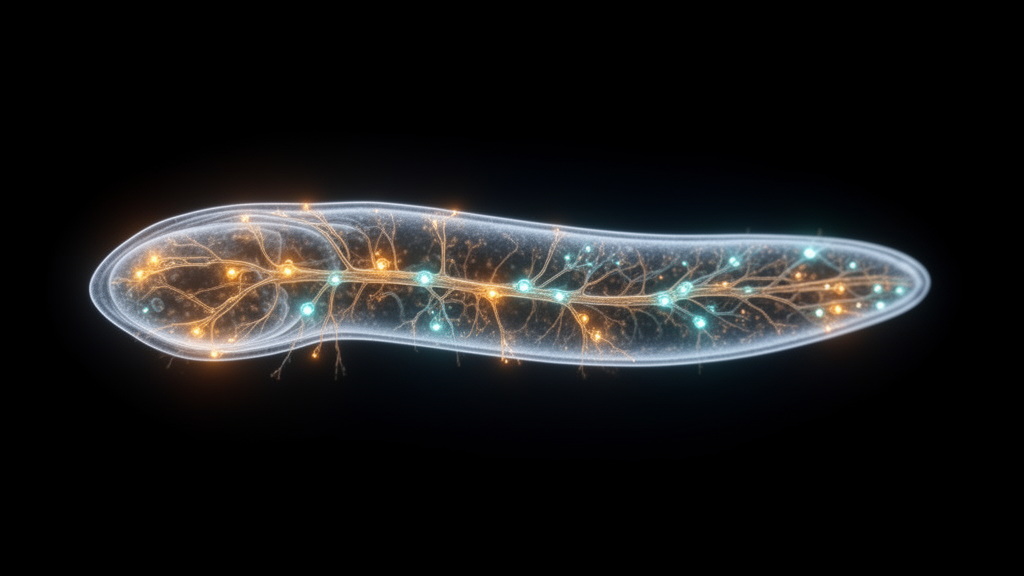
A computational study investigating a Caenorhabditis elegans connectome-based recurrent model revealed acute functional dependence on synaptic processes and documented partial recovery following structural rewiring. Conducted by researchers Sungjin Park and Jungjoon Park, the investigation utilized a recurrent neural network architecture featuring a single optimization lineage originating from one common parent model to probe how network controllers depend on existing parameters and whether alternative pathways compensate for perturbations.
The researchers applied acute perturbations to evaluate immediate controller dependencies alongside re-optimization to test whether alternative network parameters could compensate for structural and operational disruptions. When the researchers disabled synaptic updating or altered synaptic scaling within the connectome model, overall system performance declined substantially. These functional disruptions produced pronounced non-additive effects across the simulated circuit, indicating that synaptic maintenance mechanisms interact dynamically within the recurrent network architecture.
Further structural interventions demonstrated that major functional ablation deficits persisted even after incident electrical connections were completely removed from the model. In contrast, eliminating residual electrical coupling produced no resolved loss in performance scores. However, when the authors restored a stronger reference scale within the model, network performance decreased. Additionally, a test involving voltage step-halving failed to trigger the study’s prespecified mean-change criterion during baseline assessments.
Behavioral tracking in the simulated environment showed that targeted synaptic interventions degraded polarity-corrected movement aligned with food-associated salt geometry. Conversely, broad legacy yoking retained high alignment with the spatial salt gradient, revealing a distinct behavioral signature under selective constraint. When the investigators performed downstream replay experiments delivering current, plasticity-gate, and metabolic signals, the intervention failed to reproduce the specific behavioral deficits observed under legacy yoking.
To examine adaptive compensation, the authors conducted a separate re-optimization experiment comparing four prespecified rewired network branches against an intact biological-graph control. Each of the four rewired branches and the continued control network underwent 500 optimization updates within the established computational budget. Following these optimization updates, the rewired branches successfully closed 78.5 percent to 82.7 percent of their acute additive performance deficits, demonstrating significant functional recovery after topological rewiring.
Despite this substantial rebound, the rewired network branches remained quantitatively below the performance level of the continued biological-graph control. The findings confirm that while recurrent connectome controllers exhibit an acute reliance on intact synaptic processes, structural networks can achieve partial functional recovery under limited re-optimization. However, the 500 optimization updates proved insufficient to completely match the performance benchmarks sustained by the uninterrupted biological-graph baseline architecture across identical operational environments.
The study authors noted critical experimental boundaries and structural limitations governing the interpretation of their computational results. The tests did not evaluate whether re-optimization could compensate for disabling synaptic plasticity directly, nor did they determine the precise parameter modifications necessary to achieve complete topological recovery. Although environmental uncertainty was systematically quantified using eight evaluation key sets, the researchers emphasized that independent replication across distinct optimization lineages was not performed.
Subject of Research: Computational modeling of synaptic dependence and topological rewiring in C. elegans connectome networks
Article Title: Acute synaptic dependence and partial recovery after rewiring in a C. elegans connectome model
Article References: Park, S., & Park, J. (2026). Acute Synaptic Dependence and Partial Recovery After Rewiring in a C. elegans Connectome Model. Frontiers in Computational Neuroscience, 20, 1980649. https://doi.org/10.3389/fncom.2026.1980649
Image Credits: AI Generated
DOI: 10.3389/fncom.2026.1980649
Keywords: Caenorhabditis elegans, connectome, recurrent neural network, synaptic plasticity, re-optimization, network rewiring, synaptic updating, synaptic scaling, electrical coupling, continuous-time recurrent neural network, voltage step-halving, ablation deficits, legacy yoking, salt geometry, optimization lineage, computational neuroscience
News Source: Cassandra Pierce. (November 24, 2026). Rewired Worm Connectome Models Show Partial Functional Recovery After Re-Optimization. Scienmag.