• HOME
  • NEWS
  • EXPLORE
    • CAREER
      • Companies
      • Jobs
    • EVENTS
    • iGEM
      • News
      • Team
    • PHOTOS
    • VIDEO
    • WIKI
  • BLOG
  • COMMUNITY
    • FACEBOOK
    • INSTAGRAM
    • TWITTER
Sunday, October 4, 2026
BIOENGINEER.ORG
No Result
View All Result
  • Login
  • HOME
  • NEWS
  • EXPLORE
    • CAREER
      • Companies
      • Jobs
        • Lecturer
        • PhD Studentship
        • Postdoc
        • Research Assistant
    • EVENTS
    • iGEM
      • News
      • Team
    • PHOTOS
    • VIDEO
    • WIKI
  • BLOG
  • COMMUNITY
    • FACEBOOK
    • INSTAGRAM
    • TWITTER
No Result
View All Result
Bioengineer.org
No Result
View All Result
Home NEWS Science News Chemistry

Reward for cooperative behavior

Bioengineer by Bioengineer
October 28, 2022
in Chemistry
Reading Time: 3 mins read
0
Results from evolutionary simulations
Share on FacebookShare on TwitterShare on LinkedinShare on RedditShare on Telegram

Researchers at the Max Planck Institute in Plön show that reputation plays a key role in determining which rewarding policies people adopt. Using game theory, they explain why individuals learn to use rewards to specifically promote good behaviour.
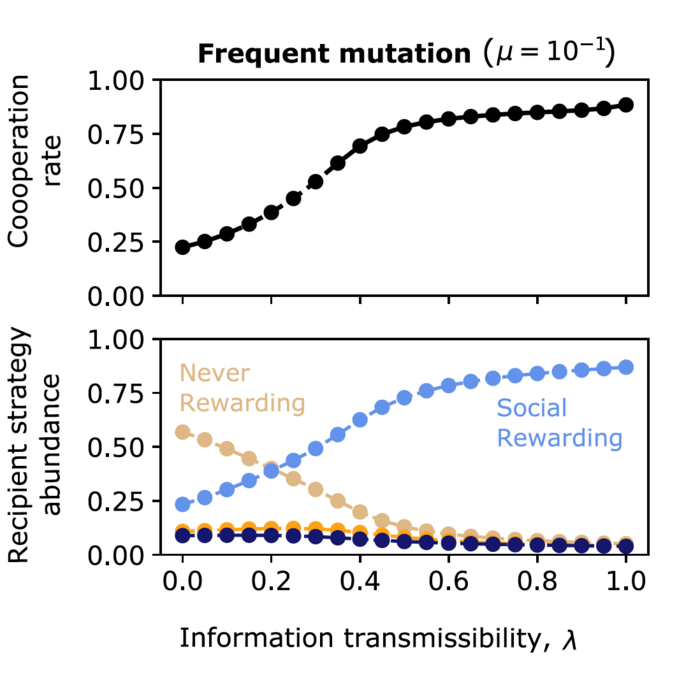
Results from evolutionary simulations

Credit: MPI for Evolutionary Biology

Researchers at the Max Planck Institute in Plön show that reputation plays a key role in determining which rewarding policies people adopt. Using game theory, they explain why individuals learn to use rewards to specifically promote good behaviour.

Often, we use positive incentives like rewards to promote cooperative behaviour. But why do we predominantly reward cooperation? Why is defection rarely rewarded? Or more generally, why do we bother to engage in any form of rewarding in the first place? Theoretical work done by researchers Saptarshi Pal and Christian Hilbe at the Max Planck Research Group ‘Dynamics of Social Behaviour’ suggests that reputation effects can explain why individuals learn to reward socially.

With tools from evolutionary game theory, the researchers construct a model where individuals in a population (the players) can adopt different strategies of cooperation and rewarding over time. In this model, the players’ reputation is a key element. The players know, with a degree of certainty (characterized by the information transmissibility of the population), how their interaction partners are going to react to their behaviour (that is, which behaviours they deem worthy of rewards). If the information transmissibility is sufficiently high, players learn to reward cooperation. In contrast, without sufficient information about peers, players refrain from using rewards. The researchers show that these effects of reputation also play out in a similar way when individuals interact in groups with more than two individuals.

Antisocial rewarding

In addition to highlighting the role of reputation in catalyzing cooperation and social rewarding, the scientists identify a couple of scenarios where antisocial rewarding may evolve. Antisocial rewarding either requires populations to be assorted or rewards to be mutually beneficial for both the recipient and the provider of the reward. “These conditions under which people may learn to reward defection are however a bit restrictive since they additionally require information to be scarce” adds Saptarshi Pal.

The results from this study suggest that rewards are only effective in promoting cooperation when they can sway individuals to act opportunistically. These opportunistic players only cooperate when they anticipate a reward for their cooperation. A higher information transmissibility increases both, the incentive to reward others for cooperating, and the incentive to cooperate in the first place. Overall, the model suggests that when people reward cooperation in an environment where information transmissibility is high, they ultimately benefit themselves. This interpretation takes the altruism out of social rewarding – people may not use rewards to enhance others’ welfare, but to help themselves.


Journal

Nature Communications

DOI

10.1038/s41467-022-33551-y

Method of Research

Observational study

Subject of Research

People

Article Title

Reputation effects drive the joint evolution of cooperation and social rewarding.

Article Publication Date

7-Oct-2022

Share12Tweet8Share2ShareShareShare2

Related Posts

Squeezing Polypropylene Flips Its Insulation From Rubbery to Glassy Conduction

Squeezing Polypropylene Flips Its Insulation From Rubbery to Glassy Conduction

October 4, 2026
Sulfated Seaweed Polymer Helps Gels Protect Anthocyanins Until the Gut

Sulfated Seaweed Polymer Helps Gels Protect Anthocyanins Until the Gut

October 4, 2026

Nickel and Lithium Doping Face Off in Zinc Oxide Films for Supercapacitors

October 4, 2026

Cobalt catalyst hits sweet spot for cleaner chemical manufacturing

October 4, 2026

POPULAR NEWS

  • Alloys That Shrink Their Own Grains: New PIX Mechanism Refines Metals With Heat Alone

    Alloys That Shrink Their Own Grains: New PIX Mechanism Refines Metals With Heat Alone

    29 shares
    Share 12 Tweet 7
  • Endurance Exercise Reshapes the Liver in Males and Females Through Distinct Molecular Routes

    29 shares
    Share 12 Tweet 7
  • Single Transcription Factor PU.1 Rapidly Converts Fibroblasts into Macrophage-Lineage Cells

    29 shares
    Share 12 Tweet 7
  • New Scale Measures How Ready Nurse Educators Really Are for the AI Era

    29 shares
    Share 12 Tweet 7

About

We bring you the latest biotechnology news from best research centers and universities around the world. Check our website.

Follow us

Recent News

Alloys That Shrink Their Own Grains: New PIX Mechanism Refines Metals With Heat Alone

Endurance Exercise Reshapes the Liver in Males and Females Through Distinct Molecular Routes

Single Transcription Factor PU.1 Rapidly Converts Fibroblasts into Macrophage-Lineage Cells

Subscribe to Blog via Email

Enter your email address to subscribe to this blog and receive notifications of new posts by email.

Join 85 other subscribers
  • Contact Us

Bioengineer.org © Copyright 2023 All Rights Reserved.

Welcome Back!

Login to your account below

Forgotten Password?

Retrieve your password

Please enter your username or email address to reset your password.

Log In
No Result
View All Result
  • Homepages
    • Home Page 1
    • Home Page 2
  • News
  • National
  • Business
  • Health
  • Lifestyle
  • Science

Bioengineer.org © Copyright 2023 All Rights Reserved.